
Legal transcription is defined as the conversion of spoken audio and video recordings into searchable, timestamped text that attorneys can review, annotate, and search within minutes of a session ending. For criminal defense attorneys, understanding how transcription speeds case prep is the difference between spending six hours scrubbing through deposition video and spending thirty minutes finding the exact admission you need. AI-powered transcription now delivers rough drafts in under fifteen minutes, while traditional certified court reporters require five to ten business days for the same material. The gap between those two timelines is where cases are won or lost.
How transcription speeds case prep: the core mechanisms
The speed advantage of transcription comes from two distinct forces working together. First, audio and video become text almost instantly. Second, that text is searchable, which is where the real productivity gain lives.
A standard four-hour deposition requires four to six hours of video review under traditional methods. With AI transcription, processing takes 5 to 15 minutes plus roughly forty-five minutes of review, cutting total time by more than 80%. That compression is not a marginal improvement. It frees an entire afternoon for witness prep, motion drafting, or client communication.
The mechanisms behind this speed gain include:
- Keyword search across transcripts. Retrieving a key quote from six depositions drops from six to ten hours of video review to approximately thirty minutes when transcripts are searchable. You type the witness's name or a disputed fact and jump directly to the relevant passage.
- Speaker labels and timestamps. Speaker diarization and timestamps allow you to navigate directly to a specific speaker's statement at a precise moment, eliminating re-reading entire documents to locate one exchange.
- Immediate availability. AI transcripts are delivered immediately after a session ends, meaning your team can begin cross-examination prep the same evening rather than waiting days for a certified copy.
- Parallel team review. When a transcript is available in a shared workspace, your paralegal can flag exhibits while you build the cross-examination outline simultaneously.
Pro Tip: When ordering AI transcripts for deposition prep, request speaker diarization from the start. Retrofitting speaker labels onto a completed transcript costs time and introduces errors that slow the review process later.
The compounded effect across a case with multiple depositions, recorded interviews, and hearing audio is substantial. What previously consumed weeks of paralegal hours compresses into days.
How does AI transcription compare to certified court reporters?
The comparison between AI transcription and certified court reporters is not a competition. They serve different legal purposes, and understanding that distinction prevents costly mistakes.
| Factor | AI Transcription | Certified Court Reporter |
|---|---|---|
| Turnaround time | Under 15 minutes | 5 to 10 business days standard |
| Expedited option | Immediate | 24 hours at $6+ per page |
| Cost | $0 to $4 per audio hour | $300 to $700 per session |
| Accuracy | 95 to 97% on clean audio | Near 100% with stenographic certification |
| Legal status | Internal prep only | Admissible in court filings |
| Best use case | Discovery, deposition prep, fact extraction | Official filings, appellate records |
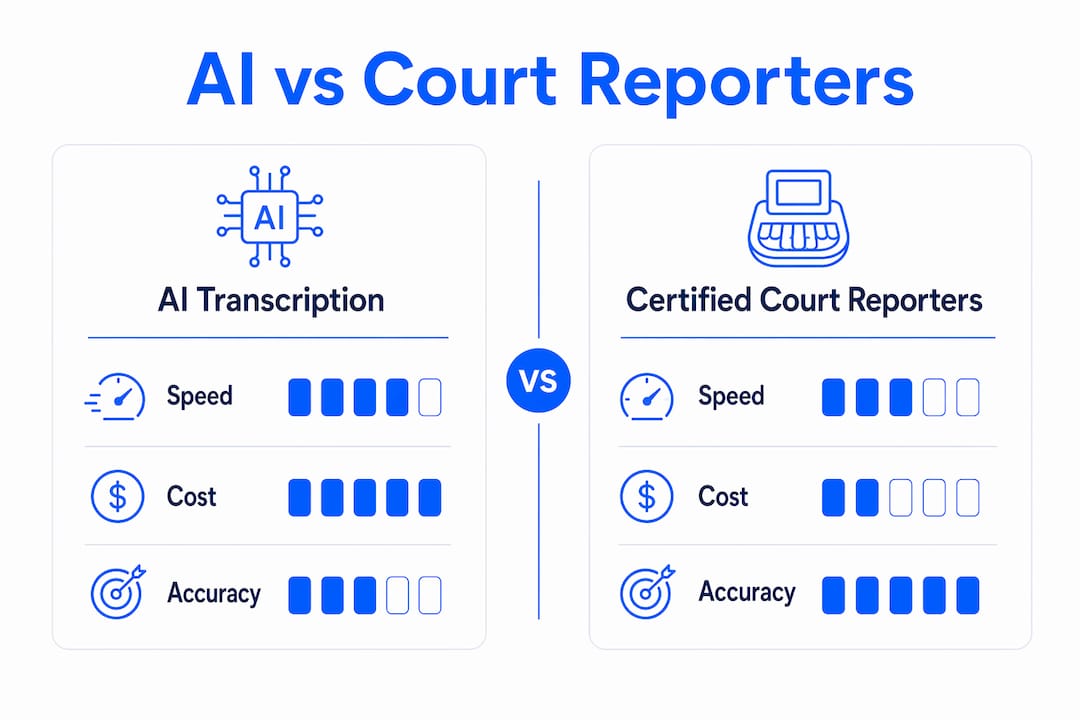
Certified court reporters, such as those provided by firms like Milestone Reporting, guarantee delivery within seven business days with expedited options available at a premium. That timeline is appropriate for official records. It is not appropriate for the working documents your team needs the night before a hearing.
AI engines built on models like OpenAI's Whisper achieve 95 to 97% word accuracy on clean legal audio. That accuracy level is sufficient for internal review, fact extraction, and cross-examination prep. It is not sufficient for a court filing or an appellate record where every word carries legal weight.
Pro Tip: Never submit an AI-generated transcript as an official court record. Use it as your working document, then order a certified transcript for any filing. This two-track approach cuts costs without creating compliance risk.
The practical implication is that AI transcripts serve discovery prep and internal case management, while certified transcripts remain necessary for jurisdictions requiring official records. Running both tracks in parallel is the standard practice among litigation teams that have adopted AI transcription.
What are the best workflow practices for transcription in case prep?
Integrating transcription into your case prep workflow requires more than just uploading audio files. The teams that extract the most value follow a structured process.
-
Establish a two-track workflow from day one. Order AI transcripts immediately after every recorded session for internal use. Schedule certified transcripts only for materials you anticipate filing. This reduces costs and compresses timelines without sacrificing compliance.
-
Run quality assurance within 24 hours of receiving an AI transcript. Verify speaker IDs against your witness list and check legal terminology for accuracy. Verifying speaker IDs and legal terminology immediately after AI transcription prevents errors from compounding across a case file.
-
Normalize formatting before team distribution. Standardize speaker labels, correct proper nouns, and confirm exhibit references before sharing with co-counsel or paralegals. A poorly labeled transcript creates confusion that costs more time than the transcription saved.
-
Enable shared workspace access for your full litigation team. Collaborative annotation across litigation teams multiplies efficiency by allowing simultaneous review, cross-checking, and briefing preparation. One attorney highlights contradictions while another builds the chronology.
-
Evaluate your transcription provider on security and compliance. Sensitive client audio requires a provider with documented data handling policies, encryption standards, and, where applicable, a Business Associate Agreement. Review the provider's data security practices before uploading any privileged material.
-
Integrate transcription output with your case management platform. Transcripts that live in a separate silo require manual transfer and create version control problems. Platforms that combine transcription with searchable entity extraction and case file management eliminate that friction entirely.
Pro Tip: Build transcript review into your case calendar as a scheduled task, not an ad hoc activity. Attorneys who treat transcript review as a structured workflow step rather than a reactive task consistently find key admissions earlier in the case cycle.
How do searchable transcripts transform specific case prep tasks?
The practical applications of searchable transcripts extend across every phase of criminal defense case preparation. The productivity gains are not theoretical. They are measurable and task-specific.
Deposition preparation. Before a deposition, you search prior statements, police reports, and witness interviews for inconsistencies. With searchable transcripts, that review takes minutes per document rather than hours. You enter a disputed fact or a witness's name and surface every relevant passage instantly.

Cross-examination briefing. Building a cross-examination outline requires identifying admissions, contradictions, and impeachment material across potentially dozens of hours of recorded testimony. Early adopters report pulling key facts 70% faster using AI-powered fact extraction tools compared to manual review. In one documented case involving 32 transcripts of 200 to 300 pages each, AI tools reduced review time by 70%. That is the difference between a week of paralegal hours and a single day.
Chronology building. Timestamped transcripts allow you to construct an accurate timeline of events by sorting statements chronologically across multiple sources. Manual chronology building from video recordings is error-prone and slow. Searchable text with timestamps makes it precise and fast.
Appellate argument preparation. Appellate work requires pinpoint citation to the trial record. Searchable transcripts let you locate exact page and line references in seconds rather than manually indexing hundreds of pages.
The table below summarizes the time impact across common case prep tasks:
| Case prep task | Manual review time | With searchable transcripts |
|---|---|---|
| Key admission retrieval (6 depositions) | 6 to 10 hours | ~30 minutes |
| 4-hour deposition review | 4 to 6 hours | ~1 hour total |
| Cross-examination outline (multiple witnesses) | 1 to 2 days | 2 to 4 hours |
| Chronology building from recorded interviews | 3 to 5 hours | 30 to 60 minutes |
The speed gains come from searchable, annotated transcripts rather than just faster transcription delivery. The text itself is the tool. Finishing transcription in fifteen minutes means nothing if the output is a flat document you still have to read linearly.
Key takeaways
Transcription speeds case preparation by converting recorded audio into searchable, timestamped text that reduces manual review from hours to minutes across every major case prep task.
| Point | Details |
|---|---|
| AI transcription turnaround | AI delivers transcripts in under 15 minutes versus 5 to 10 business days for certified copies. |
| Searchability is the real gain | Keyword search cuts multi-deposition review from 6 to 10 hours down to roughly 30 minutes. |
| Two-track workflow | Use AI transcripts for internal prep and certified transcripts only for court filings to cut cost and time. |
| Quality assurance matters | Verify speaker IDs and legal terminology within 24 hours to prevent compounding errors across case files. |
| Fact extraction speed | AI-assisted tools reduce fact-finding time by up to 70% compared to manual document review. |
Why I think most defense attorneys are still leaving hours on the table
I have watched criminal defense teams adopt AI transcription and immediately wonder how they managed without it. I have also watched teams adopt it poorly and conclude it does not work. The difference is almost always the same mistake: treating AI transcripts as finished products rather than working documents.
The attorneys who get the most out of transcription technology treat it as infrastructure, not a shortcut. They build quality assurance into their workflow, they verify speaker labels, and they run AI transcripts alongside certified copies rather than instead of them. AI transcription is becoming essential infrastructure in litigation, comparable to how e-discovery platforms changed document review a decade ago. The firms that adopted e-discovery early built durable efficiency advantages. The same dynamic is playing out now with transcription.
The attorneys who wait are not being cautious. They are ceding ground. The compounded time savings across a full caseload, depositions, recorded interviews, hearing audio, and client statements, translate directly into more thorough preparation, lower costs, and better outcomes. That is not a technology argument. It is a practice management argument.
My one caution: do not skip the verification step. Raw AI transcripts contain errors, and in criminal defense, a misidentified speaker or a misheard word can send your cross-examination in the wrong direction. Build the review step in, and the technology delivers exactly what it promises.
— Faisal
See how Caseflow cuts case prep time from weeks to hours
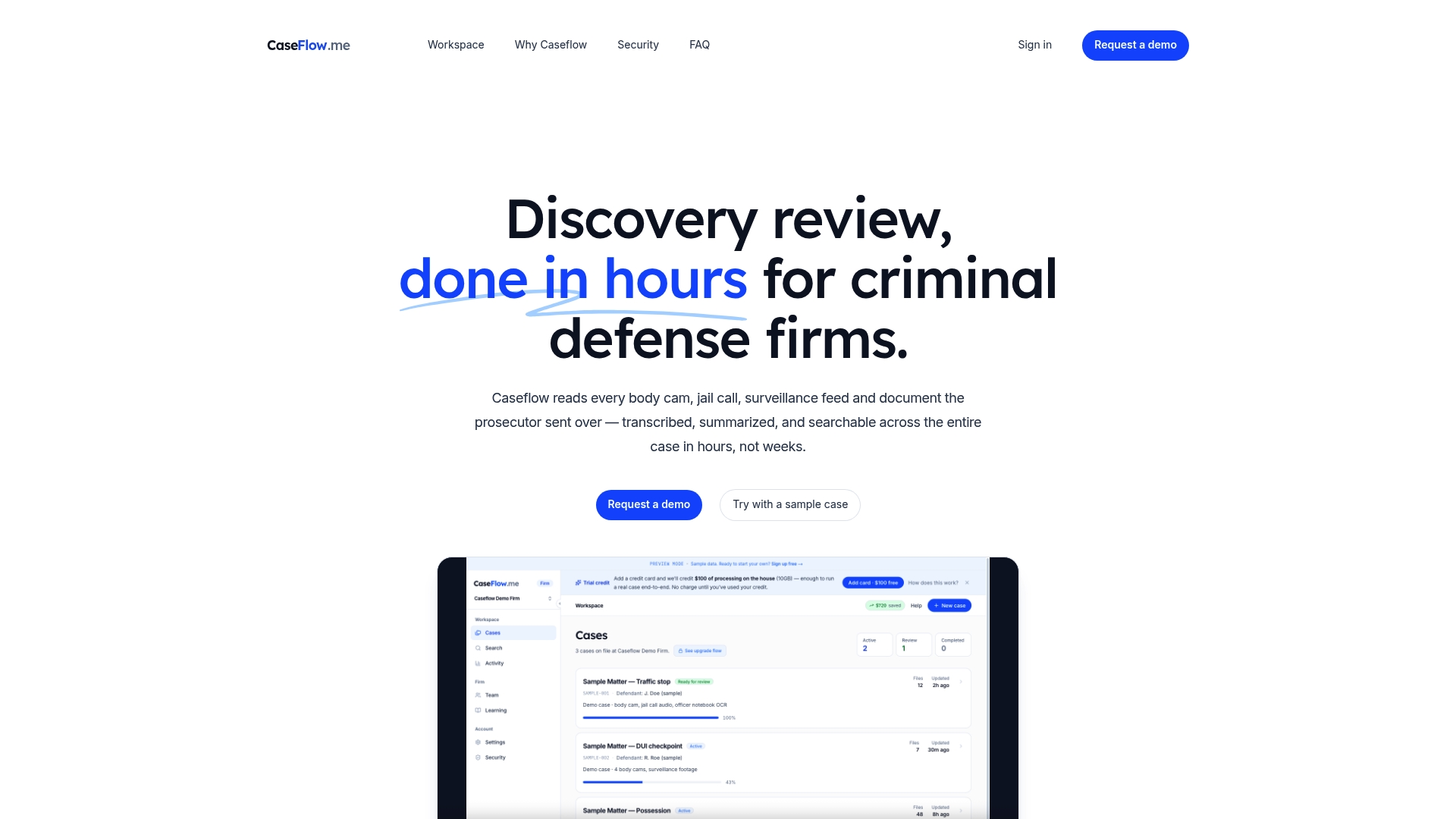
Caseflow is built specifically for criminal defense attorneys who need to move faster through discovery without sacrificing accuracy. The platform combines AI transcription, summarization, and searchable entity extraction in one place, so you are not stitching together three separate tools to get a working transcript. The Brady-trail audit log tracks every action taken on a case file, giving you compliance documentation without extra administrative work. Caseflow supports multiple languages and preserves original audio alongside every transcript for verification. If your current process still involves manually reviewing hours of recorded evidence, explore Caseflow to see how much time your team can recover on the next case.
FAQ
How fast does AI transcription work for legal recordings?
Most AI transcription engines process audio in under fifteen minutes for a standard deposition session, with clips under ten minutes finishing in twenty to sixty seconds. This compares to five to ten business days for certified court reporter transcripts.
Can AI transcripts be used in court filings?
AI-generated transcripts are working documents for internal case prep, not official court records. Certified transcripts from licensed court reporters remain required for filings and appellate records in most jurisdictions.
What makes a transcript useful for case prep beyond just having the text?
Speaker labels, timestamps, and keyword searchability are what convert a transcript from a document into a case prep tool. Without those features, you are still reading linearly rather than navigating directly to the testimony that matters.
How much does AI transcription cost compared to a court reporter?
AI transcription costs approximately $0 to $4 per audio hour, while certified court reporter sessions typically run $300 to $700 with expedited options adding further cost per page. The cost difference makes AI transcription practical for all recorded material, not just depositions.
What security considerations apply when uploading client audio for transcription?
Any platform handling privileged legal audio should provide documented encryption standards, clear data retention policies, and a formal compliance agreement. Review the provider's compliance documentation before uploading sensitive case material.