
Types of legal compliance audit logs are specialized records that capture distinct system, transactional, and document-level activities to satisfy regulatory and legal standards. Legal professionals and compliance officers working under frameworks like SOX, HIPAA, and GDPR must maintain multiple log types because no single log captures every accountability requirement. Tools like Bytebase and platforms like Chaindoc have documented that four primary categories cover the full spectrum of compliance needs: Financial, System/IT, Document/Record, and Transactional. Understanding each type is not optional. It is the foundation of defensible legal compliance documentation.
1. What are the four main types of legal compliance audit logs?
The four primary categories of audit logs recognized for regulatory compliance are Financial, System/IT, Document/Record, and Transactional. Each category addresses a distinct accountability layer, and most regulated organizations need all four operating simultaneously.
Financial audit logs record every transaction, ledger entry, journal adjustment, and approval event touching financial data. SOX (the Sarbanes-Oxley Act) mandates these logs to detect fraud and verify the accuracy of public financial statements. A financial audit log entry for a wire transfer, for example, captures the initiating user ID, the amount, the receiving account identifier, the timestamp, and the approval chain.

System/IT audit logs track system-level events: user logins, privilege escalations, configuration changes, and access grants or revocations. These logs are central to SOC 2 Type II audits and HIPAA's Technical Safeguard requirements. When a system administrator grants a new user access to a protected health information database, that event must appear in the System/IT log with full context.
Document/Record audit logs follow the lifecycle of individual documents: creation, viewing, editing, version changes, e-signature events, and deletion. FDA 21 CFR Part 11 compliance for electronic records depends entirely on this log type. Legal firms tracking contract negotiations or discovery documents rely on Document/Record logs to prove chain of custody.
Transactional audit logs capture end-to-end business processes that span multiple systems. A loan origination workflow touching a CRM, a document management system, and a payment processor generates transactional log entries at each handoff. These logs are critical in enterprise legal workflows where a single business event crosses system boundaries and must be reconstructed as a coherent sequence.
Key distinctions between the four types:
- Financial logs focus on monetary accountability and fraud prevention
- System/IT logs focus on access control and infrastructure integrity
- Document/Record logs focus on content lifecycle and chain of custody
- Transactional logs focus on cross-system process reconstruction
2. How do key compliance frameworks dictate audit log requirements?
Compliance frameworks do not merely suggest audit logging. They specify retention periods, mandatory fields, and architectural requirements that determine whether a log is legally defensible.
Log retention mandates vary significantly by regulation. SOX requires seven years of financial audit log retention. HIPAA mandates six years for audit logs related to protected health information. GDPR sets a shorter window of one to three years, reflecting its data minimization principles. PCI DSS requires twelve months of log retention with three months immediately accessible. These differences mean a single retention policy cannot satisfy all frameworks simultaneously. Compliance officers must map each log type to its governing regulation and set retention schedules accordingly.
Every audit-ready log entry must include four mandatory fields: user ID, action performed, timestamp in ISO-8601 format, and the affected resource. Missing any one of these fields renders the entry incomplete for audit purposes. SOC 2 auditors specifically test for timestamp consistency and user attribution as indicators of log integrity.
The distinction between audit logs and system logs matters enormously here. System logs capture operational metrics; audit logs are intentionally designed for accountability with tamper-evident architecture. A server CPU utilization log is a system log. A record of which administrator changed a firewall rule and when is an audit log. Regulators care about the latter, not the former.
Immutability is non-negotiable. Logs stored in write-once, read-many (WORM) formats satisfy the tamper-proof requirement that SOX, HIPAA, and PCI DSS all reference. Any log that can be edited after the fact is inadmissible as compliance evidence.
- Map each log type to its governing regulation and retention period
- Implement ISO-8601 timestamps across all log sources
- Store logs in WORM-compliant storage from the moment of creation
- Document the review schedule and retain evidence of each review cycle
- Automate alerts for high-risk events such as privilege escalations and bulk deletions
Pro Tip: SOC 2 and several federal regulations require not just that you review logs, but that you document the review itself. A log review that leaves no record of having occurred provides zero compliance credit.
3. Comparison of audit log types: use cases, metadata, and compliance relevance
The table below gives compliance officers a direct reference for matching log types to their legal context.
| Log type | Primary metadata fields | Typical use case | Governing frameworks |
|---|---|---|---|
| Financial | User ID, transaction ID, amount, approval chain, timestamp | Fraud detection, financial statement verification | SOX, PCI DSS |
| System/IT | User ID, event type, IP address, resource affected, timestamp | Access control audits, breach investigations | SOC 2, HIPAA, PCI DSS |
| Document/Record | Document ID, action, version, user ID, e-signature event, timestamp | Chain of custody, contract lifecycle, discovery | FDA 21 CFR Part 11, GDPR |
| Transactional | Correlation ID, process name, system source, outcome, timestamp | Cross-system process reconstruction, litigation readiness | SOX, HIPAA, enterprise SLAs |
The metadata differences are not cosmetic. A Document/Record log without a version field cannot prove which draft a signatory reviewed. A Transactional log without a correlation ID cannot link a payment event in one system to the approval event in another. Correlation IDs are the connective tissue of distributed compliance evidence.
One challenge that legal teams consistently underestimate is over-logging. Logging too much sensitive data is a common compliance failure. A Document/Record log that captures the full text of a privileged communication creates a discovery liability. The correct approach is to log the event metadata (who accessed what, when, and what action was taken) without capturing the substantive content of the document itself.
"Raw audit logs are not sufficient. Audit trails curate these logs into tamper-evident, end-to-end reconstructions of business events required for audits like SOX and HIPAA." — Chaindoc Audit Trail Compliance Guide
The distinction between an audit log and an audit trail is worth clarifying. An audit log is the raw record of individual events. An audit trail is the curated, chronological reconstruction of those events into a coherent narrative. Courts and regulators reviewing a litigation readiness audit expect audit trails, not raw log dumps. The trail is what makes the log legally useful.
4. Best practices for creating and managing legal compliance audit logs
Knowing the legal audit log types is necessary but not sufficient. How you create and manage those logs determines whether they hold up under regulatory scrutiny or courtroom examination.
Audit logs act as digital diaries crucial for litigation evidence, and their integrity and tamper evidence determine admissibility in courts. This means the architecture of your logging system is itself a compliance asset. A log stored on a server that the logged user can also access and modify is not a compliant log, regardless of its content.
Best practices for legal compliance audit log management:
- Use correlation IDs across all systems. Every user action that touches multiple platforms must carry a shared identifier so investigators can reconstruct the full event sequence without gaps.
- Store logs in immutable, append-only formats. WORM storage prevents alteration after the fact. Cloud providers like AWS (S3 Object Lock) and Microsoft Azure (Immutable Blob Storage) offer WORM-compliant options purpose-built for compliance workloads.
- Separate platform logs from infrastructure logs. Application-level audit logs (who did what in your software) and infrastructure logs (server health, network traffic) serve different purposes and should be stored and reviewed separately.
- Implement allowlists for logged fields. Define exactly which fields each log type captures and enforce that list programmatically. This prevents accidental logging of passwords, social security numbers, or privileged content.
- Automate review dashboards and alerts. Documented review routines with automated dashboards and alerts for high-risk activities are the standard recommended by SOC 2 and federal regulators. Manual log review without automation is not scalable and leaves gaps.
- Maintain a log inventory. Every log type, its storage location, its retention period, and its governing regulation should appear in a single inventory document. Auditors ask for this document first.
Pro Tip: When preparing for legal document workflows that touch multiple systems, assign correlation IDs at the point of document creation and carry them through every downstream system. This single practice eliminates the most common gap in cross-system audit trails.
Audit logs also play a direct role in litigation readiness. When opposing counsel requests discovery, your Document/Record and Transactional logs are the primary sources for proving or disproving a chain of events. Organizations that treat audit logging as a checkbox exercise discover during litigation that their logs cannot answer the specific questions a court requires.
Key takeaways
Legal compliance requires four distinct audit log types because each framework targets a different accountability layer, and no single log satisfies all regulatory requirements simultaneously.
| Point | Details |
|---|---|
| Four log types cover compliance | Financial, System/IT, Document/Record, and Transactional logs each address distinct regulatory requirements. |
| Retention periods vary by framework | SOX requires 7 years, HIPAA 6 years, GDPR 1 to 3 years, and PCI DSS 12 months of log retention. |
| Four mandatory fields per entry | Every compliant log entry must include user ID, action, ISO-8601 timestamp, and affected resource. |
| Immutability is non-negotiable | WORM storage prevents post-creation alteration and is required by SOX, HIPAA, and PCI DSS. |
| Over-logging creates liability | Log event metadata only. Capturing document content or sensitive payloads creates discovery and privacy risks. |
Why audit logs are the most underestimated asset in legal compliance
I have reviewed compliance programs at organizations that spent heavily on policy documentation and training but treated audit logging as an IT afterthought. Every single one of them struggled when a regulator or opposing counsel asked for a specific event reconstruction. The logs existed, but they were incomplete, inconsistently formatted, or stored in a way that raised authenticity questions.
The shift I have seen in 2026 is that regulators are no longer satisfied with the existence of logs. They want evidence that logs were reviewed, that anomalies were investigated, and that the logging architecture itself was designed for tamper-evidence. The bar has moved from "do you have logs" to "can you prove your logs are trustworthy."
My honest recommendation for compliance officers: treat your audit log architecture as a legal instrument, not a technical byproduct. The four log types covered in this article are not interchangeable. A financial audit log cannot substitute for a Document/Record log in an FDA inspection, and a System/IT log cannot reconstruct a cross-platform business process the way a Transactional log can. Each type serves a specific evidentiary function.
The organizations that handle regulatory scrutiny well are those that have mapped every log type to its governing framework, assigned ownership for each log category, and built automated review into their compliance calendar. That is not a technology problem. It is a governance decision that compliance officers must drive.
— Faisal
How Caseflow supports audit log compliance for legal teams
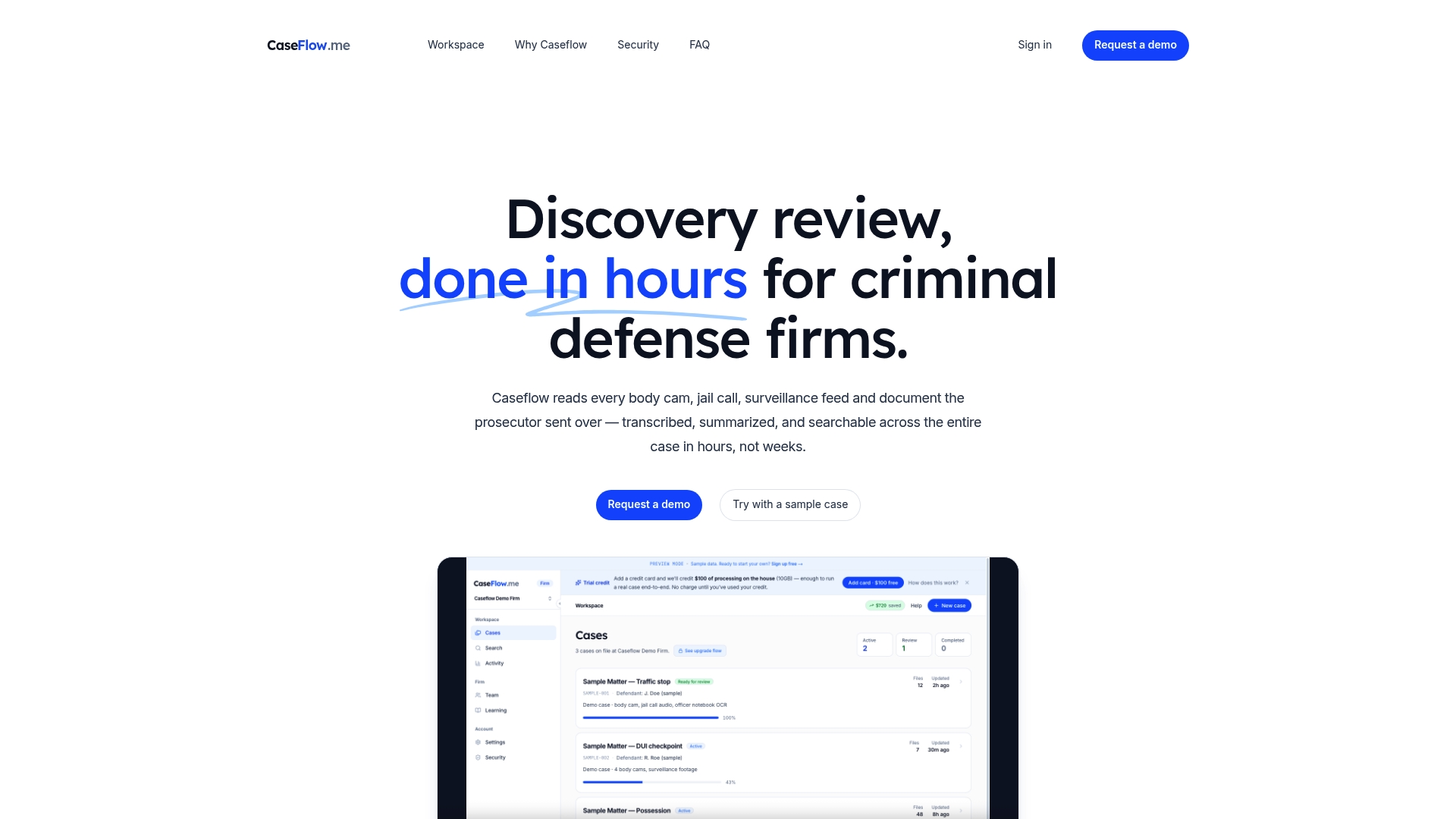
Criminal defense attorneys face a specific and demanding audit log challenge: every action taken on case files must be tracked, documented, and defensible in court. Caseflow addresses this directly with its Brady-trail audit log, which records every action taken on case files to satisfy compliance and transparency requirements. The platform combines transcription, summarization, and searchable entity extraction in one place, so attorneys can process discovery evidence while maintaining a complete, tamper-evident record of every access and review event.
Caseflow's security architecture is built for legal defensibility, tracking document access and edits with the precision that compliance officers and courts require. For legal teams managing high-volume discovery, Caseflow reduces case file review from weeks to hours without sacrificing the audit trail integrity that makes that evidence usable.
FAQ
What are the four types of legal compliance audit logs?
The four types are Financial, System/IT, Document/Record, and Transactional audit logs. Each category captures a distinct layer of accountability required by frameworks like SOX, HIPAA, GDPR, and PCI DSS.
How long must compliance audit logs be retained?
Retention periods depend on the governing regulation. SOX requires seven years, HIPAA requires six years, GDPR requires one to three years, and PCI DSS requires twelve months with three months immediately accessible.
What fields must every compliant audit log entry include?
Every audit-ready log entry must include user ID, action performed, timestamp in ISO-8601 format, and the affected resource. Missing any of these fields makes the entry incomplete for regulatory audit purposes.
What is the difference between an audit log and an audit trail?
An audit log is the raw record of individual events. An audit trail is the curated, chronological reconstruction of those events into a coherent narrative suitable for regulatory review or court examination.
Why is over-logging a compliance risk?
Logging sensitive data beyond what is needed for event reconstruction creates discovery liability and privacy violations. Compliance best practice is to log only the metadata fields required for forensic reconstruction and to redact or exclude sensitive content payloads.