
Technology in criminal defense discovery is defined as the application of AI, forensic imaging, and digital review platforms to process, classify, and analyze evidence that would otherwise require weeks of manual attorney review. Criminal discovery productions often exceed 50,000 pages, covering police reports, body camera footage, phone records, and witness statements. That volume has made traditional linear review not just slow but strategically dangerous. Missing a single Brady item buried in a 60,000-page production is no longer an edge case. It is a foreseeable risk that technology now directly addresses. Platforms like Relativity aiR, Claude, and Google NotebookLM represent the current generation of tools reshaping how defense attorneys build cases.
How the role of technology in discovery reshapes evidence review
The most immediate impact of AI in criminal discovery is speed. AI discovery management reduces initial document review from hundreds of hours to under 100 hours, a 5x efficiency gain, while simultaneously improving identification of exculpatory material. That is not a marginal improvement. It is the difference between a defense team that can mount a thorough pretrial challenge and one that is perpetually catching up.
AI-assisted document classification works by applying conceptual search across entire productions, grouping documents by theme, entity, or legal relevance rather than forcing attorneys to read sequentially. Keyword search alone misses context. Conceptual search finds the document where a witness says "he told me to delete it" even when the word "spoliation" never appears.

Multimedia evidence synthesis is where the impact of technology on discovery becomes most visible. Digital evidence now includes cell phone extractions and surveillance video, far outpacing traditional police reports in size and complexity. An attorney reviewing 40 hours of body camera footage manually is not doing legal work. That time belongs to cross-examination strategy, motion drafting, and client preparation.
Top AI applications in criminal defense include discovery and body camera synthesis, suppression motion drafting, and sentencing memo creation. Each of these shortens felony cycle times without sacrificing diligence. AI-generated timelines built from synthesized evidence give attorneys a structured narrative to challenge before trial, not after.
- Document classification: AI groups files by relevance, privilege status, and legal theme automatically
- Conceptual and keyword search: Finds evidence based on meaning, not just matching text strings
- Multimedia transcription and tagging: Converts audio and video into searchable, time-stamped text
- Timeline generation: Builds chronological case narratives from disparate evidence sources
- Brady material flagging: Surfaces potentially exculpatory content for mandatory attorney review
Pro Tip: Always validate AI-flagged documents with manual attorney review. AI categorization has blind spots, particularly with handwritten notes, poor-quality scans, and non-English materials. Treat AI output as a first pass, not a final determination.
What are the ethical risks of relying on AI in discovery?
The efficiency gains from AI come with obligations that cannot be delegated to software. Responsible AI use requires running OCR quality checks, flagging low-confidence scans, and never delegating Brady review obligations to an algorithm alone. Courts do not accept "the software missed it" as a defense to a Brady violation.
Data privacy and platform security are not optional considerations. AI tools belong inside secure, approved platforms with FedRAMP and HIPAA compliance to keep sensitive client data protected within licensed legal workflows. Free consumer AI tools, including general-purpose chatbots, are not appropriate for processing criminal case materials. Uploading a client's phone extraction to an unvetted platform is a potential ethics violation and a data breach waiting to happen.
Metadata preservation through forensic imaging is critical to maintaining authentication and avoiding evidence spoliation. Standard file copying alters metadata, which can result in evidence exclusion. Bit-for-bit forensic copies preserve hidden data partitions and creation timestamps that courts require for authentication. This is not a technical nicety. It is a legal mandate.
Courts show inconsistency in digital-era Brady obligations, with some jurisdictions shifting the search burden to the defense. That shift makes thorough AI-assisted review not just efficient but legally necessary. Defense counsel increasingly request government AI platform disclosures to understand how prosecution software has handled sensitive materials, which directly affects privilege and evidence reliability.
- Never upload client data to free or unvetted AI tools
- Confirm FedRAMP or HIPAA compliance before onboarding any platform
- Maintain forensic imaging protocols for all digital evidence intake
- Document every AI-assisted review step for chain-of-custody purposes
- Retain attorney authority over all Brady determinations, without exception
Pro Tip: Before adopting any AI discovery tool, request a written security assessment and confirm the platform's data residency policies. If the vendor cannot tell you exactly where your client's data is stored and who can access it, that is your answer.
Traditional vs. technology-driven discovery: which delivers better outcomes?
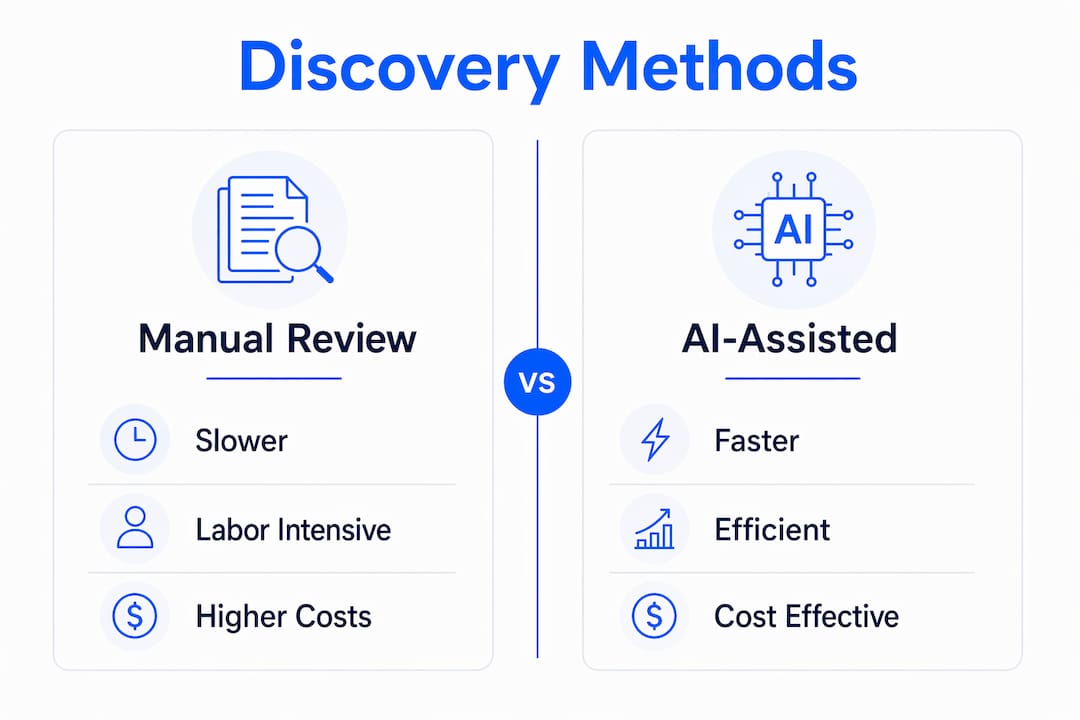
The comparison between manual and AI-assisted discovery is not close. The question for criminal defense attorneys in 2026 is not whether to adopt technology. It is which tools to adopt and how to integrate them without creating new compliance risks.
| Workflow element | Manual review | AI-assisted review |
|---|---|---|
| Initial document review time | 200+ hours per large case | Under 100 hours with AI classification |
| Brady material identification | Dependent on attorney stamina and attention | Systematic flagging across full production |
| Multimedia evidence processing | Real-time viewing required | Transcription and tagging in hours |
| Timeline construction | Manual, prone to gaps | Auto-generated from synthesized sources |
| Cost per case | High, scales with volume | Lower marginal cost at high volume |
| Error risk | Increases with fatigue | Consistent, with attorney verification layer |
AI discovery management is no longer optional for competent representation in high-volume criminal caseloads. That is a direct statement about professional standards, not a technology preference. Attorneys managing 50 or more active felony cases simultaneously cannot meet Brady obligations through manual review alone.
The phased workflow that produces the best outcomes separates raw evidence ingestion from case theory development. AI generates a neutral inventory first. Attorneys then apply legal judgment to that inventory rather than spending their cognitive bandwidth on document sorting. This preserves attorney time for the work that actually requires a law license.
Combining e-discovery platforms with specialized forensic services enhances the reliability and admissibility of digital evidence. A platform that classifies documents efficiently but lacks forensic integrity protocols creates downstream admissibility problems. The two functions must work together.
Practical steps for integrating AI into your discovery workflow
Adopting AI for criminal defense discovery does not require rebuilding your entire practice. It requires a deliberate, phased approach that keeps attorney judgment at the center of every decision.
- Audit your current workflow. Identify where manual review consumes the most time. Body camera footage, phone extractions, and large document productions are the highest-value targets for AI assistance.
- Select a compliant platform. Prioritize tools with FedRAMP authorization, HIPAA compliance, and documented chain-of-custody logging. Confirm data residency and access controls before uploading any case materials.
- Integrate with your case management system. AI review tools should feed into your existing case management structure, not create a parallel workflow that attorneys have to reconcile manually.
- Engage forensic experts early. Digital forensic experts negotiate discovery scopes, provide expert testimony, and confirm the usability of forensic evidence in court. Bringing them in at intake, not at trial, changes case outcomes.
- Define attorney review checkpoints. Every AI-generated output, whether a timeline, a flagged document set, or a motion draft, requires attorney review before it influences case strategy. Build those checkpoints into your workflow explicitly.
- Train your team on AI limitations. AI tools function best as disciplined assistants given narrowly defined tasks rather than open-ended case analysis. Staff who understand this distinction use AI more effectively and catch errors faster.
- Use AI for motion drafting and plea analysis. Beyond discovery review, AI accelerates suppression motion frameworks, plea agreement analysis, and client communication summaries. These applications compound the efficiency gains from document review. Learn more about how transcription accelerates case prep for a practical look at where time savings appear first.
Key takeaways
Technology in criminal defense discovery reduces review time by up to 5x, but attorney oversight of Brady obligations, metadata integrity, and platform compliance remains non-negotiable.
| Point | Details |
|---|---|
| AI cuts review time dramatically | AI-assisted review reduces hundreds of manual hours to under 100 hours per large case. |
| Brady obligations stay with attorneys | Software flags candidates; only licensed attorneys can make final Brady determinations. |
| Platform security is a legal duty | Only FedRAMP and HIPAA-compliant tools are appropriate for criminal case data. |
| Forensic imaging protects admissibility | Bit-for-bit copies preserve metadata and prevent evidence spoliation challenges. |
| Phased workflows maximize ROI | Separating AI inventory from attorney analysis preserves cognitive resources for strategy. |
Why disciplined AI use changes defense outcomes more than raw speed
I have watched attorneys adopt AI discovery tools for the wrong reason: they want to go faster. Speed is a byproduct. The real value is what you find that you would have missed.
AI helps defense lawyers discover conflicts, omissions, and unanswered questions hidden beneath prosecution narratives. That is not a search function. That is a strategic capability. An attorney who reviews 50,000 pages manually will read for confirmation of what they already suspect. AI reads without a theory and surfaces anomalies that human pattern recognition filters out.
The attorneys I respect most in this space treat AI output the way a good surgeon treats imaging results. The scan tells you where to look. It does not tell you what to do. Correctly interpreting AI-flagged inconsistencies requires legal experience to separate inference from fact and to prevent premature case theory formation based on a misread pattern.
My honest concern is the opposite of what most ethics panels focus on. The risk is not that attorneys will trust AI too much in obvious ways. The risk is subtle: an AI-generated timeline that looks authoritative becomes the frame through which an attorney interprets everything else. That is how confirmation bias enters through the back door of a technology workflow.
Ongoing legal education on digital evidence challenges is not optional anymore. The AI legal document analysis space is moving faster than bar association guidance. Attorneys who wait for formal ethics opinions before engaging with these tools will be two cycles behind by the time guidance arrives.
— Faisal
See how Caseflow handles discovery at scale
Criminal defense discovery demands a platform built specifically for the volume, sensitivity, and compliance requirements of criminal cases. Caseflow combines transcription, summarization, and searchable entity extraction in one platform, reducing case file review from weeks to hours.
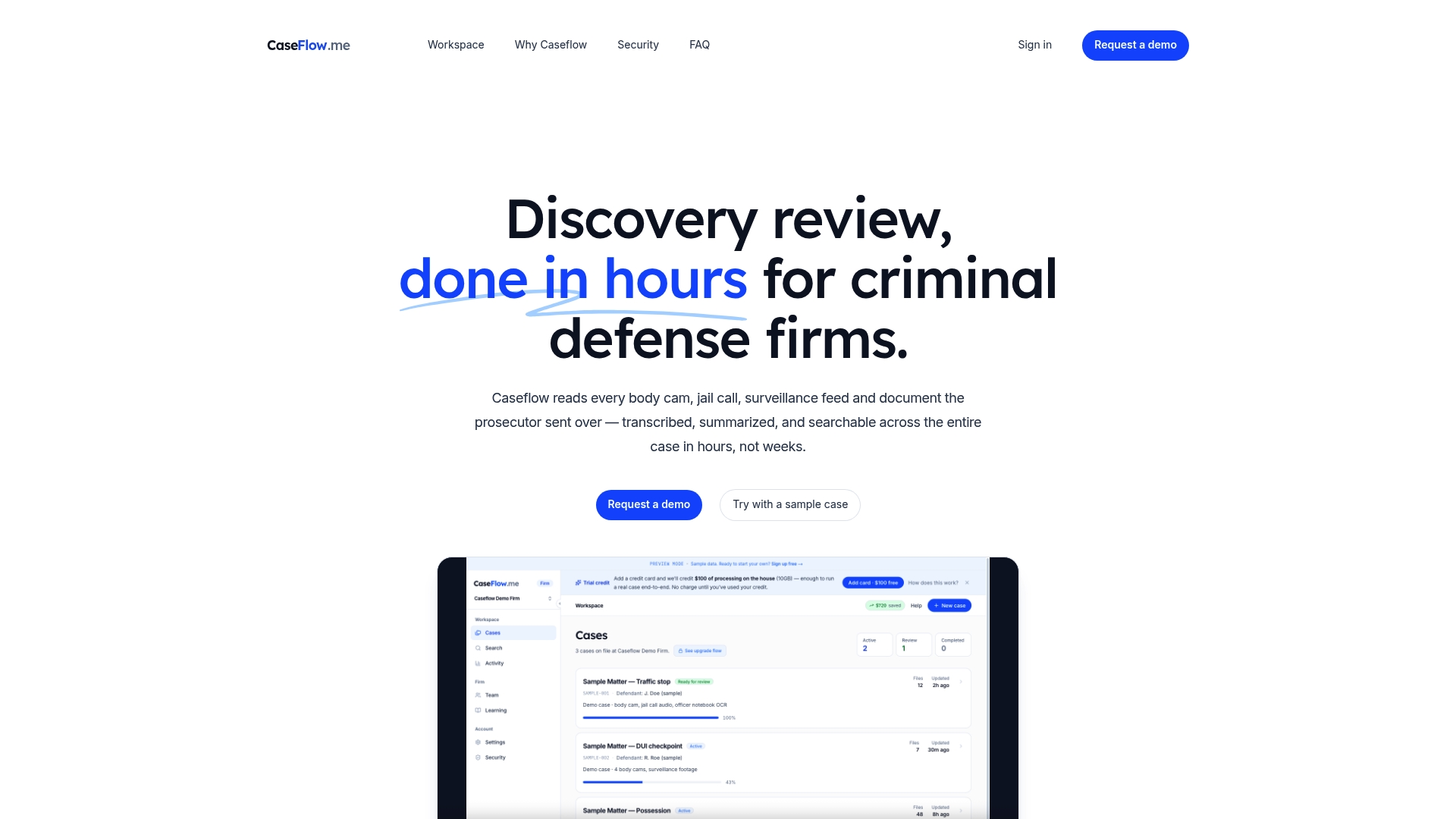
The Brady-trail audit log tracks every action taken on case files, giving you a documented chain of custody that satisfies both ethical obligations and court scrutiny. Caseflow supports multiple languages and preserves original audio alongside transcriptions, so accuracy is never sacrificed for speed. If your current workflow still relies on linear document review for large productions, explore Caseflow's AI platform to see what a purpose-built criminal defense discovery tool actually looks like in practice. You can also review Caseflow's security protocols to confirm compliance before onboarding any case data.
FAQ
What is the role of technology in criminal defense discovery?
Technology in criminal defense discovery automates document classification, multimedia transcription, and Brady material flagging, reducing review time from hundreds of hours to under 100 hours per large case. Attorneys retain full responsibility for all legal determinations.
Can AI replace attorney review of discovery materials?
No. AI identifies and organizes evidence, but attorney Brady review obligations cannot be delegated to software under any jurisdiction's professional conduct rules. AI is a review assistant, not a decision-maker.
What security standards should a discovery AI platform meet?
Any platform handling criminal case data should carry FedRAMP authorization and HIPAA compliance at minimum. Free or consumer-grade AI tools are not appropriate for sensitive defense materials and create potential ethics and data breach exposure.
How does forensic imaging protect digital evidence in discovery?
Forensic imaging creates bit-for-bit copies that preserve metadata, hidden partitions, and creation timestamps. Standard file copying alters this data, which can result in authentication failures and evidence exclusion at trial.
How do AI tools help identify Brady material more reliably?
AI applies conceptual search across entire productions, surfacing potentially exculpatory content regardless of whether specific legal terms appear in the document. This systematic approach catches material that sequential manual review misses, particularly in productions exceeding 50,000 pages.