
An audit trail in criminal cases is defined as a chronological, tamper-evident record of every action taken on evidence, case files, and digital assets from the moment of seizure through courtroom presentation. Audit trail best practices criminal cases demand are not optional compliance checkboxes. They determine whether evidence survives a legal challenge. 78% of compliance audits identify audit trail gaps as a primary control deficiency. Organizations with mature, tamper-evident systems detect incidents 36% faster. For legal professionals and law enforcement, that gap between a defensible record and an excluded exhibit can decide a case.
1. What are the mandatory components of a legally defensible audit trail?
Regulators and courts recognize seven critical fields that every defensible audit trail must capture: Identity, Timestamp, Action, Object, Version, Context, and Integrity Proof. Missing even one field creates a gap that opposing counsel can exploit to challenge admissibility.
- Identity: Who performed the action. This must be a unique user ID, not a shared account or generic role label.
- Timestamp: When the action occurred, sourced from a trusted, calibrated clock. A timestamp from an uncalibrated forensic workstation is legally vulnerable.
- Action: What was done. Read, write, delete, export, and transfer are distinct actions and must be logged separately.
- Object: Which file, record, or evidence item was affected. Log the specific item, not just the folder or case number.
- Version: Which version of the object was accessed or modified. Version control prevents disputes over what the evidence contained at a given point.
- Context: The session, device, IP address, and application involved. Context reconstructs the environment in which the action occurred.
- Integrity Proof: A cryptographic hash or digital signature confirming the log entry has not been altered since creation.
Pro Tip: Build a pre-logging checklist that verifies all seven fields are captured before any evidence is processed. A single missing field discovered during trial preparation is far more costly to address than a setup gap caught on day one.
2. How to ensure tamper-evidence and integrity in forensic investigations

Standard database logs are not sufficient for criminal proceedings. Standard logs can be altered or replayed by system administrators, which means they fail the basic test of cryptographic immutability that courts now expect.
The table below contrasts standard logs with forensically defensible audit trails across four key dimensions.
| Dimension | Standard database log | Forensically defensible audit trail |
|---|---|---|
| Modification risk | Alterable by admins | Cryptographically sealed at write time |
| Timestamp source | System clock, unverified | Trusted timestamping authority |
| Verification method | Manual review | Independent hash validation |
| Court admissibility | Challenged routinely | Meets ACPO Principle 3 and ISO/IEC 27037 |
Hash chaining links each log entry to the previous one using a cryptographic hash. Any modification to an earlier entry breaks the chain and is immediately detectable. Blockchain anchoring takes this further by publishing a hash to an immutable public ledger, providing an external reference point no internal actor can alter. Trusted timestamping authorities, such as those operating under RFC 3161, certify the exact moment a record was created without relying on the local system clock.
Cryptographic immutability is now the expected standard for audit trails across regulated industries, not a premium feature. Law enforcement agencies that rely on process controls alone face increasing challenges when opposing counsel retains a forensic expert.
Pro Tip: Test your hash chain integrity monthly. Run an automated verification script against archived logs and document the result. That documented test becomes evidence of your agency's due diligence if the trail is challenged.
3. Best practices for audit trail management across the criminal case workflow
A continuous, tamper-evident audit trail must begin logging at the moment evidence is seized. Any gap between seizure and the first log entry is a gap opposing counsel will find.
The following numbered practices cover the full workflow from seizure to courtroom.
- Log at the point of seizure. Activate logging before touching the device or file. The first log entry should record the seizure location, officer identity, and a hash of the original evidence state.
- Calibrate forensic workstations before every session. Proper calibration of forensic workstations is critical to preserving valid hash creation dates. An inaccurate system clock invalidates timestamps and can collapse chain of custody.
- Centralize logs across all systems. Successful audit trails integrate multiple systems, including e-signature platforms, case management tools, and forensic software, into a single cryptographically linked record. Siloed logs create timeline gaps.
- Apply role-based and row-level access controls. Audit trail access control via role-based security protects log integrity and creates individual accountability. No shared credentials. No group logins.
- Log metadata only, not sensitive content. Audit trails should log metadata only, not the sensitive data itself. Use unique IDs to reference records. This protects privacy and simplifies compliance with regulations like HIPAA and SOX.
- Run tabletop reconstruction tests quarterly. A well-structured audit trail must pass a tabletop reconstruction test within 30 minutes to be considered court-ready. If your team cannot reconstruct the full evidence timeline in that window, the trail is not ready for court.
- Set and enforce retention periods. Retention must align with the jurisdiction's requirements for the offense category. Review legal audit log retention standards annually and update policies when statutes change.
- Encrypt logs at rest and in transit. Encryption prevents unauthorized access and supports compliance with data protection regulations. Use AES-256 for storage and TLS 1.3 for transmission.
4. Common audit trail pitfalls in criminal investigations
The most damaging audit trail failures are not technical. They are procedural. The following pitfalls appear repeatedly in cases where evidence is challenged or excluded.
- Unexplained custody gaps. Unexplained custody gaps of as little as 4 hours during digital seizure are sufficient grounds for evidence exclusion in multiple jurisdictions, including recent 2026 high court rulings in Delhi and Bombay. Every transfer, storage event, and access must be logged without interruption.
- Failure to support independent reproducibility. An audit trail that only your team can interpret fails the legal standard. A qualified third party must be able to follow the record and reproduce the exact sequence of actions.
- Unverified timestamp sources. Timestamps drawn from uncalibrated or unverified clocks are legally vulnerable. Auditing the forensic workstation's system clock calibration can be decisive in legal challenges, as timestamp inaccuracies invalidate digital evidence.
- Accepting unverified hash values. Independent validation of hash values is required for legal defensibility. Trusting the hash reported by the same system that created the evidence is not sufficient. Retain an independent forensic validator.
- Insufficient retention. Logs deleted before the case concludes, including appeals, create irreversible gaps. Build retention policies that account for the full litigation lifecycle, not just the trial date.
- No anomaly detection. Audit trails that are written but never reviewed provide no operational value. Implement automated alerts for unusual access patterns, off-hours activity, or bulk exports.
5. How legal standards and regulations shape audit trail requirements
Legal standards set the floor for what courts will accept. Understanding those standards is not optional for legal professionals handling criminal case documentation.
ACPO Good Practice Guide, Principle 3 requires that an independent third party must be able to reproduce the exact process used to handle digital evidence. UK criminal proceedings under PACE 1984 can exclude evidence under Section 78 if the audit trail fails this reproducibility test. The principle applies to every step from seizure to analysis.
ISO/IEC 27037:2012 sets minimum chain of custody requirements for digital evidence. It specifies that evidence must be identified, collected, acquired, and preserved in a way that protects its integrity. Any deviation from documented procedures must itself be documented in the audit trail.
U.S. regulatory influences include HIPAA, which mandates audit controls for any system handling protected health information that intersects with a criminal investigation, and SOX, which governs financial records that may appear in fraud and white-collar cases. Noncompliance with either standard can result in evidence being challenged on procedural grounds.
The importance of audit trails extends beyond individual cases. Agencies with documented, compliant audit trail programs face fewer suppression motions and shorter pretrial litigation cycles. The investment in proper logging pays off in reduced courtroom exposure.
Key takeaways
Defensible audit trails in criminal cases require tamper-evident records, seven mandatory data fields, independent reproducibility, and continuous logging from the moment of evidence seizure.
| Point | Details |
|---|---|
| Seven mandatory fields | Every log entry must capture Identity, Timestamp, Action, Object, Version, Context, and Integrity Proof. |
| Cryptographic immutability | Hash chaining and trusted timestamping are now the expected standard, not optional upgrades. |
| Log from seizure onward | Gaps of as little as 4 hours can justify evidence exclusion in multiple jurisdictions. |
| Metadata-only logging | Log unique IDs and metadata, not sensitive content, to protect privacy and maintain compliance. |
| Test for court readiness | A tabletop reconstruction test completed within 30 minutes confirms the trail is legally defensible. |
The accountability gap no one talks about
The technical side of audit trail compliance gets most of the attention. Hash chains, blockchain anchoring, trusted timestamping authorities. These are real and necessary. But the failure mode I see most often in criminal cases is not technical. It is cultural.
Agencies and defense teams build a logging system, check the compliance box, and then never look at the logs again until a motion to suppress lands on the desk. The primary value of audit trails lies not just in detection but in promoting individual accountability, which reduces unauthorized activity before it happens. That preemptive effect disappears entirely when no one reviews the logs.
The cross-jurisdiction challenge is also underestimated. A case that starts in one state and involves federal charges, or a UK case with U.S. digital evidence, must satisfy multiple standards simultaneously. ACPO Principle 3, ISO/IEC 27037, and HIPAA do not always align neatly. Building an audit trail that satisfies the strictest applicable standard is the only safe approach.
My practical advice: assign a named individual, not a team or a role, to own audit trail review. That person runs the quarterly tabletop test, reviews anomaly alerts, and signs off on retention compliance. Named ownership changes behavior. It also creates a documented record of oversight that holds up in court far better than a policy document that no one can prove was followed.
The future of this field is automation. Platforms that integrate legal audit trail creation with cryptographic sealing and anomaly detection at the point of evidence processing will reduce human error and close the accountability gap. The agencies and defense teams that adopt these tools now will spend less time in pretrial litigation and more time on the substance of their cases.
— Faisal
Caseflow's approach to forensic-ready audit trail management
Criminal defense teams that need a court-ready audit trail without building the infrastructure from scratch have a direct path forward with Caseflow.
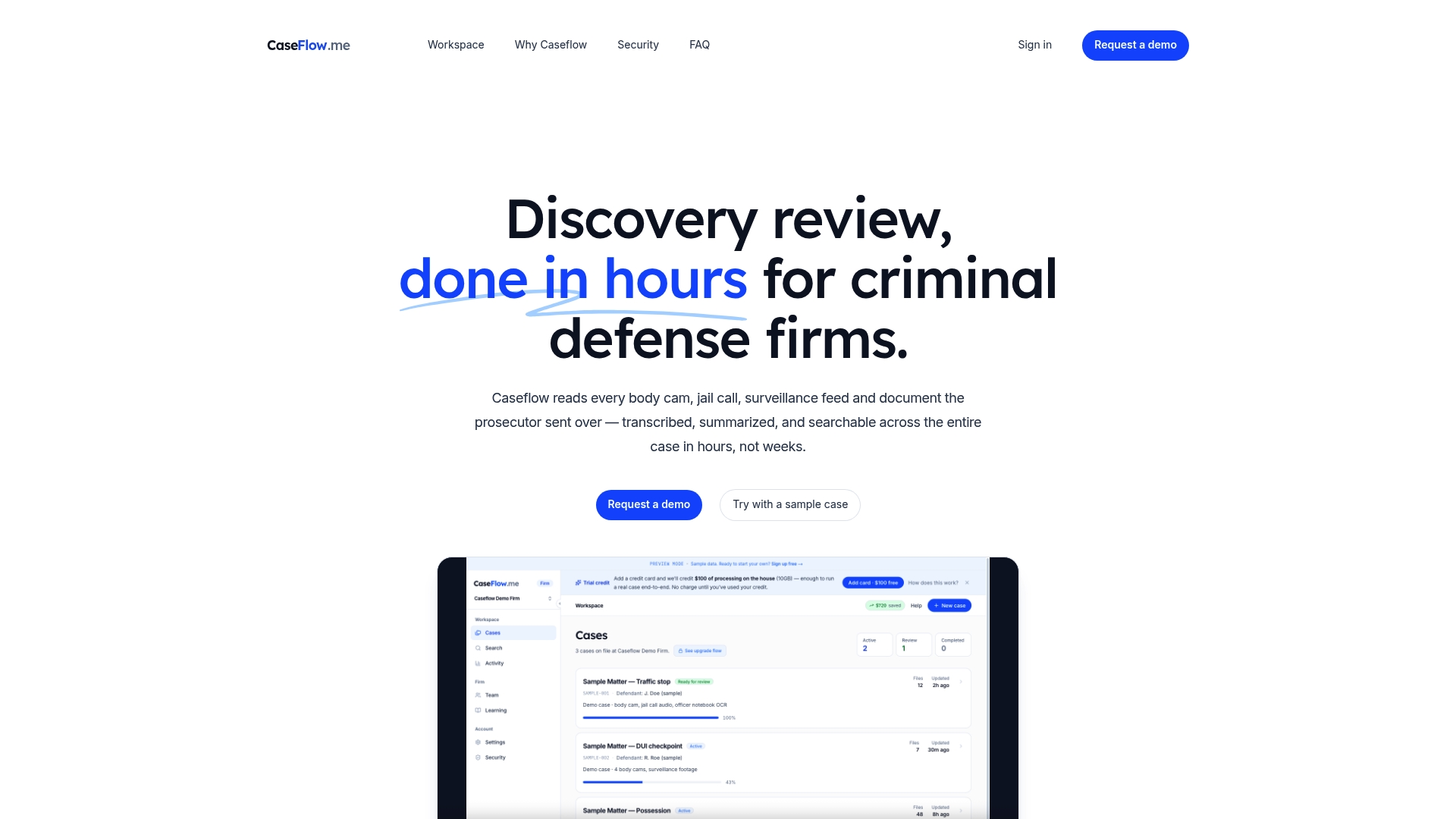
Caseflow's Brady-trail audit log tracks every action taken on case files, creating a tamper-evident record that satisfies compliance and transparency requirements. The platform combines transcription, summarization, and searchable entity extraction in one place, so the audit trail covers the full discovery workflow rather than isolated steps. Caseflow preserves original audio alongside transcriptions, protecting evidence integrity at the source. For defense teams managing multilingual evidence or high-volume discovery, Caseflow's AI platform reduces case preparation time from weeks to hours while keeping every action logged and defensible.
FAQ
What are the seven required fields in a defensible audit trail?
A defensible audit trail must capture Identity, Timestamp, Action, Object, Version, Context, and Integrity Proof. Missing any one field creates a gap that can result in evidence exclusion.
How long must audit trail logs be retained in criminal cases?
Retention periods vary by jurisdiction and offense category, but logs must cover the full litigation lifecycle including appeals. Review applicable statutes annually and update retention policies accordingly.
What makes an audit trail tamper-evident?
Tamper-evidence requires cryptographic controls such as hash chaining, blockchain anchoring, or trusted timestamping. Standard database logs that administrators can modify do not meet the legal standard for criminal proceedings.
Can a custody gap of a few hours really exclude evidence?
Unexplained custody gaps of as little as 4 hours have been sufficient grounds for evidence exclusion in multiple jurisdictions, including 2026 high court rulings. Continuous, uninterrupted logging from the moment of seizure is the only reliable protection.
What is ACPO Principle 3 and why does it matter?
ACPO Principle 3 requires that an independent third party must be able to reproduce the exact process used to handle digital evidence. Failure to meet this standard can result in evidence exclusion under Section 78 of PACE 1984 in UK criminal proceedings.