
Audit logs are chronological, tamper-evident records of every user and system action taken within a digital environment, and they serve as primary evidence in legal proceedings to establish authenticity, accountability, and event provenance. Understanding how audit logs work in legal cases is no longer optional for attorneys and investigators. Courts in 2026 compel production of system-level logs from platforms like Google Workspace and electronic medical record (EMR) systems to validate electronically stored information. Compliance frameworks including SOC2, HIPAA, and GDPR each mandate specific audit log controls. When those records are properly preserved and presented, they can make or break a case.
How audit logs work in legal cases: what they capture and why it matters
An audit log is a structured record generated automatically by a system each time a defined event occurs. Logs capture timestamps, user IDs, actions, and system events, and are stored with hash-based tamper detection to prevent undetected modification. That combination of specificity and immutability is what gives audit logs their evidentiary weight.
The events captured vary by system, but legally relevant logs typically include:
- User access events: logins, logouts, failed authentication attempts
- Document actions: creation, modification, deletion, and version changes
- Permission changes: role assignments, access grants, and revocations
- Data exports and downloads
- Administrative actions: configuration changes and system setting updates
These records come from multiple sources. Applications, operating systems, databases, and cloud platforms each generate their own logs. Security information and event management (SIEM) tools like Splunk or IBM QRadar aggregate those streams, normalize the data into a consistent format, and store them in append-only repositories. That aggregation step is what transforms scattered system output into a coherent record a court can follow.
Audit logs differ from general event logs in one critical way: they are designed for accountability. A general event log might record that a server restarted. An audit log records that a specific user with administrator privileges initiated that restart at a specific time from a specific IP address.

Pro Tip: Request logs from all relevant system layers, not just the application layer. A document may appear unmodified at the application level while the underlying database log shows a deletion and re-entry.
What makes audit logs admissible in court?
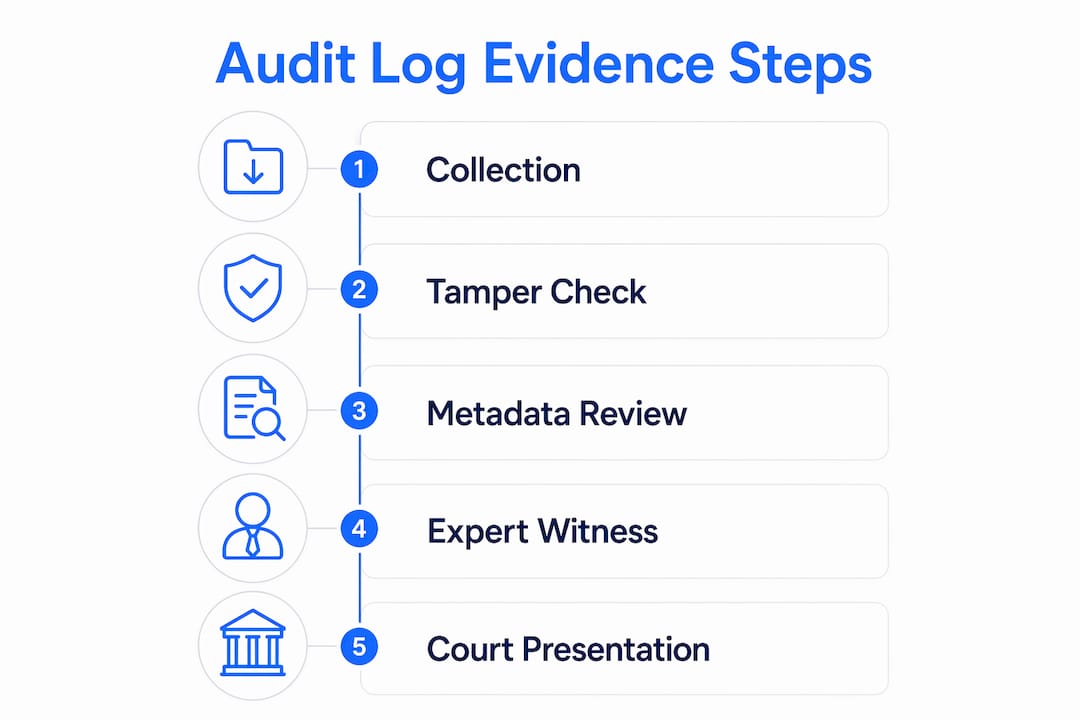
Admissibility turns on authenticity. Under Federal Rule of Evidence 901, the proponent of an audit log must demonstrate that the record is what it claims to be. Tamper-evidence must be proven from the moment of creation through production, or the opposing party can raise a successful authenticity challenge.
Courts in 2026 recognize three primary methods for establishing that proof:
- Cryptographic hash chains. Each log entry generates a hash value. Any modification to a prior entry breaks the chain and is mathematically detectable. Append-only storage with hash chaining and blockchain anchoring are the current standard for high-stakes legal environments.
- Custodian foundation testimony. A qualified witness, typically an IT administrator or forensic examiner, testifies to the system's logging configuration, storage controls, and chain of custody from generation to production.
- Regulatory compliance documentation. Logs generated under HIPAA audit control requirements or SOC2 Type II certification carry an implicit integrity baseline. Courts treat documented compliance as supporting evidence of reliability.
Retention policy failures carry serious consequences. Failure to maintain logs or prove retention diligence during discovery leads to negative court rulings under Federal Rule of Civil Procedure 37(e). That rule governs sanctions for failure to preserve electronically stored information. Judges have issued adverse inference instructions and case-dispositive sanctions where audit log gaps could not be explained.
| Requirement | What courts look for |
|---|---|
| Tamper-evidence | Cryptographic hash chains or write-once storage |
| Chain of custody | Documented handling from system generation to production |
| Retention compliance | Logs preserved per HIPAA, SOC2, or GDPR mandates |
| Expert foundation | IT witness to explain logging architecture and integrity |
| Completeness | No unexplained gaps during the relevant time period |
Courts require expert witness testimony to explain audit log metadata, system logging practices, and data authenticity. Legal teams must prepare IT experts before trial to overcome reliability objections.
Audit logs vs. audit trails: why the distinction decides cases
The terms "audit log" and "audit trail" are used interchangeably in practice, but they describe fundamentally different things in litigation. Raw audit logs are unstructured event data. A raw CSV export from a database is a log. An audit trail is a curated, chronological, and cryptographically secured reconstruction of business events built from those raw records.
Courts do not simply accept a raw log dump as sufficient evidence. A raw log requires explanation, expert testimony, and proof of tamper-evidence before it carries weight. The distinction matters most in two common scenarios:
- EMR cases. EMR audit trails capture edits, deletions, and access automatically, providing immutable evidence of who modified a patient record and when. In medical malpractice litigation, the difference between a raw system export and a properly structured EMR audit trail can determine whether alleged record alterations are provable.
- Contract and document authentication. Electronic signature platforms generate audit trails showing each party's IP address, timestamp, and authentication method at signing. A raw log from the same platform, without the structured trail, often fails to establish the legal standard for document authenticity.
"Audit logs are raw data. Usable audit trails are curated and tamper-evident. Presenting raw logs to a court without that curation is the single most common and most avoidable evidentiary mistake in digital litigation." — Audit trail compliance guide
Legal teams must understand that courts treat undocumented controls as ineffective. Audit logs turn written policies into verifiable evidence. Without the structured trail, the policy is just paper.
For a deeper look at how legal audit trails are built from raw log data, the guide on creating legal audit trails covers the technical and procedural steps attorneys need to understand.
Practical uses of audit logs in case management and compliance
Audit logs serve legal teams across three distinct phases of a case: discovery, forensic analysis, and compliance verification.
During discovery, audit logs answer questions that file metadata cannot. Metadata shows when a document was last saved. An audit log shows every person who accessed it, every change made, and whether any version was deleted and recreated. That granularity is why courts now routinely compel audit log production in document authenticity disputes.
In forensic analysis, investigators use logs to reconstruct a timeline of events. A fraud investigation, for example, might cross-reference access logs from a financial system with email server logs and VPN connection records to establish that a specific user accessed sensitive records outside normal business hours before a transaction was executed.
Compliance verification is the third application. During regulatory inspections under HIPAA or GDPR, auditors examine log completeness, retention schedules, and access control records. Organizations that cannot produce complete logs face enforcement exposure independent of any underlying violation.
Pro Tip: When issuing a litigation hold, explicitly include audit logs in the preservation notice. Many organizations apply holds to documents and email but overlook system logs, which are often subject to automatic deletion on 30-day or 90-day retention cycles.
Preserving audit logs during litigation requires more than pausing deletion. Litigation hold obligations extend to all electronically stored information reasonably anticipated to be relevant. Forensic imaging of log repositories, rather than simple export, provides the strongest chain of custody documentation. For guidance on demonstrating compliance with court expectations, the resource on discovery transparency in court addresses retention management during litigation pauses directly.
Common pitfalls when using audit logs as legal evidence
The most frequent failure is presenting raw logs without a structured audit trail. Courts expect explanation and authentication, not a spreadsheet of system events. Legal teams that skip the curation step face authenticity objections they cannot easily overcome mid-trial.
The four most damaging mistakes in audit log litigation are:
- Incomplete preservation. Logs deleted during a litigation hold period trigger Rule 37(e) sanctions. Automatic retention cycles must be suspended the moment litigation is reasonably anticipated.
- No expert witness. IT experts are essential witnesses for explaining log fields, logging procedures, and integrity controls. Without expert foundation testimony, opposing counsel can exclude the evidence entirely.
- Unexplained gaps. A log that shows continuous activity and then a 48-hour gap during the critical period will draw adverse inference arguments. Gaps must be explained by system documentation, not assumption.
- Relying on application logs alone. Daily review of logs for errors and suspicious activities is standard practice in security operations. Legal teams requesting logs after the fact often find that application-level logs were overwritten while database and OS-level logs survived.
Pro Tip: Ask opposing counsel to identify the specific logging systems in use, not just the applications. Database transaction logs and OS security logs frequently contain evidence that application-level logs do not.
Key Takeaways
Audit logs are only as strong as the chain of custody and curation process behind them. Presenting raw logs without a structured, tamper-evident audit trail is the most common and most preventable failure in digital evidence practice.
| Point | Details |
|---|---|
| Audit logs vs. audit trails | Raw logs require curation and authentication before courts treat them as reliable evidence. |
| Admissibility standard | Federal Rule of Evidence 901 requires proof of tamper-evidence through hash chains or custodian testimony. |
| Retention obligations | Litigation holds must explicitly cover audit logs to avoid Rule 37(e) sanctions for spoliation. |
| Expert witness necessity | IT experts must testify to logging architecture and integrity controls to establish foundation. |
| EMR and contract applications | Structured audit trails in EMR systems and e-signature platforms provide the strongest document authenticity evidence. |
Why legal professionals need to rethink how they approach audit evidence
The legal profession has been slow to treat audit logs as a first-class evidence category. Most attorneys request documents and email in discovery and treat system logs as a secondary afterthought. That approach is increasingly costly.
Courts are moving faster than legal practice on this issue. Judges in 2026 are not waiting for attorneys to ask for audit logs. They are compelling production on their own motion in document authenticity disputes. The attorneys who walk into those hearings without having already analyzed the available log data are at a structural disadvantage.
The deeper problem is that many legal professionals conflate the existence of a log with the existence of usable evidence. A log exists. An audit trail is built. That distinction requires technical literacy that most law school curricula do not provide. Attorneys who develop even a basic understanding of how hash chaining works, what a SIEM tool produces, and why append-only storage matters will consistently outperform those who treat logs as an IT problem.
My strongest recommendation is to bring a forensic IT consultant into the case at the same time you bring in your first expert witness, not after discovery closes. The logs that would have been your best evidence are often gone by then.
— Faisal
How Caseflow helps legal teams manage audit evidence
Criminal defense attorneys managing complex discovery face a specific version of this problem. Case files arrive in bulk, audit data is scattered across formats, and the timeline for analysis is short.
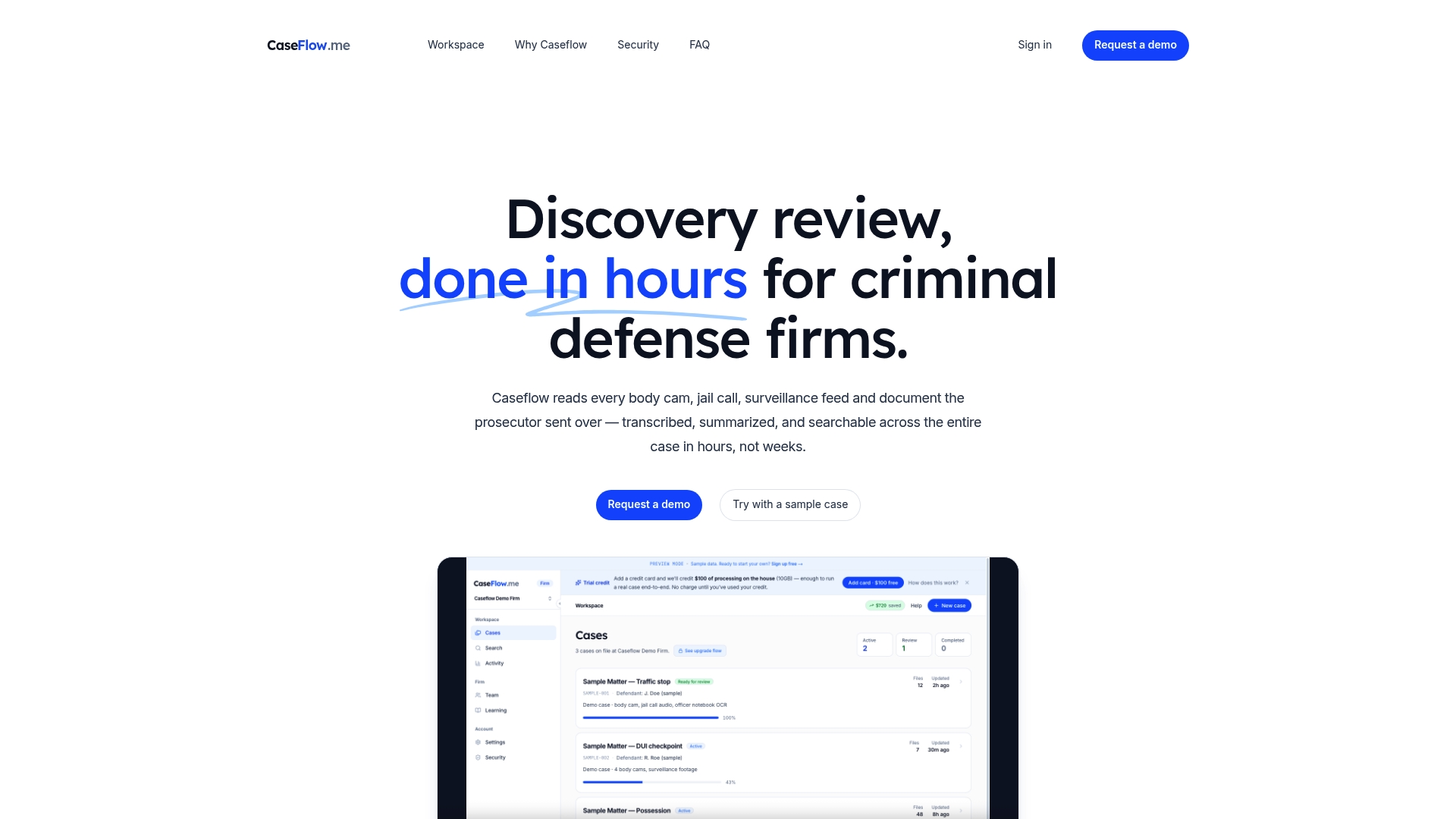
Caseflow addresses this directly. The platform combines transcription, summarization, and searchable entity extraction in one environment, reducing discovery review from weeks to hours. Its Brady-trail audit log tracks every action taken on case files, creating a transparent, compliance-ready record of all discovery activity. That feature directly supports the chain of custody documentation courts require. For defense teams managing multilingual evidence or large audio files, Caseflow preserves original audio while processing content for review. Explore what Caseflow's AI-powered legal platform can do for your case management workflow.
FAQ
What are audit logs used for in legal cases?
Audit logs document who accessed, modified, or deleted digital records and when. Courts use them to establish document authenticity, prove event provenance, and detect tampering in disputes involving electronically stored information.
Are audit logs admissible as evidence in court?
Audit logs are admissible when the proponent establishes tamper-evidence under Federal Rule of Evidence 901, typically through cryptographic hash chains, custodian testimony, and documented chain of custody from generation to production.
What is the difference between an audit log and an audit trail?
An audit log is raw, unstructured event data generated by a system. An audit trail is a curated, chronological, and cryptographically secured reconstruction built from those raw records. Courts require audit trails, not raw log exports, to treat digital evidence as reliable.
What happens if audit logs are not preserved during litigation?
Failure to preserve audit logs during a litigation hold can result in sanctions under Federal Rule of Civil Procedure 37(e), including adverse inference instructions or case-dispositive rulings for spoliation of electronically stored information.
Do you need an expert witness to present audit logs in court?
Courts require expert witness testimony to explain audit log metadata, logging architecture, and integrity controls. Without a qualified IT expert to establish foundation, opposing counsel can successfully challenge the admissibility of the evidence.