
Audit logs protect attorneys by creating timestamped, tamper-evident records of every action taken within legal systems, from document access to AI tool usage, giving you verifiable evidence when ethics inquiries, client disputes, or cybersecurity incidents arise. The industry term for this protection is an audit trail, and understanding why audit logs protect attorneys is no longer optional for any firm handling sensitive client data. Tools like LexVault, guidance from ABA Formal Opinion 512, and platforms like Caseflow have made audit trails a foundational requirement rather than a nice-to-have feature. This guide covers how audit trails work across ethics compliance, security response, AI governance, and real dispute scenarios.
Why audit logs protect attorneys in ethics inquiries
Audit trails convert operational trust into documented evidence, which is exactly what ethics inquiries and client disputes require. When a bar association asks who accessed a client file, or when a former client claims unauthorized disclosure, your answer cannot be "we believe our staff followed protocol." You need a record.
Audit logs capture the specific actions that matter most in ethics reviews:
- Document access: Who opened a file, and when
- Editing and version changes: What was altered, by whom, and at what time
- Downloads and exports: Which files left the system and who authorized them
- Search queries: What terms were used to locate client information
- Login events: When users entered the system and from which device or location
These logs prove confidentiality was maintained and that conflict checks were run before representation began. A matter-scoped log lets you filter by client file and date range, then export a complete audit extract in about five minutes. That speed matters when a bar inquiry has a tight response deadline.
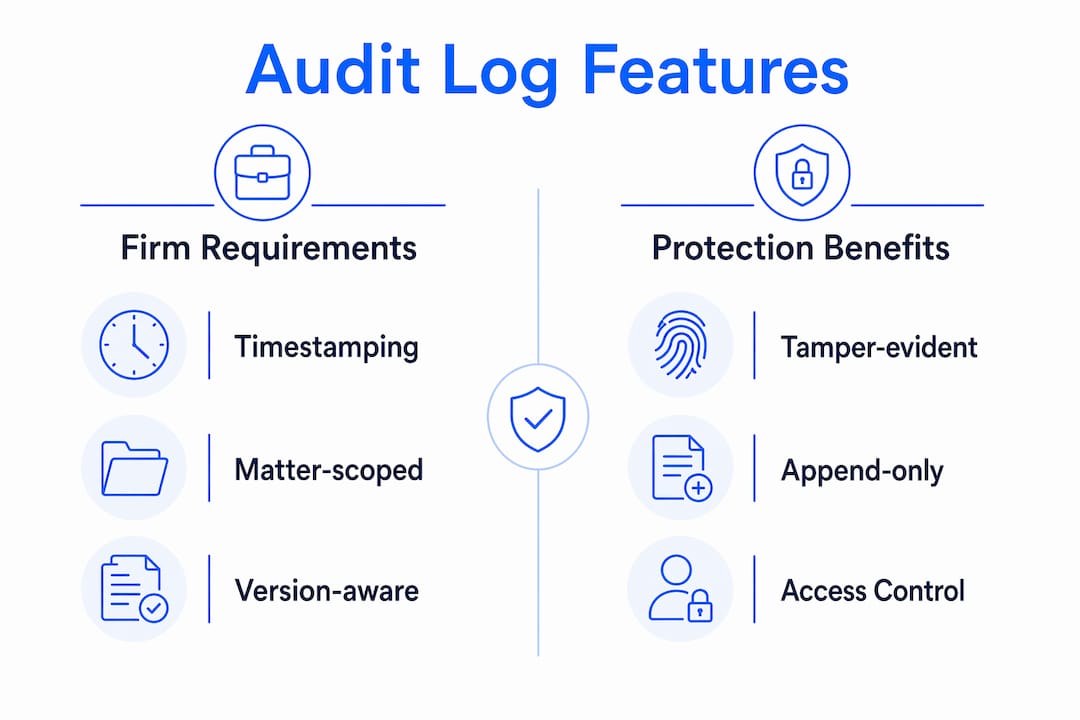
Pro Tip: Make sure your logs are matter-specific and version-aware. A log that shows "Document A was accessed" is far less useful than one showing "Version 3 of Document A was opened by J. Smith at 2:14 PM on March 4, 2026, in Matter 2024-CR-0047."
The importance of audit logs becomes clearest when you face a professional responsibility complaint. Without a log, you are reconstructing events from memory and email threads. With one, you produce a factual timeline in minutes.
How audit logs secure law firms against cyber threats
Law firms are high-value targets for cybercriminals because they hold privileged client data, financial records, and case strategy documents. Audit logs are the forensic foundation that security teams rely on to reconstruct attack timelines after a breach.
Here is how a forensic investigation using audit logs typically unfolds:
- Detect the anomaly. Logs flag unusual behavior, such as a login from an unfamiliar IP address at 3 AM or a mass export of files outside normal working hours.
- Trace the entry point. Audit logs revealed access from an unfamiliar IP followed by unusual file deletions, tracing a phishing compromise to its source.
- Map lateral movement. Logs show which systems the attacker touched after initial entry, revealing the full scope of exposure.
- Establish a timeline. Security teams build a chronological record of every action taken during the incident, which is required for regulatory notification and legal defense.
- Identify what was taken. Logs confirm which client files were accessed or copied, so you can notify affected clients accurately.
Log integrity is not automatic. Tamper-evident, append-only records form the foundation for incident investigations and legal defense. A log that can be edited or deleted after the fact carries no evidentiary weight. Firms must protect logs from alteration by restricting write access and storing them on separate, secured infrastructure.
Pro Tip: Synchronize all system clocks to a single time source like an NTP server, and restrict log access to authorized security personnel only. Inconsistent timestamps across systems make forensic timelines unreliable and can undermine your defense in a regulatory investigation.

Are audit logs required for ai-enabled legal work?
The short answer is yes. ABA Formal Opinion 512 and NYC Bar Association Opinion 2024-1 both address attorney obligations when using AI tools, and both emphasize the need to document supervision and verification of AI-generated work. Without an audit trail, you cannot prove you reviewed what the AI produced before it left your firm.
AI usage logs and verification logs documenting supervision before work product leaves the firm are now considered baseline requirements under these opinions. The biggest risk in AI-assisted legal work is not the AI itself. The risk is the failure to prove supervision and verification steps after the fact.
Common failure modes that audit logs prevent include:
- Missing citation verification: No record that an attorney checked AI-generated case citations before filing
- Undocumented human review: No log showing that a supervising attorney reviewed the AI output
- Lost prompt archives: No record of what instructions were given to the AI tool, making it impossible to reconstruct the workflow
- Version gaps: No documentation of which AI model version produced which output, creating liability if the model is later found to have errors
Firms that use standalone AI tools without integrated logging face the highest exposure. Embedded audit trails in practice management platforms produce complete, matter-specific AI usage traces quickly, lowering malpractice risk. The difference between a defensible AI workflow and a sanctionable one often comes down to whether your platform logs inputs, outputs, review steps, and the identity of the reviewing attorney.
You can learn more about how automated discovery logging works inside AI-enabled legal platforms to understand what a compliant workflow looks like in practice.
What features should legal audit logs include?
Not all audit logs provide equal protection. The table below compares the features that matter most for law firms and explains why each one is required.
| Feature | Why It Matters for Law Firms |
|---|---|
| Timestamping | Establishes the exact sequence of events for ethics inquiries and incident response |
| User identity capture | Proves which attorney or staff member performed each action, critical for accountability |
| Matter and document association | Allows targeted extraction by client file, reducing response time from hours to minutes |
| Tamper-evident design | Ensures logs hold evidentiary weight; altered logs are inadmissible and damage credibility |
| Export and filter tools | Lets you produce a complete audit extract filtered by matter, date, or user on demand |
| Version tracking | Records what a document said at each point in time, not just its current state |
| AI usage logging | Captures tool inputs, outputs, model versions, and review steps for malpractice defense |
Matter-scoped, version-aware audit log extracts are the most valuable in legal disputes, allowing targeted quick responses like identifying exactly who accessed or changed a document and when. Logs that lack matter association force you to search through firm-wide records manually, which is slow and error-prone under pressure.
Best practices for legal audit logging include reviewing logs on a regular schedule rather than only after incidents, training staff on what actions are logged and why, and integrating log review into your annual security and compliance program. The types of legal compliance audit logs your firm needs will depend on your practice area, but the features above apply universally.
How attorneys use audit logs to defend against disputes
Audit logs for legal protection work best when they are already in place before a dispute arises. Retroactive logging is not possible. The scenarios below show how attorneys use existing logs to respond quickly and credibly.
- Unauthorized access allegations: A client claims a staff member accessed their file without authorization. A matter-filtered log shows every access event, the user identity, and the timestamp, confirming or refuting the claim in minutes.
- Ethics board investigations: A bar inquiry asks whether an attorney maintained confidentiality during a representation. Logs document every person who touched the file and every export event, producing a complete chain of custody.
- Malpractice claims: In litigation, audit trails show not just what a record says now but who changed it and when, which is critical to proving document integrity and defeating spoliation arguments.
- Regulatory audits: Compliance reviews require proof of authorized access and data handling. Logs that are accurate, complete, and tamper-protected satisfy auditors without requiring manual reconstruction.
The audit trails in legal environments that hold up best share one characteristic: they were designed for legal use, not adapted from generic IT logging tools. Generic logs often lack matter association, version tracking, and the export formats that bar associations and courts expect.
Pro Tip: Align your log retention policy with your state bar's records retention rules and any applicable federal regulations. Many firms retain audit logs for at least seven years, but your jurisdiction may require more. Deleting logs prematurely can be treated as spoliation in litigation.
Key takeaways
Audit logs protect attorneys by providing tamper-evident, matter-specific records that serve as verifiable evidence in ethics inquiries, cybersecurity incidents, AI compliance reviews, and client disputes.
| Point | Details |
|---|---|
| Ethics and accountability | Matter-scoped logs prove who accessed client files and when, satisfying bar inquiry requirements. |
| Cybersecurity defense | Tamper-evident, append-only logs enable forensic timeline reconstruction after a breach. |
| AI workflow compliance | ABA Formal Opinion 512 requires documented supervision and verification logs for AI-generated work. |
| Dispute resolution | Version-aware logs show document history, defeating malpractice and spoliation arguments. |
| Log integrity is non-negotiable | Logs that can be altered carry no evidentiary weight and must be stored on secured, restricted infrastructure. |
Audit logs have become the ethical backbone of legal practice
I have watched audit logging shift from a checkbox on an IT security form to the single most important evidentiary tool attorneys carry into ethics hearings and malpractice depositions. That shift happened fast, and most firms were not ready for it.
The gap I see most often is not technical. Firms have logging tools. The problem is that the logs are not matter-scoped, not version-aware, and not protected from tampering. When a dispute arrives, the attorney discovers their logs are either too generic to answer the specific question or stored in a format no one can export quickly. That is a preventable failure.
The AI dimension makes this more urgent. Attorneys who use AI drafting tools without integrated logging are building liability on a foundation they cannot see. When a supervising partner cannot reconstruct what the AI produced, what was reviewed, and who signed off, the firm has no defense. The ABA and New York bar have both said this plainly, and more jurisdictions will follow.
My honest view is that audit logs are not a security feature. They are a professional responsibility tool. Firms that treat them as IT infrastructure miss the point entirely. The attorneys who understand this are the ones who will be able to defend their work confidently, whether the challenge comes from a client, a regulator, or opposing counsel.
— Faisal
How Caseflow puts audit logs to work for criminal defense
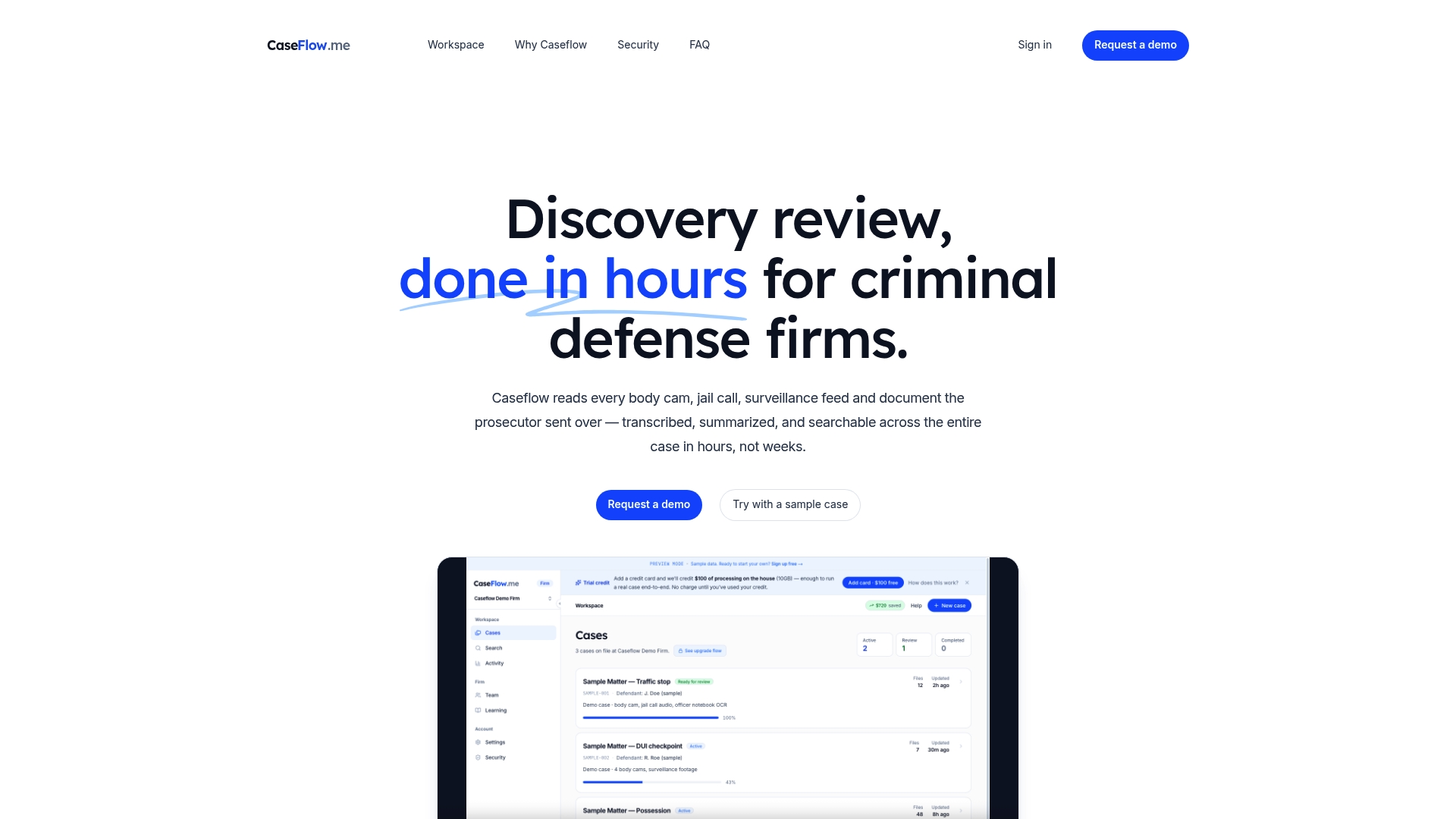
Caseflow is built specifically for criminal defense attorneys who need more than a generic logging tool. The platform's Brady-trail audit log tracks every action taken on case files, from initial upload through transcription, summarization, and entity extraction, giving you a complete, matter-specific record that satisfies both ethics and discovery requirements. Every step in your workflow is documented, exportable, and tamper-evident.
For attorneys who need to prove compliance with ABA guidance on AI supervision, Caseflow's integrated audit trail captures AI inputs, outputs, and review steps inside a single platform. You can review Caseflow's security architecture and system status directly for full transparency on how your audit data is protected. Explore Caseflow's AI platform to see how integrated audit logging works in a criminal defense workflow.
FAQ
What is an audit log in a legal context?
An audit log is a timestamped, tamper-evident record of every user action within a legal system, documenting who accessed, edited, or exported documents and when. Law firms use audit logs to prove compliance, respond to ethics inquiries, and defend against malpractice claims.
Are audit logs required by bar association ethics rules?
ABA Formal Opinion 512 and NYC Bar Association Opinion 2024-1 both require attorneys using AI tools to maintain logs documenting supervision and verification of AI-generated work. Broader ethics obligations around confidentiality and competence also support maintaining audit trails for all client matter activity.
How do audit logs help during a cybersecurity breach?
Audit logs provide a forensic timeline of access events, allowing security teams to identify the breach entry point, trace attacker movement, and determine which client files were exposed. Logs must be tamper-evident and stored separately from the systems they monitor to remain credible during an investigation.
What makes an audit log legally defensible?
A legally defensible audit log is tamper-evident, append-only, matter-scoped, and version-aware. Logs that can be altered after the fact carry no evidentiary weight and will not hold up in bar hearings, regulatory audits, or litigation.
How long should law firms retain audit logs?
Most firms retain audit logs for at least seven years, but retention requirements vary by jurisdiction and practice area. Align your retention policy with your state bar's records rules and any applicable federal regulations to avoid spoliation exposure.