
A legal audit trail is a tamper-evident, chronological record of every action taken within a legal workflow, capturing who did what, when, and how. Understanding how legal audit trails are created is not optional for attorneys and compliance officers. Courts, regulators, and opposing counsel treat these records as objective proof of process integrity. When an audit trail is missing, incomplete, or editable, the consequences range from sanctions to criminal liability. This article breaks down the exact data points, technologies, and security controls that make an audit trail legally defensible.
What key data points are essential in creating a legally defensible audit trail?
A legally defensible audit trail must capture seven core data points per event to ensure tampering is detectable and the record holds up under scrutiny. Each field serves a specific evidentiary purpose. Missing even one creates a gap that opposing counsel or a regulator will exploit.
The seven mandatory fields are:
- User identity. The authenticated identity of the person who performed the action, not just a username. This means verified credentials tied to a real individual.
- Precise timestamp. The exact date and time from an authoritative source, synchronized to a trusted time server. Timestamps from local system clocks are vulnerable to manipulation.
- Action details. A specific description of what was done. "File accessed" is insufficient. "Document opened for editing" or "exhibit uploaded to case record" is defensible.
- Affected object and version. The specific document, record, or data element that was acted upon, including its version number or hash at the time of the action.
- Originating context. The IP address, device identifier, or session token from which the action originated. This places the action in a physical and technical context.
- Cryptographic integrity proof. A hash or digital signature applied to the log entry at the moment of creation. Cryptographic proofs in audit logs ensure data integrity and make the record immutable, which is what transforms a log into evidence.
- Outcome or result. Whether the action succeeded or failed. A failed login attempt is as legally significant as a successful one.
Pro Tip: When reviewing a vendor's audit trail capabilities, ask specifically whether the cryptographic hash is applied at the entry level or only at the batch level. Entry-level hashing is the only standard that proves individual record integrity.
The implication of incomplete data is severe. Audit trail deficiencies appear in a significant share of data breach incidents, and falsification carries penalties including up to 20 years imprisonment under Sarbanes-Oxley. That is not a compliance footnote. It is a career-ending risk.
How are audit trails generated and maintained in modern legal systems?
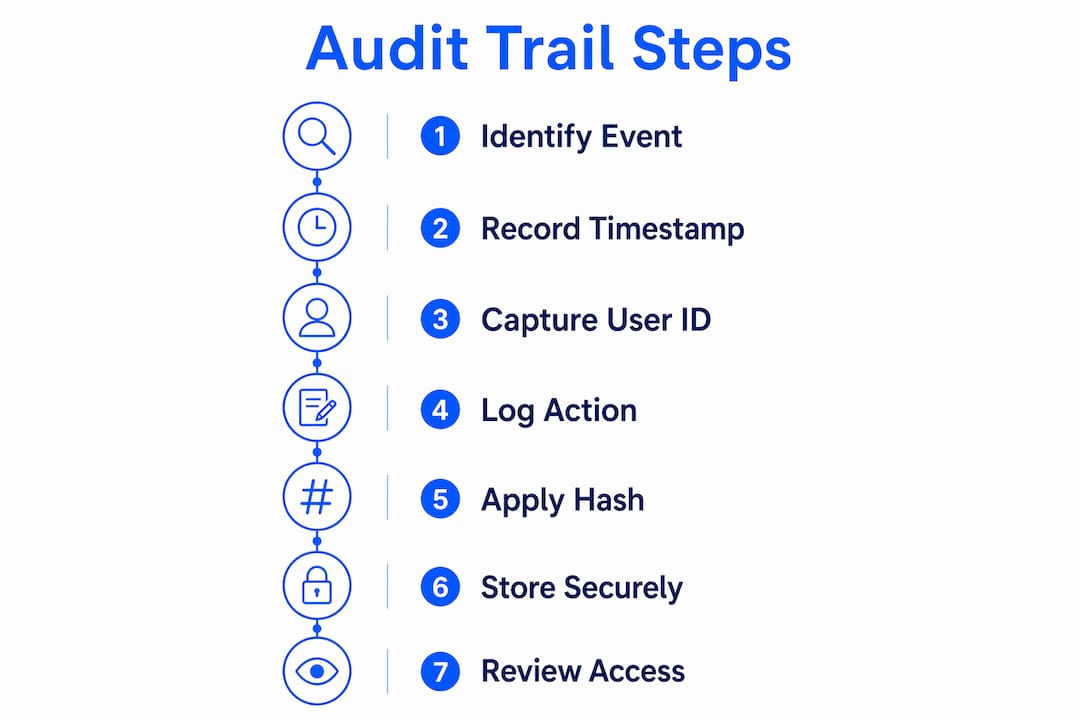
The shift from manual to automated audit logging is the single most important development in legal record-keeping over the past decade. Manual audit trails are less reliable and easier to falsify than automated ones. Modern systems generate logs in real-time, triggered by system events rather than human diligence.
Here is how a well-designed audit trail generation process works in practice:
- Event-driven triggers. Every user action in the system, opening a file, editing a document, exporting data, or granting access, fires an automatic log entry. The system does not wait for a user to record the action.
- Append-only storage. Audit logs must be append-only, meaning new entries can be added but existing entries cannot be modified or deleted. This is enforced at the database or storage layer, not just the application layer.
- NTP synchronization. Timestamps are synchronized to a Network Time Protocol (NTP) server or another authoritative time source. This prevents clock drift from creating inconsistencies that undermine the chronological integrity of the record.
- Hash chaining. Each log entry includes a cryptographic hash of the previous entry. This creates a chain where altering any single record breaks the entire sequence, making tampering immediately detectable.
- SIEM integration. Security Information and Event Management (SIEM) platforms collect, normalize, and correlate log data across systems in real-time. For legal operations with multiple platforms, SIEM provides a unified audit record.
- Retention policy enforcement. Regulations like SOX and HIPAA require specific retention periods, often up to seven years. Automated retention policies archive logs to immutable storage and flag records approaching deletion deadlines.
- Workflow-embedded design. Embedding audit logging into workflow design from the start is critical for defensibility. Retrofitting logging onto an existing system almost always produces gaps. If your case management platform was not built with audit trails as a core feature, the logs it produces will not withstand adversarial review.
The practical takeaway for legal teams is that audit trail creation is an architectural decision, not a configuration option. The digital discovery workflow must be designed around logging requirements from day one.
What are the security and compliance challenges in creating legal audit trails?

Creating an audit trail is only half the problem. Keeping it secure and compliant is where most organizations fail. The most common vulnerabilities are not external attacks. They are internal access control failures.
The core security challenges include:
- Administrator overreach. System administrators who can modify or delete audit logs represent the single greatest threat to log integrity. The solution is to separate log storage from the systems administrators manage, and to log all access to the audit logs themselves.
- Editable application logs versus tamper-evident audit trails. A key distinction exists between application logs and defensible audit trails. Application logs are often stored in writable files that any developer or administrator can edit. A defensible audit trail requires append-only, tamper-evident storage, often secured with cryptographic hashing or blockchain anchoring.
- Insufficient access controls. Role-Based Access Control (RBAC) restricts who can view audit logs and under what conditions. Compliance officers should be able to read logs. Developers should not be able to delete them. These are separate permissions that must be enforced at the infrastructure level.
- Logging the log access. Every time someone views, exports, or queries the audit log, that action must itself be recorded. Without this second-order logging, an administrator could review and potentially act on sensitive log data without any record of doing so.
- Legal consequences of falsification. Altering an audit trail in the context of litigation or a regulatory investigation is obstruction. The global average cost of a data breach is $4.88 million, and that figure does not include the criminal exposure that follows when investigators find evidence of log tampering.
Pro Tip: Run a quarterly access review specifically for audit log permissions. Ask your IT team to produce a list of every user account with write or delete access to log storage. If that list contains more than two or three accounts, your controls are too permissive.
Caseflow's security architecture addresses these challenges directly by enforcing strict access controls and maintaining tamper-evident logs that attorneys can rely on in court.
How do legal audit trails support case management and regulatory compliance?
A well-constructed audit trail does more than satisfy a regulator. It changes how legal teams operate, resolve disputes, and prepare for litigation.
| Use case | Without audit trail | With audit trail |
|---|---|---|
| Proving chain of custody | Relies on witness testimony and manual records | Cryptographically verified sequence of actions with timestamps |
| AI-assisted workflow defensibility | AI output has no documented human review | AI input, output, and human approvals are all logged, proving human-in-the-loop review |
| Regulatory audit response | Reconstruction takes days or weeks | Event timeline rebuilt in minutes from structured log data |
| Dispute resolution | Speculation about who accessed or changed a file | Objective record resolves the dispute with facts |
| Deterrence of unauthorized actions | Employees know gaps exist | Traceable records deter fraud and unauthorized behavior |
The AI-assisted workflow row deserves particular attention. As legal teams adopt AI tools for document review, summarization, and research, regulators and courts are beginning to ask how human oversight was exercised. An audit trail that captures AI input, AI output, attorney edits, and final approval creates a documented record of professional judgment. Without that record, the AI output is unverifiable.
The cultural impact is equally significant. When attorneys and staff know that every action is logged, behavior changes. The shift from implicit to explicit record-keeping deters unauthorized access, reduces internal disputes, and creates a shared standard of accountability across the team. For compliance officers managing large legal departments, that cultural shift is often more valuable than the logs themselves.
Rapid event reconstruction is another practical benefit. If a regulator asks you to produce a timeline of all actions taken on a specific case file within the last 18 months, a well-designed audit trail makes that a one-hour task. Without it, the same request can consume weeks of staff time and still produce an incomplete answer.
Key takeaways
A legally defensible audit trail requires seven specific data points, automated append-only logging, cryptographic integrity proofs, and strict access controls applied from the moment a legal workflow is designed.
| Point | Details |
|---|---|
| Seven mandatory fields | Every log entry must include user identity, timestamp, action, affected object, version, context, and a cryptographic hash. |
| Automated over manual logging | Event-driven, real-time logging eliminates the human error and falsification risk inherent in manual records. |
| Append-only storage is non-negotiable | Writable application logs are not audit trails. Immutable, append-only storage is the minimum standard for legal defensibility. |
| Access controls protect integrity | RBAC and second-order logging of log access prevent administrator tampering, the most common internal threat. |
| Audit trails change legal culture | Explicit, traceable records deter unauthorized actions and shift dispute resolution from speculation to objective evidence. |
Why most legal teams get audit trails wrong before they even start
Most attorneys and compliance officers I have worked with treat audit trails as a compliance checkbox. They ask their IT team to turn on logging, confirm that something is being recorded, and move on. That approach produces logs that look complete until the moment they are actually needed.
The problem is architectural. If audit logging is not embedded in the workflow from the start, the resulting records will have gaps that only become visible under adversarial scrutiny. A regulator or opposing counsel will find those gaps. The tabletop testing approach recommended by compliance specialists is the most reliable way to discover them first. The test is simple: pick a case file, pick a date range, and ask your team to reconstruct every action taken on that file within 30 minutes. If reconstruction takes longer than 30 minutes, the audit trail is effectively broken for compliance purposes.
The second mistake I see consistently is conflating application logs with audit trails. They are not the same thing. Application logs are diagnostic tools. Audit trails are evidence. The distinction matters because application logs are typically stored in writable formats that developers can modify. A court or regulator will ask whether your logs are tamper-evident. "We have logs" is not the same answer as "our logs are cryptographically signed and stored in append-only infrastructure."
The legal teams that get this right share one characteristic. They treat audit trail design as a legal requirement, not an IT task. That means attorneys and compliance officers are in the room when the system architecture is decided, not reviewing the output after the fact.
— Faisal
How Caseflow automates secure audit trail creation for criminal defense
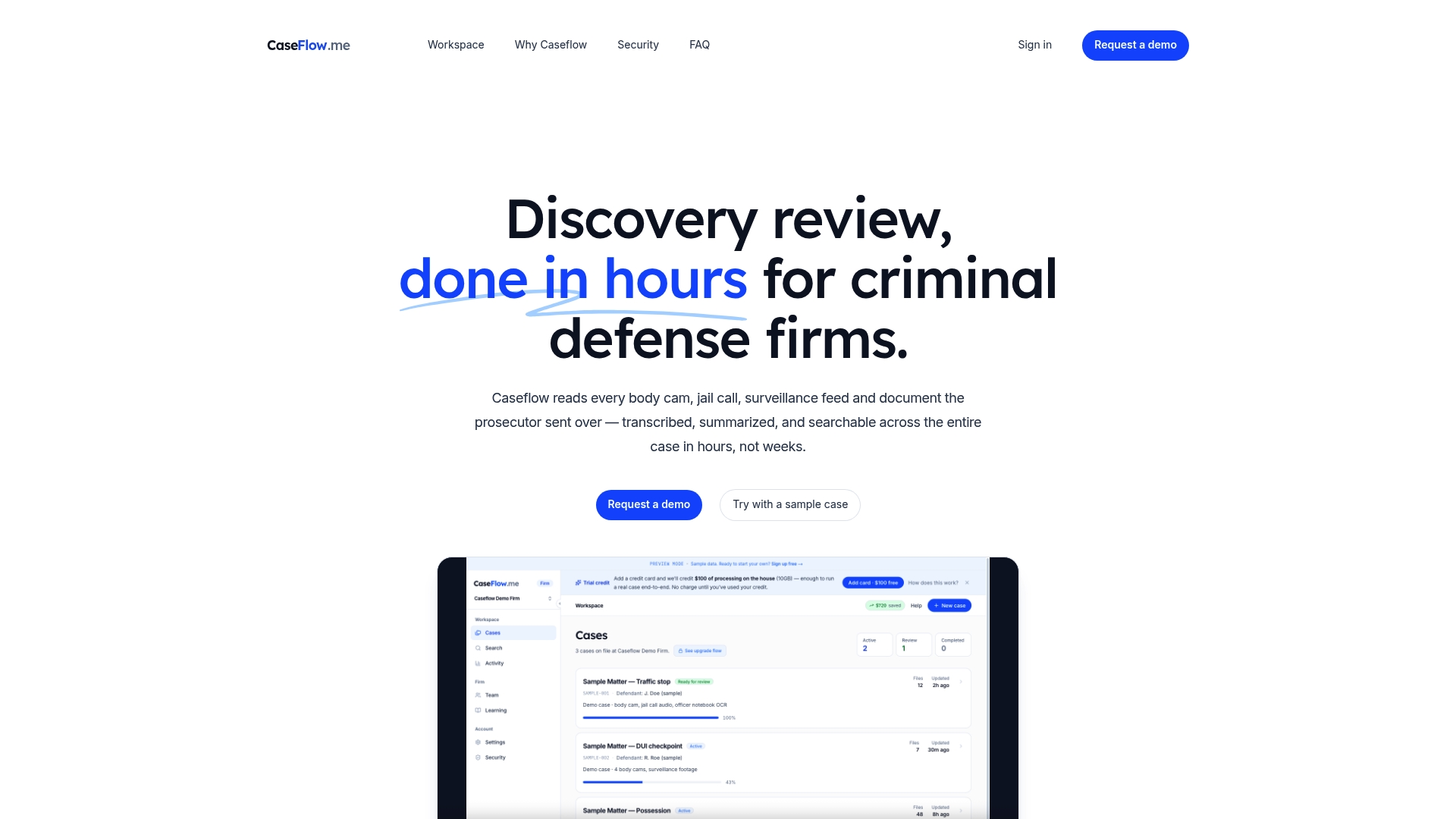
Caseflow is built specifically for criminal defense attorneys who need audit trail documentation that holds up in court and satisfies Brady disclosure requirements. The platform's Brady-trail audit log automatically records every action taken on a case file, from the moment evidence is uploaded through every review, annotation, and export. Every entry is tamper-evident, timestamped, and tied to a verified user identity. You do not configure this after the fact. It is embedded in the case management workflow from the first interaction with a file. For attorneys managing complex discovery across multiple languages and file formats, Caseflow's combination of transcription, summarization, and searchable entity extraction means the audit trail covers every step of the process, not just document access. See how Caseflow's security architecture protects your case records and keeps your practice compliant.
FAQ
What are audit trails in legal contexts?
An audit trail in a legal context is a chronological, tamper-evident record of every action taken on a case file, document, or system, capturing who acted, what they did, and when. It serves as objective evidence of process integrity in litigation, regulatory audits, and internal investigations.
How do you establish an audit trail for legal compliance?
Establishing a compliant audit trail requires selecting a system with append-only, event-driven logging that captures all seven mandatory data points, including cryptographic integrity proofs, and enforces Role-Based Access Control to prevent unauthorized modifications.
What regulations require audit trail retention?
SOX requires audit log retention for up to seven years for financial records, while HIPAA mandates retention of access logs for a minimum of six years. Criminal defense matters may also require preservation under Brady and Giglio obligations.
How do you test whether an audit trail is sufficient?
Run a tabletop exercise: select a specific case file and attempt to reconstruct a complete event timeline for a defined date range within 30 minutes. If reconstruction takes longer, the audit trail has gaps that will not survive a compliance inquiry.
Can AI-generated legal work be covered by an audit trail?
Yes. Audit trails for AI-assisted workflows must log the AI input, the AI output, any human edits, and the attorney's final approval decision. This documented human-in-the-loop record is what makes AI-assisted legal work defensible under current professional responsibility standards.