
Legal audit log retention is defined as the structured process of preserving tamper-evident records of system and user actions for a documented period to satisfy regulatory, legal, and operational requirements. Compliance officers managing frameworks like SOX, HIPAA, PCI DSS, and GDPR face overlapping mandates with different retention clocks, access requirements, and deletion rules. Getting this wrong does not just mean a failed audit. It can mean sanctions, spoliation findings, and lost litigation. This guide covers the core legal audit log retention best practices that legal professionals and compliance teams need to apply right now.
1. What are the core regulatory retention requirements?
Regulatory frameworks set the floor for how long to keep audit logs. Retention periods vary by framework: HIPAA mandates 6 years, SOX requires 7 years, and PCI DSS requires 12 months of log retention with at least 3 months in immediately accessible storage. That variation matters because most organizations operate under more than one framework at once.
The practical solution is to apply the longest applicable retention period across all frameworks. An organization subject to both HIPAA and SOX should default to 7 years for overlapping log categories. This single rule eliminates the risk of premature deletion under one framework while still complying with another.

GDPR takes a different approach. It requires purpose-based retention, meaning you keep logs only as long as the original processing purpose justifies. Data minimization principles under GDPR push back against indefinite retention. The result is a tension between GDPR's minimization mandate and SOX or HIPAA's longer retention floors that legal teams must resolve in writing.
| Regulation | Minimum retention | Immediate access requirement |
|---|---|---|
| HIPAA | 6 years | Not specified |
| SOX | 7 years | Not specified |
| PCI DSS | 12 months | 3 months hot storage |
| GDPR | Purpose-based | Not specified |
Annual policy reviews with legal and compliance teams are not optional. Regulations update, business purposes change, and retention schedules that were defensible last year may not hold up this year.
2. How to build a tamper-evident, defensible audit log system
A defensible audit trail must capture seven core fields: identity, timestamp, action, object, version, context, and integrity proof. Audit-trail gaps are cited as the primary control deficiency in 78% of compliance audits. Missing even one of those seven fields can make an entire log record inadmissible or unreliable under scrutiny.
Cryptographic integrity is the standard that auditors now expect. Hash chains, blockchain anchoring, and digital signing each prevent retroactive modification of log records. Procedural controls alone, such as access restrictions or manual review, are no longer sufficient. Auditors increasingly expect cryptographic proofs over procedural controls to confirm tamper-evidence.
Separation of duties is equally critical. The administrator who manages a system should not also control the logs that record their own actions. Assigning log custody to a separate team or system removes the most common vector for internal tampering.
Trusted time sources prevent timestamp manipulation. Logs tied to an internal clock that an administrator controls are vulnerable. Network Time Protocol servers synchronized to authoritative external sources provide timestamps that are far harder to dispute in court.
Pro Tip: Automate integrity verification on a weekly schedule. Waiting for an audit to discover hash mismatches means discovering the problem too late to fix it.
3. What are the best storage tiers for audit log compliance?
Logs in cold storage requiring 24–48 hours to retrieve fail compliance audits. Retention does not mean archiving alone. Logs must be accessible within minutes for audits to pass compliance tests.
Tiered storage solves the cost-versus-access problem. Hot storage holds the most recent logs in instantly queryable systems. Warm storage holds logs from the past several months at moderate cost with retrieval times measured in minutes to hours. Cold and archive storage holds older logs at low cost but with retrieval times that disqualify them from immediate audit use.
PCI DSS requires 3 months of hot storage for instant analysis. Auditors test log integrity by reconstructing events within 30 minutes. A delay beyond that window is treated as non-compliance, regardless of whether the logs technically exist somewhere.
| Storage tier | Typical age of logs | Retrieval time | Compliance use |
|---|---|---|---|
| Hot | 0–3 months | Under 5 minutes | Active audit queries |
| Warm | 3–12 months | Minutes to hours | Incident investigation |
| Cold | 1–3 years | Hours | Long-term compliance |
| Archive | 3+ years | 24–48 hours | Legal hold, historical review |
Pro Tip: Map your regulatory retention floors against each storage tier before you set automated migration rules. Moving PCI DSS logs to cold storage at 60 days violates the 3-month hot storage requirement.
4. How to manage retention policies, legal holds, and deletion automation
Failing to document retention justifications is the most common mistake in audit log management. Every retention period in your policy must be tied to a specific regulatory requirement, contractual obligation, or documented business purpose. A policy that says "keep logs for 7 years" without explaining why is not defensible under GDPR or in litigation.
Legal holds override all automated deletion policies the moment litigation is reasonably anticipated. Failure to suspend automated deletion on legal hold leads to spoliation sanctions. Courts treat the destruction of potentially relevant records as an adverse inference against the party that destroyed them. Manual override capability is not a nice-to-have feature. It is a legal requirement.
Operational best practices for managing retention and deletion safely include:
- Document the regulatory or business basis for every retention period in writing.
- Assign a named owner to each retention schedule who is responsible for annual review.
- Build legal hold triggers into your case management or matter management system.
- Test deletion automation quarterly to confirm holds are respected before records are purged.
- Maintain an exception log for any records held beyond their scheduled deletion date.
- Review retention policy coverage annually with both legal counsel and your IT team.
Automated deletion is efficient, but it requires human oversight at the policy level. The goal is a system that deletes on schedule by default and freezes immediately on legal hold without requiring manual intervention at the record level.
5. How to tailor log retention to your legal or business context
Audit logs require accountability focus, not just volume. Not every system event merits audit-level logging. Logging everything creates storage costs and alert fatigue without improving compliance. The right approach is to identify which events carry legal or regulatory accountability and log those at the audit level.
Financial services firms operating under SOX need 7-year retention for financial system logs and should treat any log touching a financial record as subject to that floor. Healthcare organizations under HIPAA need 6-year retention for logs touching protected health information. SaaS providers serving both sectors must apply the stricter standard to shared infrastructure logs.
Multi-region operations add another layer. GDPR's data minimization rules apply to EU resident data regardless of where your servers sit. Logs containing EU personal data must be reviewed for purpose-based retention even if your primary framework is SOX or HIPAA.
| Context | Primary framework | Recommended retention | Key consideration |
|---|---|---|---|
| Financial services | SOX | 7 years | Apply to all financial system logs |
| Healthcare | HIPAA | 6 years | Covers all PHI-touching events |
| SaaS (multi-sector) | SOX + HIPAA | 7 years | Apply strictest floor to shared logs |
| EU data subjects | GDPR | Purpose-based | Minimize retention; document purpose |
| Criminal defense | Brady rules | Case duration + appeals | Chain of custody logs critical |
Criminal defense teams carry a specific obligation. Brady audit logs must track every action taken on case files to demonstrate disclosure compliance. Retention must cover the full case duration plus any appeal window, which can extend well beyond standard commercial retention periods.
Integrating log retention with your discovery workflow reduces the risk of gaps when litigation begins. Logs that are already organized, searchable, and tied to case events are far easier to produce under a discovery request than logs stored in raw format across multiple systems.
Key takeaways
Legal audit log retention requires documented, tamper-evident records aligned to the strictest applicable regulatory framework, with hot storage for immediate access and legal hold processes that suspend deletion the moment litigation is anticipated.
| Point | Details |
|---|---|
| Apply the longest retention period | Use the strictest framework's period to satisfy all overlapping regulations at once. |
| Require cryptographic integrity | Hash chains and digital signing are now the baseline standard auditors expect. |
| Keep 3 months in hot storage | PCI DSS requires instant access; cold-only storage fails compliance tests. |
| Suspend deletion on legal hold | Automated deletion that runs during litigation creates spoliation risk and sanctions. |
| Document every retention justification | Undocumented retention periods are indefensible under GDPR and in court. |
What I've learned from watching retention programs fail
The gap I see most often is not technical. Organizations invest in log collection tools and storage infrastructure, then neglect the policy layer entirely. A log that exists but has no documented retention justification is nearly as risky as a log that was never kept. Auditors and opposing counsel both ask the same question: why did you keep this, and why did you delete that? If you cannot answer in writing, the log's existence works against you.
The second pattern I see is treating legal holds as an IT problem rather than a legal problem. When litigation is anticipated, the obligation to suspend deletion falls on the legal team, not the system administrator. I have watched organizations lose sanctions motions because the hold notification sat in a ticketing queue for three days while automated deletion ran on schedule. The fix is a legal hold trigger that fires the moment a matter is opened, not when IT gets around to it.
Auditors have also shifted their expectations significantly. A few years ago, a well-documented access control policy was enough to satisfy tamper-evidence requirements. Now, auditors want to see cryptographic proof. If your logs are not hash-chained or digitally signed, expect that question in your next audit. Build the cryptographic layer now, before the auditor asks.
The organizations that handle this well run tabletop exercises. They simulate an audit or a discovery request and time how long it takes to produce a specific log record from each storage tier. That exercise surfaces retrieval failures, missing records, and policy gaps faster than any internal review process. If you have not done one in the past 12 months, schedule it now.
— Faisal
How Caseflow supports audit log compliance for legal teams
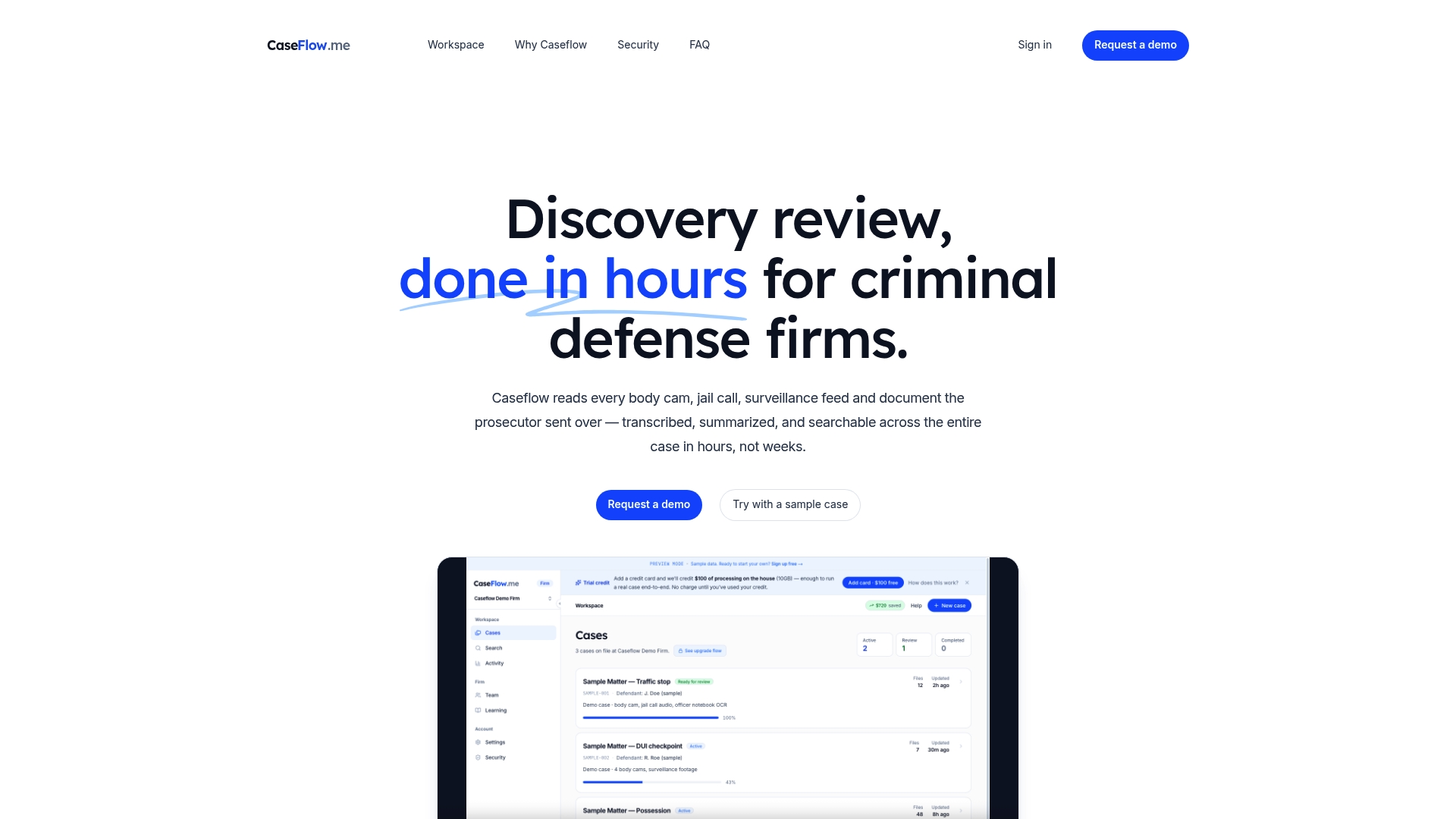
Caseflow is built specifically for criminal defense attorneys who need audit log management and discovery compliance in one place. The platform's Brady-trail audit log tracks every action taken on case files, creating a tamper-evident record that satisfies disclosure obligations and supports legal hold requirements. Caseflow combines transcription, summarization, and searchable entity extraction so attorneys can retrieve specific log events in hours rather than weeks. For legal teams that need to demonstrate discovery transparency in court, Caseflow provides the documented, accessible audit trail that compliance requires. Explore Caseflow's AI tools to see how the platform fits your retention and compliance workflow.
FAQ
How long should audit logs be retained for legal compliance?
Retention periods depend on the applicable framework: HIPAA requires 6 years, SOX requires 7 years, and PCI DSS requires 12 months. Organizations subject to multiple frameworks should apply the longest period to satisfy all requirements.
What makes an audit log legally defensible?
A defensible audit trail captures identity, timestamp, action, object, version, context, and integrity proof for every recorded event. Cryptographic integrity methods like hash chains or digital signing are now the standard auditors expect.
What happens if you delete logs during a legal hold?
Deleting logs after litigation is anticipated constitutes spoliation and can result in court sanctions, adverse inference instructions, or case-dispositive penalties. Automated deletion must be suspended immediately when a legal hold is triggered.
How quickly must audit logs be accessible for compliance?
Auditors reconstruct events within 30 minutes during compliance tests. Logs stored in cold or archive tiers with 24–48 hour retrieval times fail this requirement. At least 3 months of logs must be in hot, instantly queryable storage.
Does GDPR conflict with long audit log retention periods?
GDPR requires purpose-based retention and data minimization, which creates tension with SOX and HIPAA's longer retention floors. Legal teams must document a specific processing purpose for each log category and review that justification annually to remain compliant under both frameworks.