
Discovery transparency in court is defined as the complete, timely, and documented disclosure of all materials, methodologies, and processes used during the discovery phase of litigation. Courts in 2026 treat transparency not as a courtesy but as a procedural obligation with real consequences for noncompliance. From Rule 26 expert disclosures to the Tennessee Supreme Court's recent sealing standards, the bar for what counts as sufficient openness has risen sharply. Criminal defense attorneys and civil litigators alike must now account for AI-generated materials, audit trails, and methodology documentation as core components of any credible discovery record.
How do you demonstrate discovery transparency in court?
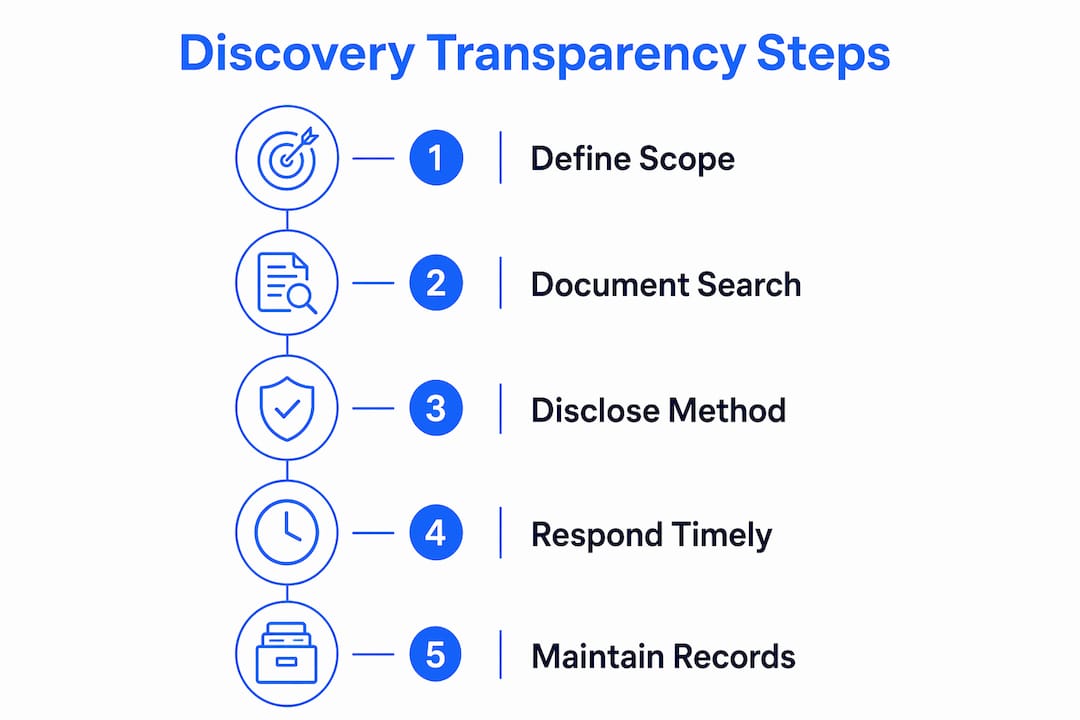
Demonstrating discovery transparency in court means producing a clear, documented record of what you collected, how you filtered it, and what you disclosed. Courts do not reward good intentions. They reward paper trails.
The court discovery process operates under strict procedural rules. Under Pa.R.C.P. 4014, parties must respond within 30 days or risk having unanswered requests deemed admitted. That deadline is not a suggestion. Missing it triggers motions to compel, sanctions under Rule 37, and in serious cases, evidence exclusion.

Transparency in court cases also means disclosing your methodology, not just your documents. A production that dumps 50,000 files without a data dictionary or hit count report signals nothing about completeness. Courts and opposing counsel will question it. Proactive disclosure of your process is what separates defensible production from a discovery dispute waiting to happen.
The importance of court transparency has been reinforced at the highest judicial levels. The Tennessee Supreme Court ruled in 2026 that trial courts must articulate specific compelling interests before sealing judicial records. That ruling establishes a strong presumption of openness. It signals that courts across the country are moving toward requiring explicit findings rather than accepting broad confidentiality claims.
What legal standards govern transparency in discovery?
The legal framework for discovery transparency is built on federal and state rules that set deadlines, define scope, and prescribe consequences for failure.
Core rules every litigator must know:
- Rule 26(a): Requires initial disclosures of witnesses, documents, and damages computations without waiting for a formal request.
- Rule 26(b): Defines the scope of discoverable material, including expert methodology. Courts now treat AI prompts used by experts as falling within this scope.
- Rule 37: Authorizes sanctions for failure to comply with discovery obligations, including adverse inference instructions and dismissal.
- Pa.R.C.P. 4014: Mandates 30-day responses to requests for admission. Silence equals admission.
- Local AI standing orders: Many federal districts have issued standing orders requiring disclosure of AI-generated materials. These complement general disclosure rules and must be checked separately.
"Transparency is a procedural requirement, not a mere aspirational principle, as courts increasingly demand explicit findings for secrecy." — Tennessee Supreme Court, 2026
The 2026 Tennessee Supreme Court ruling on judicial records goes further than prior standards. It requires that sealing orders protect only the necessary portions of a record and be narrowly tailored to the specific interest at stake. Broad confidentiality motions that fail to identify a compelling interest will not survive scrutiny. That standard is already influencing how trial courts in other jurisdictions evaluate sealing requests.
Failure to meet these standards carries compounding costs. A motion to compel costs time and credibility. Sanctions cost money. Evidence exclusion can cost the case. The legal discovery guidelines in place today leave little room for ambiguity about what courts expect.
How have 2026 rulings changed expert witness and AI disclosures?
The most significant shift in discovery transparency in 2026 involves AI. Courts now treat AI prompts used by expert witnesses as discoverable methodology, not protected draft notes.
In Conservation Law Foundation, Inc. v. Shell Oil Company, Magistrate Judge Farrish ordered production of AI prompts by June 1, 2026. The court rejected arguments that those prompts fell outside Rule 26(b) or were shielded by Rule 29 agreements. That ruling is a direct signal to every litigator using AI tools in expert preparation: the prompts are part of the methodology, and the methodology is discoverable.
The court's reasoning is straightforward. AI prompts are discoverable expert methodology, not protected draft notes, because they shape the expert's analysis and conclusions. Opposing counsel has a legitimate interest in understanding how an expert reached their opinion. If AI was part of that process, the inputs are fair game.
Here is what this means practically for counsel:
- Retain with disclosure in mind. When you retain an expert who will use AI tools, build disclosure planning into the retention conversation. Decide upfront which AI tools will be used and document that decision.
- Create an AI methodology log. Track every prompt submitted to a generative AI tool as part of expert work. Date it, label it, and store it with the case file.
- Draft explicit Rule 29 agreements. If you want to attempt protection of AI-generated materials, the agreement must be quite clear in its scope. Vague language will not hold up.
- Check local AI standing orders. General disclosure rules do not cover every jurisdiction's requirements. Local AI standing orders must be reviewed alongside Rule 26 to avoid a disclosure gap.
- Disclose proactively in expert reports. Include a section in every expert report identifying AI tools used, the nature of their use, and the prompts submitted if they influenced the analysis.
Pro Tip: Litigators should plan AI prompt disclosure at the moment of expert retention, not after a motion is filed. Retroactive disclosure looks reactive and damages credibility with the court.
The AI in the courtroom trend is accelerating. Courts are not waiting for legislation to catch up. They are applying existing discovery rules to new technology and expecting counsel to do the same.
What are the best practices for documenting discovery transparency?
Effective documentation is the foundation of any defensible discovery record. The goal is to show the court and opposing counsel exactly what you did, why you did it, and what the results were.
| Documentation Method | Purpose | When to Use |
|---|---|---|
| Data dictionary | Defines search terms, custodians, and data sources | At the start of ESI collection |
| Hit count reports | Shows volume of results per search term | During meet and confer negotiations |
| Chain of custody log | Tracks handling of physical and digital evidence | Throughout collection and review |
| AI methodology log | Records prompts and tools used by experts | Whenever AI tools assist expert analysis |
| Filtering methodology memo | Explains deduplication, date ranges, and exclusions | Before finalizing production |
Proactive ESI documentation prevents the most common discovery disputes. Modern conflicts often arise not from bad faith but from perceptions of opacity. When opposing counsel cannot see how you filtered your data, they assume the worst. A hit count report shared early in the meet and confer process eliminates that assumption.
Technology platforms that support discovery action tracking give legal teams a structural advantage. Audit logs that record every action taken on a case file create an automatic transparency record. You do not have to reconstruct your process from memory when a dispute arises. The log speaks for itself.
Pro Tip: During meet and confer, share your search term hit counts before opposing counsel asks. It signals good faith and often prevents a formal motion to compel.
Standard discovery responses should also include explicit language about what was searched, what was excluded, and why. A response that says "all responsive documents have been produced" without methodology context is technically compliant but practically vulnerable. Courts and opposing counsel will probe it. A response that describes your collection scope, filtering criteria, and review process is far harder to challenge.
For automated discovery workflows, the documentation requirements are the same. Automation does not reduce your disclosure obligations. It shifts them. You must now document the parameters of your automated process with the same rigor you would apply to a manual review.
How do you handle discovery transparency disputes in court?
Discovery disputes over transparency fall into three categories: incomplete production claims, AI disclosure gaps, and sealing requests. Each requires a different response strategy.
Incomplete production claims arise when opposing counsel believes you have withheld responsive documents. The best defense is a documented collection methodology. If you can show your search terms, custodians, date ranges, and review criteria, you can demonstrate that your production was complete within a defined and reasonable scope. Without that documentation, you are arguing intent rather than process.
AI disclosure gaps are the newest and fastest-growing category of transparency disputes. Courts face a disclosure gap when AI-generated demonstratives are introduced without showing the creation methodology. If you use AI to generate a chart, a timeline, or an analysis for trial, you must be prepared to disclose how it was created. Local standing orders may require this disclosure before the exhibit is admitted.
Sealing requests require the most careful handling in 2026. The Tennessee Supreme Court's ruling means that a motion to seal must identify a specific compelling interest, explain why that interest outweighs the public's right of access, and request only the narrowest possible restriction. A blanket confidentiality designation will not satisfy that standard.
Practical steps for managing transparency disputes:
- Document every meet and confer communication in writing. Confirm agreements by email immediately after any call.
- When you identify a gap in your own production, supplement promptly and notify opposing counsel in writing with an explanation.
- If opposing counsel raises a methodology dispute, respond with your documentation first. Do not wait for a motion to compel to produce your process records.
- For sealing motions, prepare a specific factual record supporting the compelling interest. Judicial records transparency rulings require courts to resist broad sealing claims, so your motion must be precise.
Key takeaways
Demonstrating discovery transparency in court requires documented methodology, timely disclosure, and proactive compliance with both general rules and AI-specific standing orders.
| Point | Details |
|---|---|
| Transparency is procedural | Courts require explicit findings and documented processes, not just good-faith assertions. |
| AI prompts are discoverable | Expert AI inputs fall under Rule 26(b); plan disclosure at the moment of expert retention. |
| Documentation prevents disputes | Hit count reports, data dictionaries, and audit logs resolve most transparency challenges before they reach a judge. |
| Sealing requires specificity | Post-2026 standards demand narrowly tailored orders with compelling interest findings, not broad confidentiality claims. |
| Local rules matter | AI standing orders vary by jurisdiction and must be checked alongside federal disclosure rules. |
Discovery transparency is shifting faster than most firms realize
I have watched discovery practice evolve for years, and the pace of change in 2026 is unlike anything I have seen before. The Conservation Law Foundation v. Shell Oil ruling did not create a new principle. It applied an existing one to a technology that most litigators assumed was invisible to opposing counsel. That assumption is now gone.
What strikes me most is how many legal teams still treat transparency as a defensive posture. They disclose what they must, when they must, and nothing more. That approach made sense when discovery was a paper exercise. It does not make sense when courts are actively looking for methodology gaps and opposing counsel knows exactly what questions to ask about AI tools.
The firms that will win discovery disputes in the next three years are the ones building transparency into their workflows from day one. Not because judges will reward them for it, but because a documented process is genuinely harder to attack. When you can show every search term, every custodian, every AI prompt, and every filtering decision, there is nothing left for opposing counsel to speculate about.
Transparency in court cases is also increasingly a public trust issue. First Amendment challenges to court secrecy are rising. Clients, journalists, and advocacy groups are pushing for openness in ways that affect how judges think about sealing requests. Staying ahead of that pressure means building a practice that defaults to disclosure rather than protection.
My advice: treat your discovery documentation as if it will be submitted to the court as an exhibit. Because in a dispute, it will be.
— Faisal
How Caseflow supports discovery transparency for defense teams
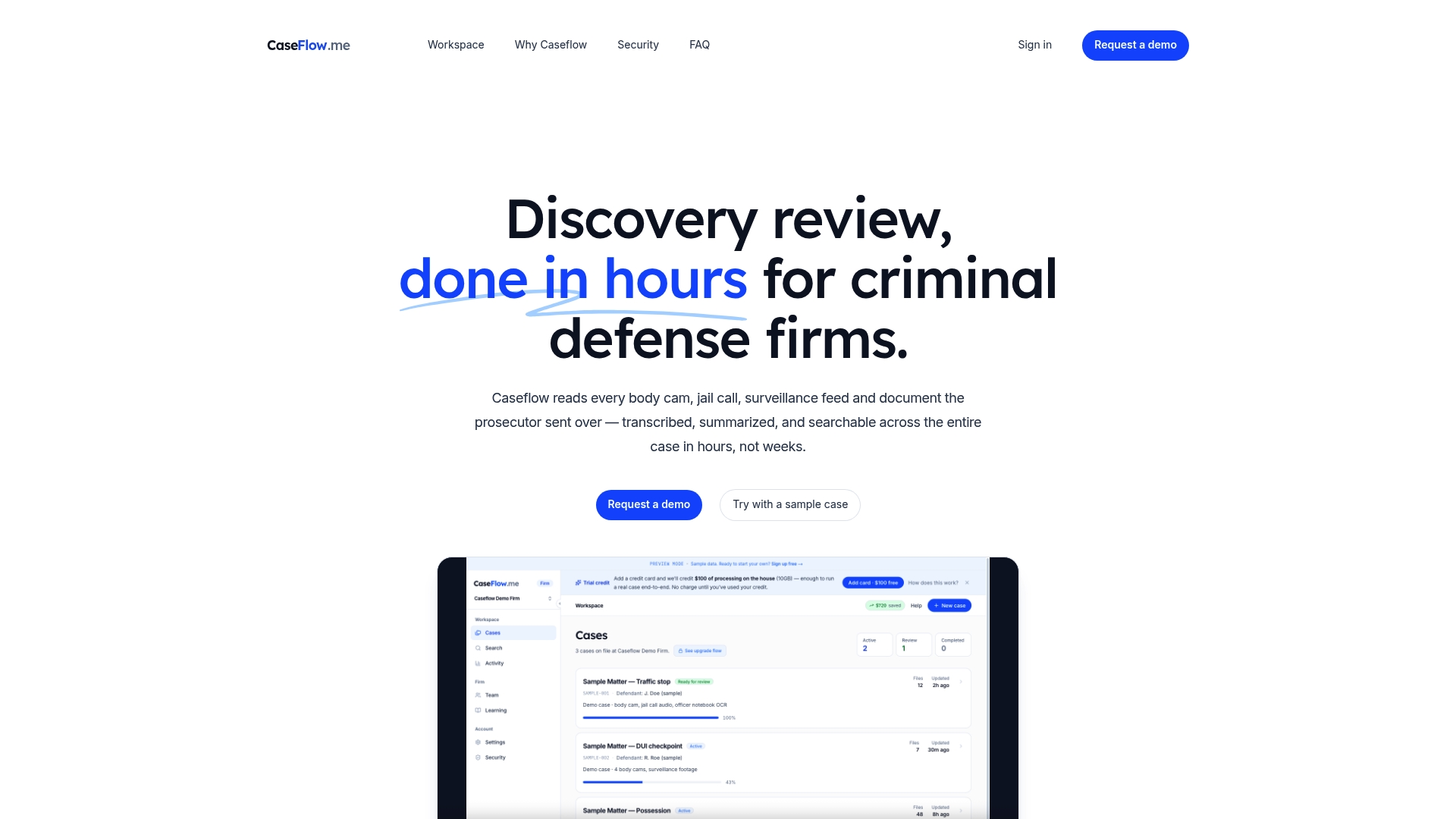
Caseflow is built specifically for criminal defense attorneys who need to move fast without sacrificing compliance. The platform's Brady-trail audit log tracks every action taken on a case file, creating an automatic transparency record that satisfies court documentation requirements without extra manual work. When a dispute arises over what was reviewed, when, and by whom, the audit log answers those questions immediately.
Caseflow combines transcription, summarization, and searchable entity extraction in one platform, reducing case file review from weeks to hours. For teams managing AI-assisted analysis, that speed comes with a built-in documentation trail. Explore Caseflow's discovery platform to see how it aligns your discovery workflow with the transparency standards courts now demand. For teams handling sensitive records, Caseflow's security and compliance features provide the protection your clients expect.
FAQ
What does it mean to demonstrate discovery transparency in court?
Demonstrating discovery transparency in court means producing documented proof of your collection methodology, search terms, filtering decisions, and disclosure timeline. Courts treat this documentation as evidence of good faith compliance with discovery obligations.
Are AI prompts used by expert witnesses discoverable?
Yes. In Conservation Law Foundation v. Shell Oil, a federal court ordered production of AI prompts as part of expert methodology under Rule 26(b). Courts do not treat AI prompts as protected draft notes.
What happens if you fail to meet discovery transparency requirements?
Failure to comply with discovery obligations can result in motions to compel, Rule 37 sanctions, adverse inference instructions, or evidence exclusion. Under Pa.R.C.P. 4014, unanswered requests for admission are deemed admitted after 30 days.
How do you handle a sealing request under 2026 standards?
A sealing motion must identify a specific compelling interest, explain why it outweighs public access rights, and request only the narrowest restriction. The 2026 Tennessee Supreme Court ruling requires trial courts to make explicit findings before granting any sealing order.
What documentation should every discovery response include?
Every discovery response should include a description of custodians searched, date ranges applied, search terms used, filtering methodology, and any exclusions made. For AI-assisted review, include an AI methodology log identifying tools used and prompts submitted.