
Discovery action tracking is the systematic process of capturing and auditing every action taken on discovery requests, evidence materials, and case files in legal proceedings. For criminal defense attorneys and compliance officers, this audit trail is not optional. It is the operational backbone of defensible discovery practice, protecting firms from sanctions under Federal Rule of Civil Procedure 37 and providing transparent records that courts and opposing counsel can scrutinize. Tools range from basic spreadsheets to purpose-built eDiscovery platforms like Venio One, and the gap between them matters more than most teams realize.
What is discovery action tracking and why does it matter?
Discovery action tracking is defined as the organized, attributable recording of every step taken during the discovery process, including who accessed a file, what action was performed, and when it occurred. Think of it as a living audit log that follows every piece of evidence from collection through production. This is distinct from simply knowing that documents exist. It answers the harder question: what did your team do with them, and can you prove it?
Discovery tracking involves organized records of discovery requests, responses, and produced information, managed through spreadsheets or cloud eDiscovery systems. That definition captures the what, but the why is where legal professionals need to pay close attention. Courts do not just want to know that discovery happened. They want to see a defensible operational record showing that your team followed proper procedures at every stage.

The importance of discovery tracking becomes concrete when sanctions enter the picture. Rule 37 mandates certification of good faith efforts and imposes penalties for noncompliance, including fee shifts and evidentiary sanctions. A well-maintained action tracking system is your first line of defense against those outcomes. Without it, you are arguing intent without evidence.
How does discovery action tracking fit into the broader discovery tracking process?
Discovery action tracking sits inside a larger discovery tracking process that manages requests, responses, custodians, and produced materials across the full lifecycle of a case. Understanding where action tracking fits, and where it differs from related concepts, prevents costly operational gaps.
Discovery tracking systems differ from docketing by focusing on operational, workflow-based records rather than solely formal legal events. Docketing records court filings and deadlines in a chronological case register. Discovery action tracking records what your team did operationally: which custodian's files were collected, which reviewer approved a privilege call, which documents were produced and when. These are two separate records serving two separate purposes, and conflating them creates blind spots in both.
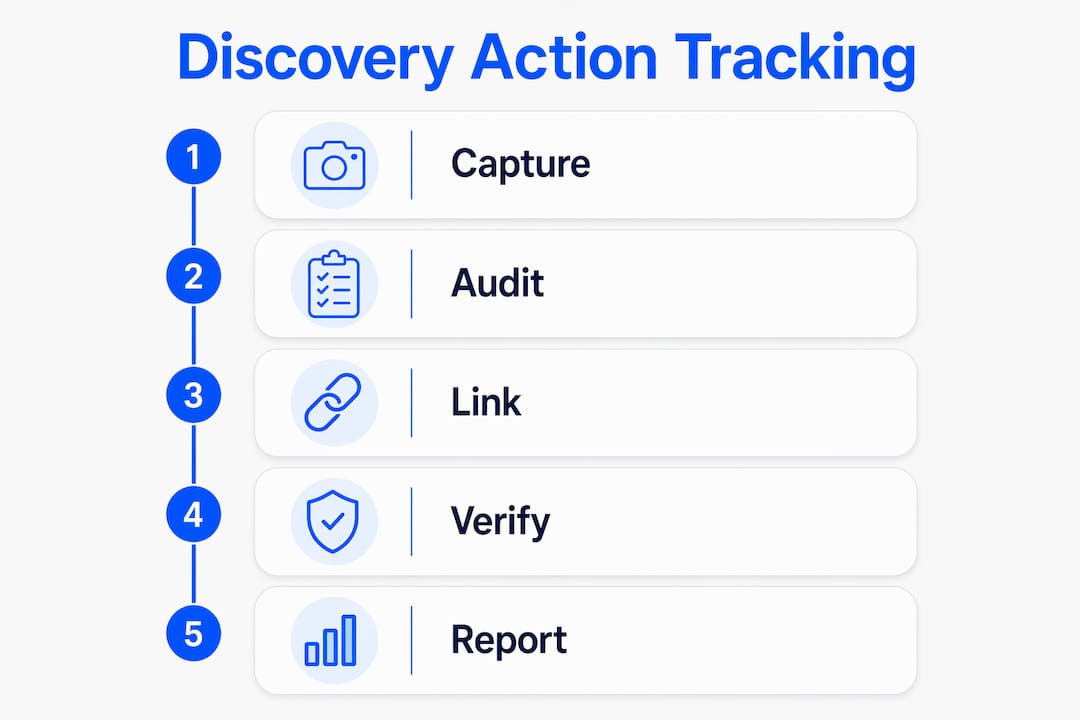
The core function of action tracking within the discovery workflow breaks down into four categories:
- Collection records: Who authorized collection, from which custodians, on what date, and using what method.
- Processing records: What transformations were applied to electronically stored information (ESI), including format conversions and deduplication decisions.
- Review records: Who reviewed each document, what coding decisions were made, and whether any privilege assertions were logged.
- Production records: What was produced, to whom, in what format, and under which court order or agreement.
Workflow tasks mapped to tracking identifiers give teams control over the discovery process, though schemas vary across firms. The firms with the most defensible records are those that standardize their schema early and apply it consistently across every matter.
What tools are used for discovery action tracking, and how do they compare?
Legal teams have two primary options for managing the discovery tracking process: spreadsheets and purpose-built eDiscovery platforms. Both work. Neither works equally well at scale.
Spreadsheets are common but less efficient for ESI workflows than dedicated eDiscovery platforms. A spreadsheet can capture basic request and response logs, but it cannot automatically timestamp user actions, enforce access controls, or link a log entry to the underlying document ID. When a court asks you to demonstrate chain of custody for 50,000 documents, a spreadsheet becomes a liability rather than a record.
Purpose-built platforms like Venio One offer integrated collection, processing, audit trails, and compliance capabilities within a single environment. Cloud eDiscovery platforms represent the future standard for scalable, compliant discovery workflows over traditional spreadsheet logs. That shift is already underway at larger firms, and compliance officers at smaller practices are increasingly expected to follow.
| Feature | Spreadsheets | eDiscovery Platforms |
|---|---|---|
| Audit trail automation | Manual entry only | Automated, timestamped logs |
| ESI scalability | Limited, error-prone | Handles large ESI volumes natively |
| Compliance support | No built-in Rule 37 alignment | Designed for defensible discovery |
| Object-level linkage | Requires manual mapping | Links actions to document and custodian IDs |
| Access attribution | Not enforced | Role-based access with user attribution |
| Cost at small scale | Low | Higher upfront, lower risk cost |
Pro Tip: When evaluating any eDiscovery platform, ask specifically whether audit logs link to underlying discovery objects like custodian IDs and document IDs. A platform that logs actions without object-level linkage creates an audit trail that courts cannot easily verify.
Linking audit logs to discovery objects with attributed access records is critical for traceability. Without that linkage, your logs become a list of events disconnected from the actual evidence, which is nearly as problematic as having no log at all.
Why is discovery action tracking critical for legal compliance and avoiding sanctions?
The compliance stakes around discovery action tracking are not theoretical. Rule 37 sanctions for discovery failures include expense awards, adverse inference instructions, and in severe cases, case-dispositive penalties. The difference between a team that faces sanctions and one that does not often comes down to the quality of their action records.
Detailed records of who did what and when aid in demonstrating required steps were taken and defend against disputes or sanctions. Courts look for evidence of good faith. A timestamped, attributed audit trail showing that your team collected from the right custodians, reviewed with appropriate protocols, and produced on schedule is the most direct way to demonstrate that good faith.
Common gaps that expose firms to compliance risk include:
- Undocumented privilege assertions: Logging that a document was withheld without recording who made the privilege call and under what legal basis.
- Missing re-review records: When documents are re-reviewed after an initial coding decision, the original and revised decisions must both appear in the log.
- Unattributed access: Logs that show a document was accessed but not by whom, which undermines chain of custody arguments.
- Incomplete non-production records: Failing to document why specific documents were not produced is as risky as failing to document what was produced.
"Compliance teams proactively track productions, non-productions, privilege assertions, and re-review decisions to demonstrate consistent legal application and avoid sanctions." Comprehensive tracking across the document lifecycle prepares teams for challenges under discovery rules.
Proactive tracking of exceptions and non-productions supports consistent application of discovery standards and readiness for sanctions challenges. This is the practice that separates firms that survive discovery disputes from those that do not.
How to use discovery action tracking to optimize workflows and case outcomes
Building an effective discovery action tracking system requires structure from the start of a matter, not as a retroactive cleanup exercise. The following steps reflect how experienced compliance officers approach implementation.
- Define your tracking schema before collection begins. Decide which workflow events require a log entry, what data fields each entry must contain, and how entries link to discovery objects like custodian IDs, matter numbers, and document IDs.
- Assign clear ownership for each action category. Action item tracking with clear owners and deadlines prevents action loss and supports follow-up. Apply the same principle to discovery logs: every logged action must have an attributed user, not a shared team account.
- Automate timestamping wherever possible. Manual timestamps are vulnerable to error and challenge. Platforms that auto-generate timestamps at the moment of action remove that vulnerability entirely.
- Build audit trails around discrete workflow events, not just documents. Practitioners build discovery audits around discrete process events, enabling clear answers to questions about custodianship and approvals. Logging that a document exists is not the same as logging that it was collected, processed, reviewed, and produced through documented steps.
- Review tracking logs at defined intervals during active matters. Weekly log reviews during active discovery catch gaps before they become sanctions risks. Assign a compliance officer or senior paralegal to flag incomplete entries and resolve them within 48 hours.
Pro Tip: Integrate your discovery action tracking directly into your digital discovery workflow from day one of a matter. Retrofitting a tracking system after collection has begun almost always leaves gaps in the early-stage records that are the hardest to reconstruct.
AI-powered platforms like Caseflow take this further by automating attribution, generating Brady-trail audit logs, and making every action on a case file searchable and retrievable. That level of automation is where the field is heading, and teams that adopt it now build a structural compliance advantage over those still relying on manual logs. You can also review types of legal compliance audit logs to understand which log formats courts find most defensible.
Key takeaways
Discovery action tracking is the single most defensible practice a legal team can implement to protect against Rule 37 sanctions and demonstrate good faith in discovery disputes.
| Point | Details |
|---|---|
| Core definition | Discovery action tracking records who did what and when across every stage of the discovery lifecycle. |
| Compliance protection | Detailed audit trails are the primary defense against Rule 37 sanctions and adverse inference instructions. |
| Tool selection matters | Purpose-built eDiscovery platforms outperform spreadsheets for ESI scale, attribution, and object-level linkage. |
| Schema first | Define your tracking schema before collection begins to avoid retroactive gaps in early-stage records. |
| Automate attribution | Automated timestamping and user attribution remove the manual error risk that courts scrutinize most. |
Why most legal teams are still underestimating this
I have reviewed discovery workflows at firms ranging from solo criminal defense practices to mid-size litigation teams, and the pattern is consistent. Teams treat discovery action tracking as a documentation task rather than a compliance infrastructure decision. They build their logs after the fact, assign them to the most junior person on the team, and then wonder why they cannot reconstruct a clean chain of custody when opposing counsel challenges their production.
The shift from spreadsheets to cloud eDiscovery platforms is not primarily about efficiency. It is about the quality of the record you can produce under pressure. A spreadsheet log that took 20 hours to maintain manually will not hold up the same way as an automated audit trail that captured every action at the moment it occurred, attributed to a specific user, linked to a specific document ID.
What I find most underappreciated is the non-production record. Most teams log what they produce. Far fewer log what they chose not to produce and why. That gap is exactly where sanctions motions find their footing. The firms I have seen navigate discovery disputes most effectively are the ones that treat every withholding decision as a logged, attributed, reviewable event, not a judgment call that lives only in someone's memory.
The next wave of improvement in this space will come from AI tools that not only log actions but flag anomalies in real time. When a reviewer codes 200 documents as privileged in a single session without any supervisory review, an intelligent system should surface that for oversight. That capability exists today in platforms built specifically for legal workflows, and it will become a baseline expectation within the next few years.
— Faisal
See how Caseflow handles discovery action tracking
Caseflow is built specifically for criminal defense attorneys who need more than a document repository. The platform's Brady-trail audit log automatically records every action taken on case files, with full user attribution and timestamps, so your compliance record builds itself as your team works. Transcription, summarization, and searchable entity extraction all feed into a single integrated environment, cutting case file review from weeks to hours. If your current discovery tracking process relies on manual logs or disconnected spreadsheets, Caseflow's AI platform gives you the audit infrastructure that courts expect and opposing counsel cannot easily challenge. Request a demo and see the difference a purpose-built audit trail makes.
FAQ
What is discovery action tracking in legal cases?
Discovery action tracking is the systematic recording of every action taken on discovery materials, including who accessed, reviewed, coded, or produced each item and when. It creates an attributable audit trail that supports compliance with court-ordered discovery obligations.
How does discovery action tracking differ from docketing?
Docketing records formal court filings and case deadlines in a chronological register. Discovery action tracking focuses on operational workflow records, capturing what your team did with evidence and discovery materials rather than what was filed with the court.
What are the risks of poor discovery action tracking?
Inadequate tracking exposes legal teams to sanctions under Federal Rule of Civil Procedure 37, including expense awards and adverse inference instructions. Courts interpret gaps in audit trails as evidence of bad faith or noncompliance.
Can spreadsheets handle discovery action tracking effectively?
Spreadsheets work for basic request and response logs but fail at scale with ESI workflows. They cannot enforce access attribution, auto-generate timestamps, or link log entries to underlying document and custodian IDs the way purpose-built eDiscovery platforms can.
What should a discovery action tracking log always include?
Every log entry should record the specific action taken, the attributed user, a system-generated timestamp, and a link to the relevant discovery object such as a custodian ID, document ID, or matter number. Entries for non-productions must also include the legal basis for withholding.