
Affordable discovery software is defined as AI-powered legal technology that delivers document review, evidence organization, and case management capabilities at subscription costs significantly below traditional commissioned search services. The benefits of affordable discovery software extend far beyond price: AI-driven tools reduce first-pass review time from 10 to 30 hours down to under 10 minutes per matter, at monthly subscription costs between $1,000 and $5,000 compared to the $5,000 to $20,000 per-matter fees charged by traditional providers. For criminal defense attorneys and public defenders operating under tight budgets, this shift is not incremental. It is the difference between spending two weeks buried in discovery files and walking into court fully prepared in hours. Platforms like Caseflow have made this level of capability accessible without the enterprise price tag that once reserved AI-powered review for large firms.
1. Benefits of affordable discovery software: cost savings that change your practice
The most direct advantage of cost-effective discovery software is the reduction in document review labor costs. AI-powered discovery tools generate a 285% ROI, cutting review costs from $487,000 to $156,000 per major case in documented case studies. That figure means a solo defense attorney or small public defender office can redirect tens of thousands of dollars annually toward client services, expert witnesses, or simply financial sustainability.
Associate review time drops by 68% when AI handles first-pass document triage. That is not a marginal efficiency gain. It means your associates spend their hours on legal strategy rather than reading through irrelevant police reports. For public defenders managing caseloads that would overwhelm most private firms, this reallocation is not optional. It is survival.

2. Speed of document review: from weeks to hours
Manual discovery review at a typical reading pace takes between 10 and 30 hours per matter for a senior attorney. Mid-tier AI discovery tools with semantic search compress that same task to under 10 minutes. The mechanism is semantic search combined with citation graph features that surface relevant evidence clusters rather than forcing you to read every document sequentially.
This speed advantage compounds across a full caseload. If you handle 40 active cases, cutting review time from 20 hours to 10 minutes per matter frees roughly 780 hours annually. That is nearly 20 full work weeks returned to case strategy, client communication, and court preparation. The value of inexpensive discovery software, measured in recovered attorney time, dwarfs the subscription cost in almost every realistic scenario.
Pro Tip: When evaluating any discovery platform, ask the vendor to demonstrate semantic search on a real evidence set from your practice area. Generic demos using clean, well-formatted documents do not reflect the messy audio files, handwritten notes, and multi-language materials that criminal defense work actually involves.
3. Accuracy improvements that protect your clients
Speed without accuracy is dangerous in criminal defense. AI-enhanced review achieves 94.2% accuracy, outperforming fatigued human reviewers working through large document sets under time pressure. Higher accuracy means fewer missed Brady materials, fewer overlooked exculpatory statements, and a lower risk of procedural errors that can damage a case.
Accuracy also matters for compliance. Quality affordable discovery software supports compliant electronic stored information retention and reduces data breach risks, which is a real liability concern when handling sensitive client files. A platform that combines speed with audit logging gives you both efficiency and the documentation trail that protects you professionally.
4. How affordable tools compare with traditional and premium options
The pricing gap between affordable and premium discovery platforms is substantial, but the feature gap has narrowed considerably. The table below summarizes the key differences you should weigh before selecting a platform.
| Factor | Affordable AI platforms | Traditional/premium tools |
|---|---|---|
| Monthly cost | $1,000 to $5,000 per matter | $5,000 to $20,000 per matter |
| First-pass review speed | Under 10 minutes | 10 to 30 hours |
| AI semantic search | Included in mid-tier plans | Often add-on or enterprise-only |
| Integrated workflow | Available in unified platforms | Frequently fragmented |
| ROI documented | Up to 285% | Variable, often lower |
| Compliance features | Included in quality platforms | Included but at higher cost |
The critical distinction is not price alone. Integration friction costs from fragmented tools often cancel out the savings from low-cost subscriptions. A $500 per month tool that requires manual data transfer between three separate applications costs more in attorney time than a $2,000 per month unified platform. This is the core argument for choosing consolidated discovery environments over piecemeal budget solutions.
Pro Tip: Before signing any contract, map every step of your current discovery workflow and identify where data moves between tools. Each handoff point is a potential integration friction cost. A platform that eliminates those handoffs pays for itself faster than its subscription price suggests.
5. Total cost of ownership: what the subscription price does not tell you
Total cost of ownership includes hidden costs like data migration, staff training, and productivity loss during transition. License fees are the most visible expense, but they are rarely the largest. A platform that charges $1,500 per month but requires 40 hours of staff training and two weeks of reduced productivity during onboarding has a real first-year cost that looks nothing like its advertised price.
Calculate TCO across at least 12 months before comparing platforms. Include migration time for existing case files, the learning curve for your team, and any support costs not covered by the base subscription. For digital discovery workflow setup, platforms with intuitive interfaces and dedicated onboarding support consistently deliver faster time to value than cheaper tools with poor documentation.
6. Compliance and audit trail features you cannot skip
Criminal defense work carries specific compliance obligations that generic document review tools do not address. Brady disclosure requirements, chain of custody documentation, and evidence handling protocols all require a verifiable record of who accessed what and when. Affordable discovery software that includes a built-in audit log is not a luxury. It is a professional necessity.
Caseflow's Brady-trail audit log tracks every action taken on case files, creating a transparent record that protects attorneys during disclosure disputes. This feature, built into the platform rather than sold as an add-on, represents exactly the kind of value that separates purpose-built legal discovery tools from repurposed general document management software. You can learn more about how these systems work in practice by reviewing types of legal compliance audit logs.
7. Multi-language support and audio preservation
Public defenders and criminal defense attorneys in urban jurisdictions routinely handle evidence in Spanish, Mandarin, Vietnamese, Haitian Creole, and dozens of other languages. Discovery software that processes only English documents creates a two-tier system where non-English evidence gets reviewed later, less carefully, or not at all. That is a case preparation failure waiting to happen.
Platforms that combine transcription with original audio preservation solve this problem directly. You get a searchable text record for fast review while retaining the source audio for accuracy verification and court use. This combination is particularly valuable when witness credibility depends on tone, pacing, or specific word choice that a transcript alone cannot capture.
8. Accessibility for small firms and public defender offices
Small law firms benefit most from AI-enhanced discovery through shared platforms or cloud-based services, particularly when processing fewer than 15 cases annually. Cloud delivery eliminates the infrastructure costs that once made enterprise discovery tools inaccessible to solo practitioners and small public defender offices. You pay for what you use rather than maintaining servers, IT staff, and software licenses that sit idle between major cases.
The accessibility of discovery software at this price point has fundamentally changed what a two-attorney defense practice can accomplish. The same AI capabilities available to a 200-attorney firm are now within reach for a public defender handling 80 cases with one paralegal. That democratization of technology is the most underappreciated advantage of the current market.
9. Freeing attorney time for higher-value work
The strategic benefit of automated discovery for legal professionals is not just speed. It is the reallocation of attorney cognition toward work that actually requires legal judgment. Document triage, transcript review, and evidence cataloging are necessary but cognitively routine tasks. AI handles them faster and more consistently than humans. That frees you to focus on witness preparation, motion strategy, and client counseling.
This reallocation has a measurable impact on case outcomes. Attorneys who spend less time on mechanical review spend more time identifying the legal theory that wins. For public defenders with caseloads that make thorough preparation feel impossible, affordable AI discovery tools are not a convenience. They are the mechanism that makes competent representation achievable.
10. Practical selection criteria for defense-focused practices
Choosing the right platform requires matching features to your actual workflow rather than selecting based on price alone. The following criteria apply specifically to criminal defense and public defense contexts.
- Unified workflow: The platform must handle transcription, summarization, and entity extraction in one environment. Fragmented tools impose the integration friction costs that erase savings.
- Semantic search: The ability to search by concept rather than exact keyword surfaces relevant evidence that keyword search misses entirely.
- Audit logging: Brady compliance requires a documented chain of custody for all evidence interactions. This feature must be native, not an add-on.
- Multi-language support: Any jurisdiction with a diverse population requires this capability. Verify it works on your specific language pairs before committing.
- Transparent pricing: Avoid platforms with per-document or per-page pricing models that make costs unpredictable across varying case sizes.
- Vendor support quality: Proper AI implementation requires change management and ongoing quality assurance. A vendor that disappears after onboarding creates long-term risk.
Pro Tip: Request a pilot on two or three of your actual pending cases before committing to any platform. Vendors who refuse pilots on real case data are signaling that their tool performs better on demos than in practice.
Key takeaways
Affordable discovery software delivers measurable ROI, faster review, and compliance-grade features that criminal defense attorneys and public defenders can access today without enterprise budgets.
| Point | Details |
|---|---|
| Cost savings are documented | AI discovery tools reduce review costs by up to 68% in associate time and deliver 285% ROI in case studies. |
| Speed transforms caseload capacity | First-pass review drops from 10 to 30 hours to under 10 minutes, returning hundreds of billable hours annually. |
| Integration friction erases cheap savings | Fragmented low-cost tools cost more in attorney time than unified platforms at higher subscription prices. |
| Compliance features are non-negotiable | Audit logs and evidence chain-of-custody tracking must be native to the platform, not purchased separately. |
| TCO beats sticker price every time | Calculate migration, training, and transition costs across 12 months before comparing platforms on price alone. |
Why I think most defense attorneys are still leaving money on the table
I have watched legal technology conversations in criminal defense circles focus almost entirely on whether a firm can afford AI discovery tools. That framing is backwards. The real question is whether you can afford not to use them. When a platform cuts document review from 20 hours to 10 minutes, the cost of the subscription is recovered on the first case. Every subsequent case is pure efficiency gain.
The attorneys I see getting the most value from affordable discovery software share one habit: they treat the platform as infrastructure, not a trial tool. They invest time upfront in learning semantic search, configuring entity extraction for their case types, and training their staff on the workflow. The attorneys who get poor results are the ones who buy a subscription, use it like a search engine, and wonder why it did not change anything.
There is also a false economy trap worth naming directly. The cheapest discovery tools on the market are cheap because they lack integrated workflows. You end up paying a paralegal to manually move data between a transcription service, a document viewer, and a case management system. That labor cost is invisible in the software budget but very visible in your overhead. A unified platform at twice the price of three separate tools almost always costs less in total.
The attorneys who will define criminal defense practice in 2026 and beyond are the ones who treat AI discovery as a core competency rather than a vendor relationship. That starts with choosing a platform built specifically for defense work, not a general document tool with a legal skin on it.
— Faisal
How Caseflow delivers affordable AI discovery for criminal defense
Caseflow is built specifically for criminal defense attorneys who need AI-powered discovery without the enterprise price tag. The platform combines transcription, summarization, and searchable entity extraction in one environment, eliminating the integration friction that undermines cheaper fragmented tools.
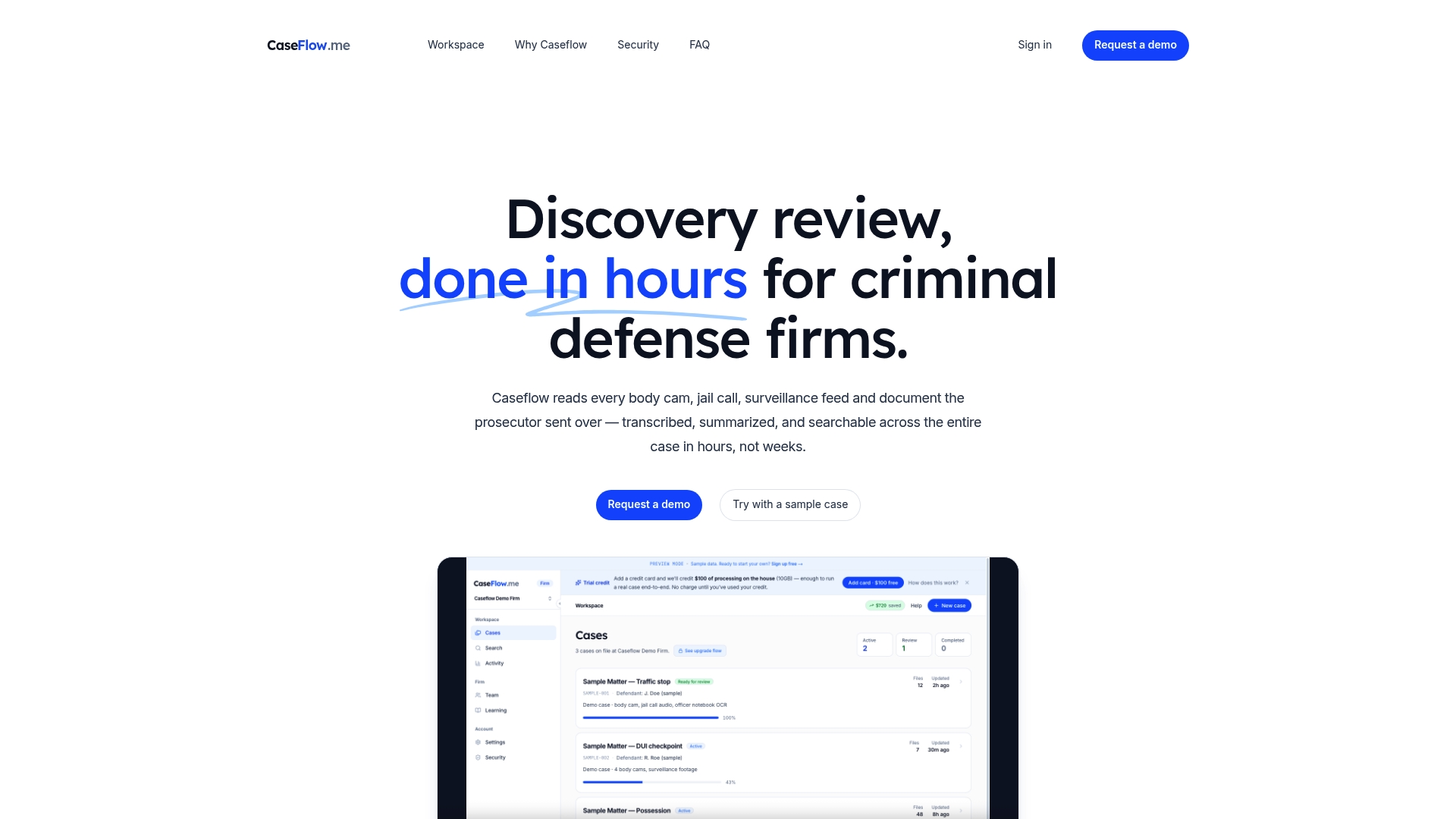
The Brady-trail audit log tracks every action on every case file, giving you the compliance documentation that Brady disclosure requires without manual record-keeping. Multi-language support preserves original audio while delivering searchable transcripts, so non-English evidence gets the same rigorous review as everything else in your case file. If you are ready to see what AI-powered criminal defense looks like in practice, Caseflow is the place to start. The platform is designed to reduce discovery time from weeks to hours, and the pricing reflects what defense practices actually spend, not what large litigation firms budget.
FAQ
What are the main benefits of affordable discovery software?
Affordable discovery software reduces document review time from hours to minutes, cuts labor costs by up to 68%, and delivers AI-powered accuracy at subscription prices between $1,000 and $5,000 per month. The core advantages include semantic search, automated summarization, and compliance audit logging at a fraction of traditional commissioned search costs.
How does affordable discovery software handle compliance requirements?
Quality platforms include native audit logging that tracks all evidence interactions, supporting Brady disclosure obligations and chain-of-custody documentation. This feature must be built into the platform rather than purchased as a separate add-on to be cost-effective.
Is affordable discovery software suitable for public defenders with high caseloads?
Yes. Cloud-based AI discovery platforms are specifically well-suited for small teams and high-volume practices because they eliminate infrastructure costs and scale with caseload. Small firms and public defender offices benefit most from shared or cloud-based solutions, particularly when processing under 15 cases annually.
What hidden costs should I evaluate beyond the subscription price?
Total cost of ownership includes data migration, staff training, and productivity loss during the transition period. Evaluating these costs across a full 12-month period prevents underestimating the true investment and allows accurate comparison between platforms at different price points.
Why does integration matter when choosing a low-cost discovery tool?
Fragmented tools that require manual data transfer between applications impose integration friction costs that often cancel out subscription savings. A unified platform handling transcription, review, and case management in one environment consistently delivers higher ROI than three cheaper tools used in sequence.