
The role of AI in defense discovery is to accelerate evidence analysis, surface contradictions, and give defense attorneys a fighting chance against overwhelming case volumes. Criminal defense teams routinely receive thousands of hours of body-cam footage, jail calls, interrogation videos, and document dumps. Manual review of that volume is not just slow. It is structurally impossible within standard case timelines. Tools like JusticeText and generative AI review platforms have moved from experimental to operational, and the legal profession's standards for using them are catching up fast.
How AI enhances audiovisual and document review in defense discovery
AI's most concrete impact on criminal defense is in audiovisual evidence triage. AI transcription and search tools are now adopted by more than 70 public defense agencies and 300 private law firms, reducing review time from dozens of hours to just hours per case. That shift is not incremental. It changes what is actually reviewable before a hearing.
The core application is finding what would otherwise stay buried. AI identifies contradictions in body-cam footage, jail calls, and interrogation videos at timestamps that no manual reviewer could locate within a standard caseload timeline. A detective's statement in a police report may contradict what he says on body-cam at minute 47. AI finds that. A human reviewer working through 80 hours of footage probably does not.

Document review has followed a parallel track. Generative AI moved from novelty to regular use in defensive document discovery by early 2026, offering something traditional Technology Assisted Review (TAR) never could: narrative reasoning. TAR classifies documents as responsive or not. Generative AI explains why a document matters and how it connects to other evidence. That reasoning layer is what makes it useful for building defense theory, not just sorting files.
The practical workflow looks like this:
- Audiovisual triage: Upload body-cam footage, jail calls, and interrogation recordings. AI transcribes, timestamps, and makes the content searchable by keyword, speaker, or entity.
- Document review: Feed case files into a generative AI platform with a structured prompt. The system returns responsive documents with narrative summaries explaining relevance.
- Contradiction mapping: Run targeted queries across all evidence types to surface inconsistencies between witness statements, police reports, and recorded interactions.
- Brady material identification: Use AI to flag potential Brady disclosures that the prosecution may have buried in high-volume discovery dumps.
Pro Tip: Treat your AI search queries the same way you would treat deposition questions. Specific, narrow, and purposeful queries return far more useful results than broad keyword sweeps.
Learn more about how automated discovery workflows function in practice for criminal defense teams.
What evidentiary challenges does ai-generated evidence create?
AI does not just help review evidence. It is now producing evidence, and that creates a new category of legal problem. As of May 2026, legal teams must prepare for AI-generated work product entering motions and trials, requiring authentication and validation standards that existing evidentiary frameworks were not built to handle.
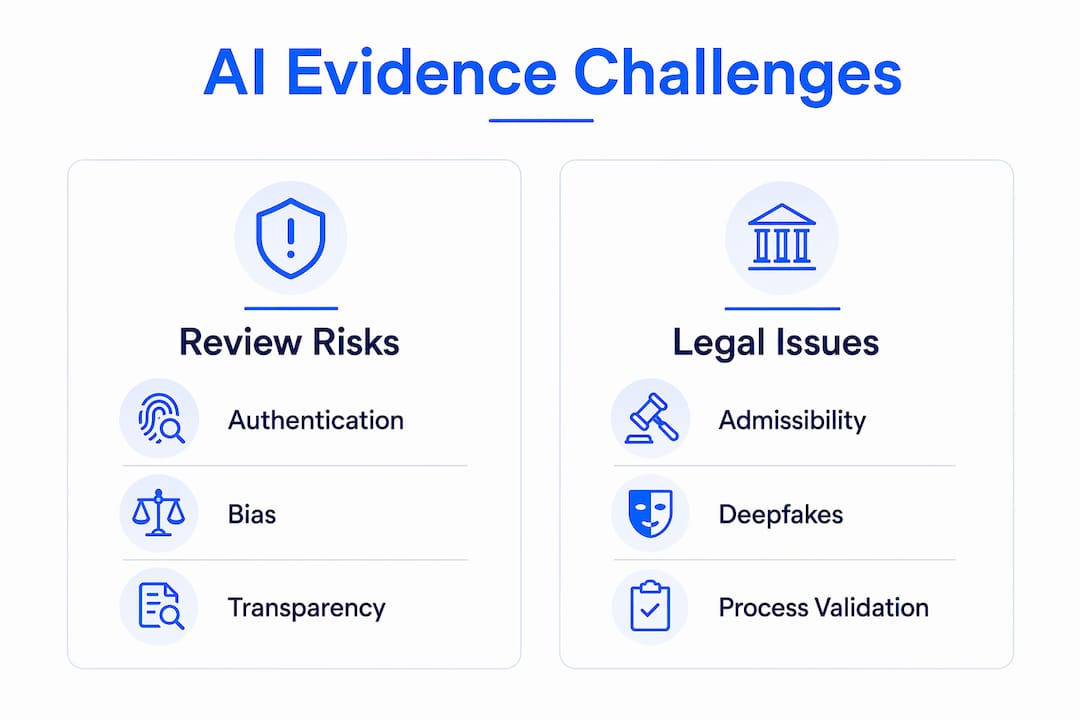
The challenge is structural. Traditional electronically stored information (ESI) frameworks assume a human created the document. AI-generated artifacts do not fit that assumption. New artifact types require tailored evidentiary frameworks, and experts in data science and AI engineering are now being deployed in trial and motion practice to authenticate and validate AI-origin materials.
Defense attorneys need to understand the specific evidentiary pressure points:
- Authentication of AI outputs: Courts require proof that an AI-generated document or summary accurately reflects the underlying source material without distortion or hallucination.
- Validation of AI processes: The methodology the AI used must be documented and defensible, not just the output.
- Expert testimony: Data scientists and AI engineers are now called to testify on whether an AI system's output is reliable for the purpose it was used.
- Distinguishing human from AI actions: When an AI agent takes an action in a workflow, that action must be traceable and distinguishable from human decisions.
- Deepfake and synthetic content: Defense teams must be prepared to challenge AI-generated media submitted by the prosecution and to defend their own AI-processed evidence against similar challenges.
The deepfake problem deserves specific attention. Synthetic audio and video are now technically indistinguishable from authentic recordings without forensic analysis. Defense attorneys who do not build synthetic content challenges into their pretrial motions are leaving a significant vulnerability unaddressed.
Best practices for integrating AI responsibly into discovery workflows
AI is a disciplined assistant, not a decision-maker. That framing matters because the failure mode in AI-assisted discovery is not that the tool misses something. The failure mode is that the attorney trusts the output without verifying it. AI must be supplemented by human verification, especially for pivotal evidence like Brady material, where the stakes of a missed disclosure are severe.
Effective generative AI deployment requires clear, precise, and iterative written prompts that mimic established human review protocols. The quality of what the AI returns is a direct function of the quality of the instruction it receives. Vague prompts produce vague results. Prompts modeled on your existing review checklists produce results you can actually use in court. The legal document drafting workflow principles that govern human reviewers apply equally to AI instruction.
| Approach | Risk Level | Best Use Case |
|---|---|---|
| AI as primary reviewer, no human check | High | None. Avoid entirely. |
| AI triage, human verification of flagged items | Low | Brady material, contradiction identification |
| AI narrative summary, attorney confirms source docs | Low | Document responsiveness review |
| AI theory generation, attorney selects and refines | Low | Defense theory development |
| AI transcription, attorney spot-checks accuracy | Medium | Audiovisual evidence review |
The table above reflects a core principle: the human stays in the loop at every decision point. AI compresses the time it takes to get to those decision points. It does not replace the judgment applied at them.
Pro Tip: Before deploying any AI tool on a new case type, run it against a set of materials where you already know the answers. Verify its accuracy on known facts before trusting it on unknown ones.
Early negotiation around AI use in discovery protocols is also worth pursuing. Opposing counsel and courts are increasingly receptive to agreed-upon AI use frameworks that establish what tools were used, how outputs were verified, and what audit trails exist. Getting ahead of that conversation protects your work product and builds credibility with the court. Review digital discovery workflow setup guidance to structure this process from the start.
AI applications across evidence types: audiovisual, documents, and narratives
Different evidence types call for different AI applications. Understanding where each tool performs well, and where it does not, prevents misapplication.
AI as a disciplined assistant helps lawyers map contradictions, separate observations from conclusions, and identify logical leaps without replacing legal judgment. That function plays out differently depending on the evidence type.
| Evidence Type | AI Application | Primary Benefit | Key Limitation |
|---|---|---|---|
| Body-cam footage | Transcription and timestamped search | Finds contradictions in hours vs. weeks | Accuracy drops with poor audio quality |
| Jail calls and recordings | Speaker identification and keyword search | Surfaces Brady moments at scale | Requires human verification of flagged clips |
| Document discovery | Generative AI review with narrative reasoning | Explains relevance, not just classification | Hallucination risk requires source verification |
| Defense narratives | Theory generation with supporting and weakening facts | Structures competing theories for attorney review | Attorney must select and refine final theory |
AI can generate defense theory options with core claims, supporting facts, and weakening facts to aid attorney decision-making without selecting the final theory. That is the right division of labor. The AI does the structural work of organizing what the evidence supports. The attorney applies legal judgment to decide which theory to pursue. The AI document review benefits that law firms are realizing in 2026 follow this same pattern across document-heavy cases.
The convergence point across all three evidence types is case understanding. AI applied to audiovisual evidence finds the contradiction. AI applied to documents finds the context. AI applied to narrative construction shows how those pieces fit into a defensible theory. Used together, these applications give defense attorneys a level of case comprehension that was structurally out of reach when review was entirely manual.
Key takeaways
AI transforms criminal defense discovery by compressing evidence review time and surfacing contradictions that manual processes miss, but only when attorneys maintain verification control over every AI output.
| Point | Details |
|---|---|
| Audiovisual triage is AI's highest-value use | AI reduces body-cam and jail call review from dozens of hours to hours per case. |
| Generative AI adds reasoning, not just classification | Unlike TAR, generative AI explains why a document matters and how it connects to the defense. |
| New evidentiary standards apply in 2026 | AI-generated work product requires authentication, validation, and expert testimony to be court-ready. |
| Prompt quality determines output quality | Clear, iterative prompts modeled on existing review protocols produce defensible AI results. |
| Human verification is non-negotiable | AI locates Brady material and contradictions, but counsel must confirm originals before relying on any finding. |
Where i think most defense teams are getting this wrong
I have watched legal teams adopt AI tools with genuine enthusiasm and then use them in ways that undercut the very advantages those tools offer. The most common mistake is treating AI output as a finished work product rather than a structured starting point.
The attorneys who get the most out of AI in discovery are the ones who use it to ask better questions, not to get final answers. They run AI triage on body-cam footage to find the timestamp worth watching, then they watch it. They use generative AI to surface document clusters worth reviewing, then they read the documents. The AI compresses the path to the relevant material. The attorney still does the legal work on that material.
The risk I see growing is the opposite pattern: attorneys who accept AI summaries without checking the source, or who build motions on AI-generated narratives without verifying the underlying evidence. That is not a technology problem. It is a workflow discipline problem. The tools are accurate enough to be useful. They are not accurate enough to be trusted without verification, especially on Brady material where a missed disclosure can end a case.
The future of AI in criminal defense is not about replacing legal judgment. It is about giving attorneys the time and information to exercise that judgment on what actually matters. The teams that figure out that division of labor early will have a structural advantage in case preparation that compounds over time.
— Faisal
See how Caseflow handles discovery at scale
Criminal defense discovery does not slow down because your caseload is heavy. Caseflow is built for exactly that pressure.
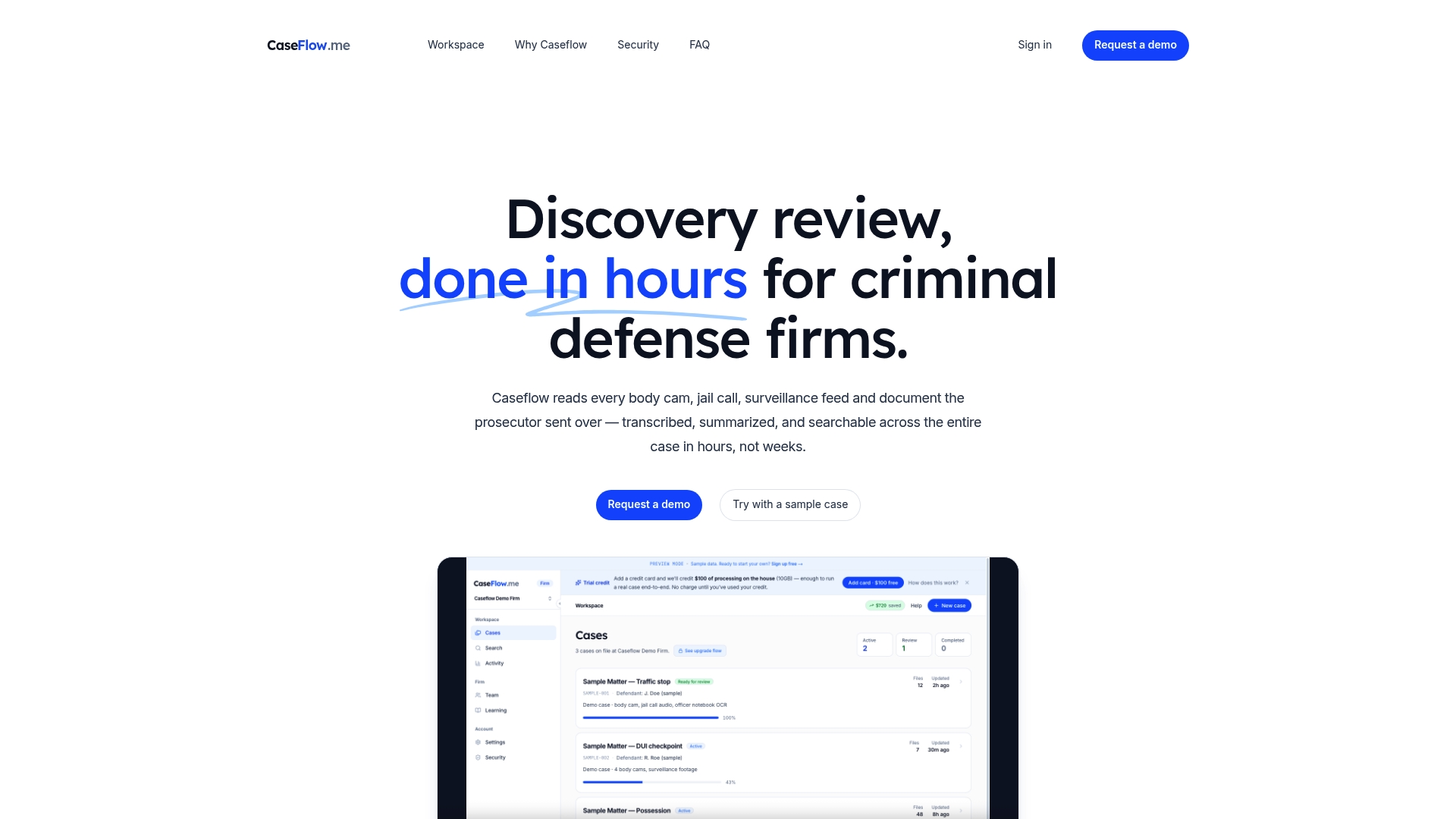
Caseflow combines AI transcription, summarization, and searchable entity extraction in one platform, reducing evidence review from weeks to hours. The Brady-trail audit log tracks every action taken on case files, giving you the compliance record courts increasingly expect when AI tools are part of your workflow. Caseflow supports multiple languages and preserves original audio throughout, so accuracy is never traded for speed. If you are ready to see what AI-powered defense discovery looks like in practice, Caseflow is worth a close look.
FAQ
What is the role of AI in defense discovery?
AI in defense discovery automates evidence triage, transcription, and document review to surface contradictions and Brady material faster than manual review allows. Its primary value is compressing review time from dozens of hours to hours per case.
How does generative AI differ from traditional TAR in document review?
Traditional TAR classifies documents as responsive or not. Generative AI provides narrative reasoning that explains why a document is relevant and how it connects to other evidence, which is far more useful for building defense theory.
What evidentiary standards apply to ai-generated work product in 2026?
As of May 2026, AI-generated work product entering motions and trials requires authentication, process validation, and in some cases expert testimony from data scientists or AI engineers to establish reliability.
Can AI replace an attorney's judgment in building a defense theory?
AI can generate theory options with supporting and weakening facts, but the attorney must select and refine the final theory. AI structures the analysis. Legal judgment determines the strategy.
How do i verify AI outputs before relying on them in court?
Always trace AI findings back to the original source material before use. For Brady material and key contradictions, confirm the AI-flagged content directly in the original recording or document before citing it in any filing.