
Discovery access equity is defined as the principle that all parties in litigation deserve fair and meaningful access to discovery tools and opportunities, not merely formal rights on paper. The concept goes well beyond procedural rules. It addresses whether attorneys and their clients can actually use discovery to build a case, given real constraints like cost, institutional barriers, and resource gaps. For criminal defense attorneys, public interest litigators, and researchers, understanding discovery access equity means recognizing the gap between what the law permits and what parties can realistically achieve. This article explains that gap, examines the barriers that create it, and covers the reforms working to close it.
What is discovery access equity in legal practice?
Discovery access equity is the fair distribution of discovery opportunities so that every party gets what it needs to participate meaningfully in litigation, not just identical procedural rights. The distinction matters. Formal access means a rule allows you to request documents. Meaningful access means you can actually obtain, review, and use those documents to prepare your case.
Access equity includes three dimensions: distributive access (fair sharing of discovery resources), procedural access (meaningful participation in the discovery process), and recognition access (cultural and contextual validation of a party's claims and needs). Each dimension can fail independently. A party might have the procedural right to take depositions but lack the funds to do so. Another party might receive documents but have no way to search or analyze them effectively.
Practical barriers drive most of the inequity. Cost is the most obvious. Document review, expert witnesses, and depositions all carry significant price tags. Parties with fewer resources face a structural disadvantage from the start of litigation. Institutional controls create a second category of barriers, particularly in civil rights cases where one party controls the evidence and the other cannot independently access it.

Pro Tip: When advising clients on discovery strategy, map out which of the three access dimensions (distributive, procedural, recognition) is most at risk in their specific case. That framing helps you target motions and arguments more precisely.
Consider an incarcerated plaintiff suing a correctional facility for civil rights violations. The plaintiff has the formal right to request records. The facility controls those records, controls the witnesses, and can cite security concerns to limit depositions. The plaintiff may have no attorney, no funds for experts, and no ability to conduct in-person interviews. Formal access exists. Meaningful access does not.
How do procedural rules and proportionality affect discovery equity?
Federal civil discovery operates under a proportionality standard that directly shapes discovery access equity. Under Rule 26(b)(1) of the Federal Rules of Civil Procedure, courts weigh the burden of discovery against its likely benefit. The factors include the importance of the issues at stake, the parties' relative resources, and each party's access to relevant information.
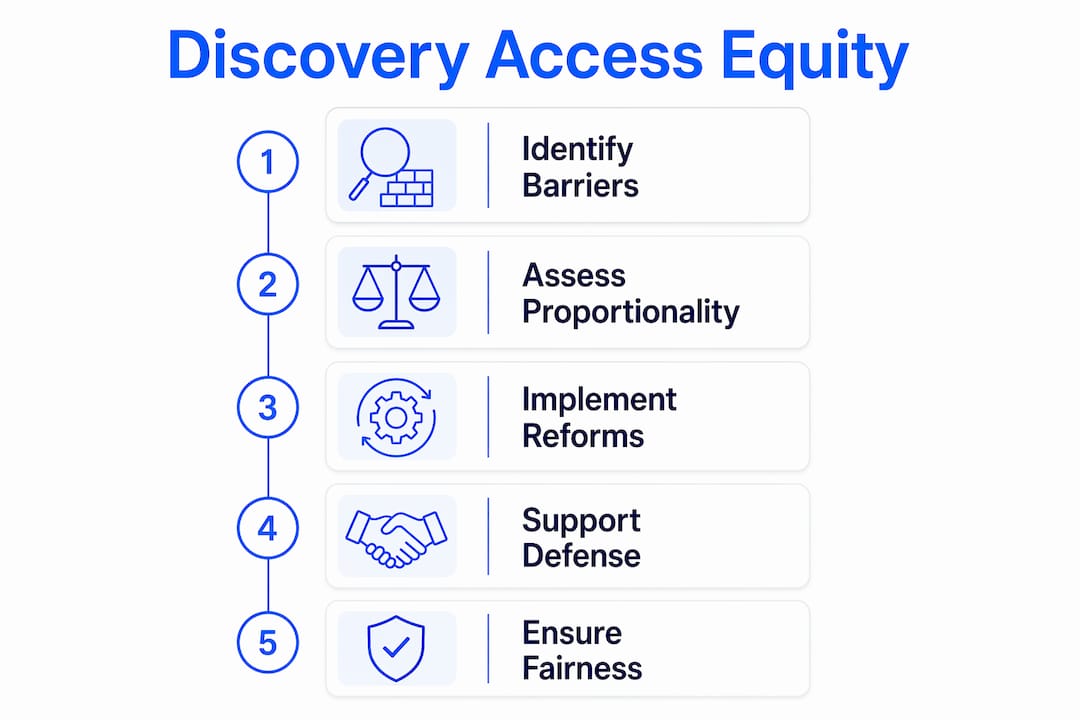
Proportionality balancing creates both a protection and a risk for equitable access. It protects weaker parties from being buried in expensive discovery demands. It also gives well-resourced defendants a tool to limit what plaintiffs can obtain, by arguing that the cost of production outweighs the benefit. The result depends heavily on how judges exercise their gatekeeping role.
Judicial decisions about discovery length, deposition limits, and document production scope have enormous consequences on information symmetry between parties. A judge who stays discovery pending a motion to dismiss can effectively end a case before the plaintiff ever sees a single document. That outcome is not neutral. It consistently favors defendants with the resources to file early dispositive motions.
Attorneys who want to protect their clients' discovery access must build a specific record on proportionality. Boilerplate objections are insufficient. Courts require detailed evidence of specific burdens, including volume, cost estimates, and the relative resources of each party. The same standard applies in reverse: attorneys seeking broader discovery must document why the information sought is proportionate to the needs of the case.
- Identify the specific discovery requests at issue and their likely evidentiary value.
- Document the requesting party's inability to obtain the information through other means.
- Present concrete cost and burden data, not general assertions.
- Highlight any resource disparity between the parties on the record.
- Argue that limiting discovery would create or worsen an information asymmetry.
Pro Tip: File a discovery conference request early in cases where resource disparity is significant. Judges who understand the asymmetry before disputes arise are more likely to craft proportionality rulings that protect meaningful access.
What challenges reduce discovery access for incarcerated litigants?
Incarcerated civil rights plaintiffs face the most severe form of discovery access inequity in the American legal system. The Yale Law Journal describes this as a prison discovery crisis, where institutional controls over evidence creation and storage make meaningful discovery practically impossible for many plaintiffs.
The structural problem is specific. Prisons control who can enter, which records exist, how they are stored, and who can testify. When an incarcerated person sues a facility for excessive force or medical neglect, the defendant controls nearly all of the evidence. Security concerns provide a legally defensible reason to limit depositions, restrict document access, and deny outside investigators entry. The result is a category of evidence that is formally discoverable but practically undiscoverable.
"Discovery access equity requires looking beyond formal availability to real-world effectiveness constrained by resources and institutional barriers." — Yale Law Journal, The Prison Discovery Crisis
The barriers compound for pro se litigants, who represent a large share of incarcerated plaintiffs. Without counsel, these litigants cannot conduct depositions, retain experts, or navigate complex discovery disputes. Even when they have attorneys, resource restrictions often prevent access to expert reports and forensic analysis that would be standard in any well-funded civil case.
Key barriers that reduce meaningful discovery access for incarcerated litigants include:
- Institutional control of evidence: Prisons create, store, and manage the records that plaintiffs need. Destruction or non-preservation of surveillance footage is a recurring problem.
- Deposition restrictions: Security protocols limit who can enter a facility, making in-person depositions of staff and witnesses difficult or impossible.
- Expert access: Retained experts often cannot access facilities to conduct independent investigations.
- Resource gaps: Most incarcerated plaintiffs cannot afford counsel, expert witnesses, or litigation support services.
- Procedural complexity: Discovery rules designed for represented parties with legal training create structural disadvantages for pro se litigants.
The gap between theoretical rights and practical discoverability is the defining feature of this problem. Practitioners working in prison civil rights litigation must treat this gap as a core strategic challenge, not a procedural inconvenience.
How have legal reforms advanced discovery equity and accessibility?
Recent statutory and procedural reforms show that legislatures and courts recognize the discovery access problem and are working to address it. Two examples stand out: New York's CPL 245.20 and Illinois Rule 222.
New York's CPL 245.20 and the constructive possession doctrine
New York's criminal discovery reforms represent one of the most significant expansions of disclosure obligations in recent American legal history. CPL 245.20 requires prosecutors to disclose 21 categories of information early in the criminal process, including Brady material, witness information, and electronically stored information. The statute does not limit disclosure to evidence physically in the prosecutor's possession.
The constructive possession doctrine embedded in CPL 245.20 treats evidentiary control as a disclosure duty. If a prosecutor has the ability to obtain evidence from a law enforcement agency, that evidence is treated as within the prosecutor's possession for disclosure purposes. This expansion of discoverability directly addresses one of the most common tactics used to limit defense access: the claim that evidence held by police agencies is not the prosecutor's responsibility to disclose.
For defense counsel, this reform shifts strategy. Attorneys must now build their discovery demands around the statutory possession concept, not just what the prosecutor physically holds. Failure to do so leaves discoverable evidence on the table.
Illinois Rule 222 vs. standard civil discovery
| Feature | Standard Civil Discovery | Illinois Rule 222 |
|---|---|---|
| Deposition length | No fixed cap | Capped at three hours |
| Scope | Full Rule 26 scope | Simplified, limited scope |
| Applicability | All civil cases | Small monetary civil claims |
| Purpose | Comprehensive fact-finding | Efficiency and proportionality |
| Access impact | High cost, high burden | Lower cost, faster resolution |
Illinois Rule 222 limits discovery in smaller monetary civil claims, including a three-hour cap on depositions. The rule keeps general discovery principles in place but modifies them where efficiency demands it. This approach recognizes that full-scale discovery is not proportionate for every case. Smaller claims deserve a discovery process that does not price out the parties who bring them.
The lesson from both reforms is the same. Discovery equity and accessibility improve when rules are designed with the actual resources and constraints of litigants in mind, not just the procedural ideals of well-funded litigation.
Key Takeaways
Discovery access equity requires closing the gap between formal discovery rights and practical access, using procedural reforms, judicial awareness, and technology.
| Point | Details |
|---|---|
| Equity goes beyond formal rights | Meaningful access requires the ability to actually use discovery tools, not just the legal right to request them. |
| Proportionality cuts both ways | Rule 26(b)(1) can protect weaker parties or restrict their access, depending on how courts apply it. |
| Incarcerated litigants face the worst barriers | Institutional control of evidence and resource gaps create a discovery crisis for civil rights plaintiffs in prison. |
| Reforms expand discoverability | New York's CPL 245.20 and Illinois Rule 222 show how statutory design can improve equity for specific litigant populations. |
| Defense strategy must adapt | Attorneys must build discovery plans around statutory possession concepts and document proportionality arguments with specific evidence. |
The gap nobody talks about enough
The conversation about discovery access equity in legal scholarship focuses heavily on doctrine. Proportionality factors, disclosure categories, possession doctrines. These are real and they matter. But the practical gap that I see most often is simpler and less discussed: attorneys do not know what they do not know.
When a defense team receives thousands of pages of discovery, the question is not just whether they have the legal right to those documents. The question is whether they can actually find the critical facts buried inside them. A Brady violation hidden on page 4,000 of a document dump is technically disclosed. It is practically invisible. That is a discovery access problem, and no procedural rule fixes it without the right tools.
Technology is changing this. AI-assisted review, searchable entity extraction, and automated summarization are not luxuries anymore. They are the difference between a defense team that can actually use its discovery and one that is technically compliant but practically blind. The role of technology in discovery has moved from optional to foundational for any team handling complex cases.
The next frontier for discovery access equity is not just about who gets documents. It is about who can actually process them. Reforms that expand disclosure without addressing the practical capacity to review that disclosure are incomplete. Defense attorneys, researchers, and policymakers need to treat processing capacity as part of the equity equation, not an afterthought.
— Faisal
How Caseflow supports equitable discovery access for defense teams
Criminal defense attorneys working on complex cases face a version of the discovery access problem every day. Receiving thousands of pages of files is not the same as having access to the information inside them.
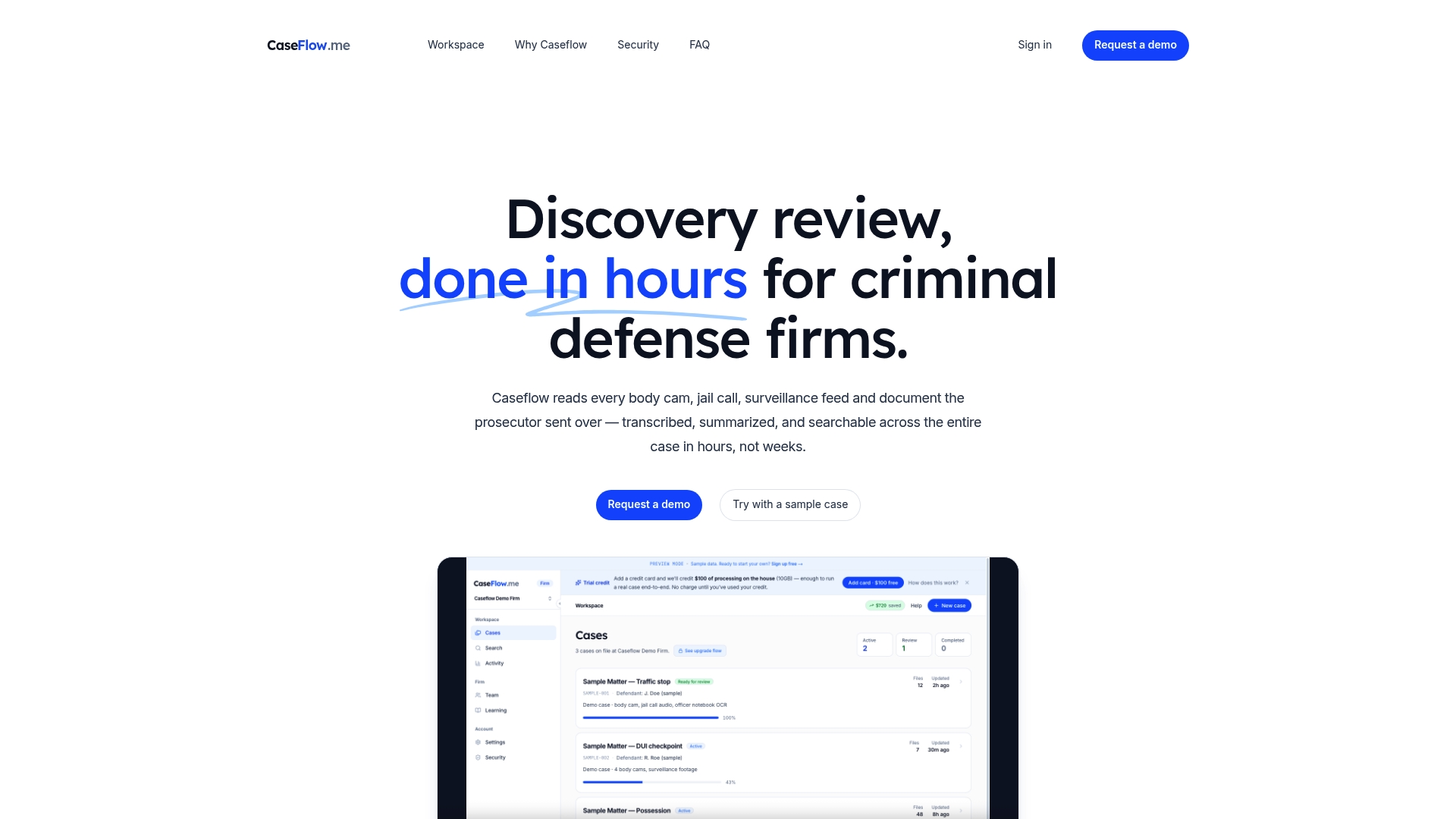
Caseflow addresses this directly. The platform combines transcription, summarization, and searchable entity extraction in one place, reducing the time attorneys spend sifting through case files from weeks to hours. The Brady-trail audit log tracks every action taken on case files, supporting discovery transparency and compliance. Caseflow also supports multiple languages, preserving original audio while making evidence searchable. For defense teams where practical access to discovery is the real barrier, Caseflow's AI tools close the gap between receiving discovery and actually using it.
FAQ
What is discovery access equity?
Discovery access equity is the principle that all parties in litigation should have fair and meaningful access to discovery tools and opportunities, not just formal procedural rights. It covers distributive, procedural, and recognition dimensions of access.
How does proportionality affect discovery access equity?
Under Federal Rule 26(b)(1), courts weigh discovery burden against likely benefit, considering each party's resources and access to information. This standard can protect weaker parties or restrict their access, depending on how judges apply it.
Why do incarcerated plaintiffs face the worst discovery access problems?
Prisons control the creation, storage, and access to most evidence in civil rights cases, making key evidence practically undiscoverable even when it is formally subject to disclosure. Resource restrictions compound the problem by limiting access to counsel, experts, and litigation support.
What did New York's CPL 245.20 change about discovery access?
CPL 245.20 requires prosecutors to disclose 21 categories of information early, including Brady material and electronically stored information. Its constructive possession doctrine extends disclosure duties to evidence held by law enforcement agencies, not just evidence physically in the prosecutor's office.
How can defense attorneys improve practical discovery access?
Defense attorneys should build discovery demands around statutory possession concepts, document proportionality arguments with specific cost and burden data, and use technology tools that make large discovery productions searchable and reviewable in a fraction of the time traditional review requires.