
Discovery compliance tracking is defined as the systematic monitoring and recording of every step in the discovery process to verify full adherence to legal obligations and procedural requirements. For criminal defense attorneys and compliance officers, the stakes are concrete: missed deadlines, undocumented handoffs, and incomplete evidence logs can result in sanctions, suppressed evidence, or lost cases. Continuous compliance monitoring systems now capture over 80% of evidence automatically, a threshold that manual processes rarely approach. Understanding how discovery compliance is tracked means understanding the difference between a defensible record and a liability.
How discovery compliance is tracked: methods and technologies
Discovery compliance monitoring relies on two broad approaches: manual tracking and automated systems. Each has a distinct role, and the gap between them is wider than most attorneys expect.
Manual tracking typically uses spreadsheets, email chains, and physical binders. Spreadsheets are error-prone for electronically stored information (ESI) management, creating risks from data entry mistakes and the absence of real-time version control. Manual reconciliation often consumes more time than the discovery work itself, and any inaccuracy creates direct liability exposure.
Automated systems replace discretionary forwarding with enforced workflow checkpoints. Encrypted cloud platforms built on infrastructure like AWS, GCP, or Azure provide centralized intake, automated deadline tracking, and immutable audit trails. These platforms timestamp every action and make records unalterable, which is the foundation of a defensible compliance record.

AI adds a scoring layer on top of automated workflows. AI measures compliance adherence by cross-referencing discovery actions against required procedural libraries, generating a compliance score based on the ratio of categories addressed to total required categories. Low scores correlate directly with weaker case outcomes. That scoring function turns compliance from a checkbox into a measurable, improvable metric.
Key technology categories used in discovery compliance tracking methods include:
- Automated eDiscovery platforms: Centralize intake, enforce routing rules, and generate timestamped logs without human intervention.
- AI compliance scoring engines: Cross-reference actions against required procedural steps and flag gaps in real time.
- Encrypted cloud storage: AWS, GCP, and Azure provide audit-grade security and access logging for all case files.
- Legal hold management systems: Automate custodian notifications and track acknowledgment status.
- Case management dashboards: Provide a single view of deadlines, evidence status, and outstanding obligations.
Pro Tip: Never use a spreadsheet as the primary tracking tool for ESI-heavy cases. Version control failures and manual entry errors create compliance gaps that are nearly impossible to reconstruct during an audit or hearing.
How does continuous compliance monitoring improve the discovery process?
Continuous compliance monitoring is the ongoing, automated verification of discovery obligations at minute or hourly intervals, rather than periodic manual reviews. The operational difference is significant. Quarterly check models leave gaps of 90 or more days during which control failures go undetected. Continuous systems detect those failures within hours.
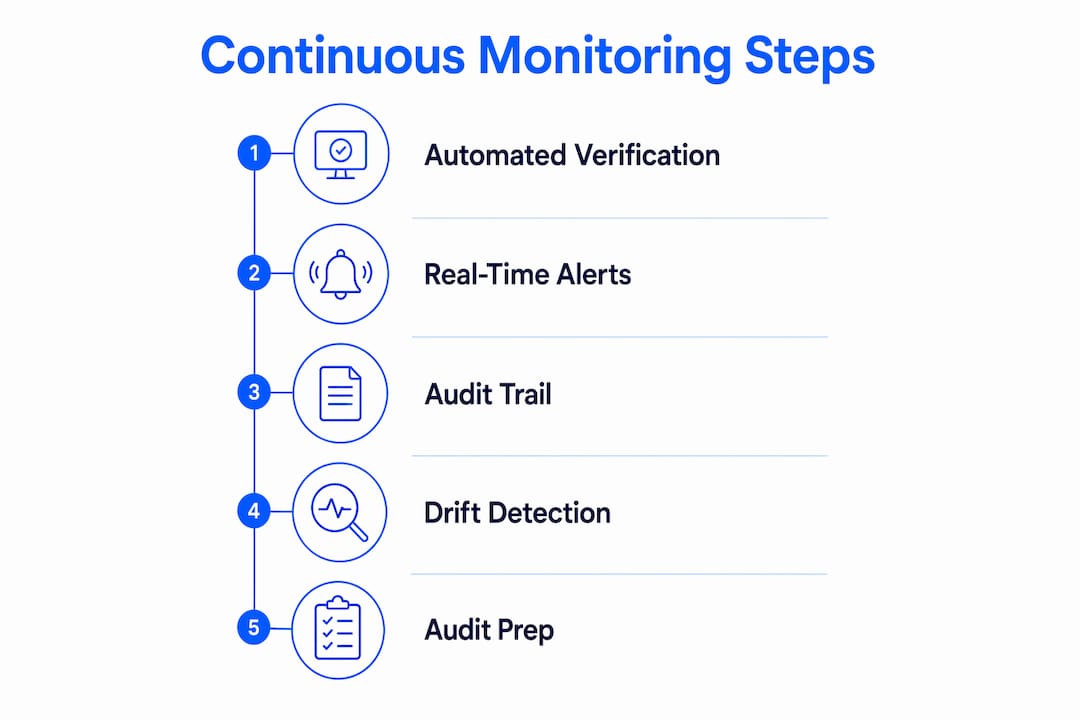
The time savings are measurable. Continuous monitoring shortens audit prep from 8–10 weeks to 2–3 weeks and cuts associated costs by 25–40%. That reduction comes directly from automated evidence collection replacing manual document assembly. Attorneys who previously spent weeks reconstructing a compliance record can instead export a pre-built, audit-ready package.
| Metric | Periodic review | Continuous monitoring |
|---|---|---|
| Audit preparation time | 8–10 weeks | 2–3 weeks |
| Cost reduction | Baseline | 25–40% lower |
| Evidence capture rate | Variable, often incomplete | Over 80% automated |
| Control failure detection | 90-plus day gaps | Within hours |
| Audit duration reduction | Baseline | 40–60% shorter |
Timestamped audit trails are the core output of continuous monitoring. Every action, every handoff, and every decision point is recorded with a timestamp that cannot be altered. That record eliminates the "I thought someone else handled it" defense and replaces it with documented fact. Real-time dashboards show current compliance posture, control drift over time, and exportable evidence packages that reduce overall audit duration by 40–60%.
Drift detection is a feature that most attorneys overlook until they need it. When a process deviates from its approved workflow, a continuous monitoring system flags the deviation immediately. That early warning prevents small procedural gaps from becoming Brady violations or discovery sanctions.
What are best practices for effective tracking of discovery compliance?
The most defensible discovery compliance process produces an audit-ready record of every action, from intake through production, with no gaps. Achieving that record requires eliminating discretionary forwarding and replacing it with standardized routing rules enforced by the system, not by individual memory.
Four practices separate reliable compliance tracking from reactive damage control:
- Centralized intake: All discovery materials enter through a single, logged channel. Parallel intake paths create untracked copies and break chain-of-custody.
- Immutable audit trails: Every action, including who accessed a file, when, and what they did, must be system-generated and unalterable. Email confirmations do not qualify.
- Workflow checkpoints: Automated gates that require documented sign-off before a file advances to the next stage prevent silent handoff failures.
- Integrated legal hold systems: Custodian notifications and acknowledgments are logged automatically, removing the risk of undocumented holds.
Mapping compliance controls directly to live, version-controlled processes rather than static binders or reports is the standard that auditors now expect. A link to a verified, current process with a review date and change history is more defensible than a printed policy document. That approach also eliminates interpretation fatigue when regulations change, because updates map directly to the affected processes.
Pro Tip: Assign explicit ownership to every compliance process and require version-controlled history for each one. When an auditor or judge asks who approved a procedural step and when, the answer should be one click away, not a search through email threads.
Common pitfalls that undermine compliance tracking include manual handoff gaps between attorneys and paralegals, spreadsheet errors in ESI logs, and the absence of a single source of truth for deadline status. Each of these is a known failure mode with a known fix: automated routing, purpose-built tracking platforms, and centralized dashboards. Attorneys who rely on digital discovery workflows built around these principles consistently produce more defensible records.
How do compliance tracking systems support audit readiness and court proceedings?
A defensible discovery compliance process produces a complete audit record covering every action, timestamp, decision point, and chain-of-custody step from intake through production. That record is not just useful for internal review. It is the primary evidence presented at discovery compliance hearings.
Discovery compliance hearings involve judicial review of evidence exchange to confirm that parties have met their obligations. Judges issue directives or sanctions when good faith is not demonstrated. Documented transcripts from those hearings become part of the appellate record. An attorney who arrives with a complete, timestamped audit trail is in a fundamentally different position than one presenting reconstructed emails and handwritten notes.
| Factor | Manual compliance tracking | Automated compliance tracking |
|---|---|---|
| Audit trail completeness | Dependent on human memory and email | System-generated, timestamped, unalterable |
| Evidence capture rate | Incomplete, variable | Over 80% automated |
| Hearing preparation time | Weeks of manual reconstruction | Pre-built exportable packages |
| Chain-of-custody documentation | Often fragmented | Continuous, logged at every step |
| Response to judicial directives | Reactive, after the fact | Proactive, with real-time alerts |
Certified transcripts and real-time dashboards serve two distinct functions in court. Transcripts provide the static, certified record for appeals. Dashboards provide the live view that attorneys use to answer judicial questions about current compliance status without delay. Demonstrating discovery transparency in court requires both: a historical record that cannot be disputed and a current view that shows ongoing good faith.
The practical implication is direct. Automated compliance tracking systems do not just reduce internal workload. They produce the specific type of evidence that judges expect to see when compliance is challenged.
Key Takeaways
Automated, continuous compliance tracking is the only method that consistently produces audit-ready, defensible discovery records for criminal defense proceedings.
| Point | Details |
|---|---|
| Automated systems outperform manual methods | Continuous platforms capture over 80% of evidence automatically, far exceeding spreadsheet-based approaches. |
| Audit prep time drops significantly | Continuous monitoring reduces audit preparation from 8–10 weeks to 2–3 weeks, cutting costs by 25–40%. |
| Immutable audit trails are non-negotiable | System-generated, timestamped records replace email chains and prevent chain-of-custody gaps. |
| AI scoring makes compliance measurable | AI cross-references discovery actions against required steps, turning compliance into a trackable metric. |
| Court readiness requires both records and dashboards | Certified transcripts cover appeals; real-time dashboards answer judicial questions about current status. |
The shift I keep seeing in criminal defense compliance
The attorneys I see struggling most with discovery compliance are not the ones using bad tools. They are the ones using good tools incorrectly, treating compliance tracking as a documentation task rather than an operational system. A spreadsheet updated after the fact is not a compliance record. It is a reconstruction. That distinction matters enormously when a judge asks for proof of good faith.
The shift toward continuous, automated monitoring is not just a technology upgrade. It is a change in how compliance is conceptualized. Reactive compliance asks, "Did we do this?" Proactive compliance asks, "Can we prove we did this, at every step, in real time?" The second question is the one that matters in court.
AI-driven compliance scoring adds a layer that most criminal defense teams have not yet adopted. Scoring discovery actions against a required procedural library turns an abstract obligation into a number. That number can be tracked, improved, and presented. Low scores are early warnings. High scores are documented evidence of diligence. The teams that adopt this approach now will be significantly better positioned when compliance is challenged.
My recommendation is direct: stop treating compliance tracking as a back-office function. Build it into the front end of every case workflow. Assign ownership, enforce checkpoints, and generate immutable records from day one. The cost of building that system is a fraction of the cost of reconstructing a compliance record under judicial scrutiny.
— Faisal
How Caseflow supports discovery compliance tracking
Criminal defense attorneys who need audit-ready compliance records without weeks of manual preparation have a direct path forward with Caseflow.
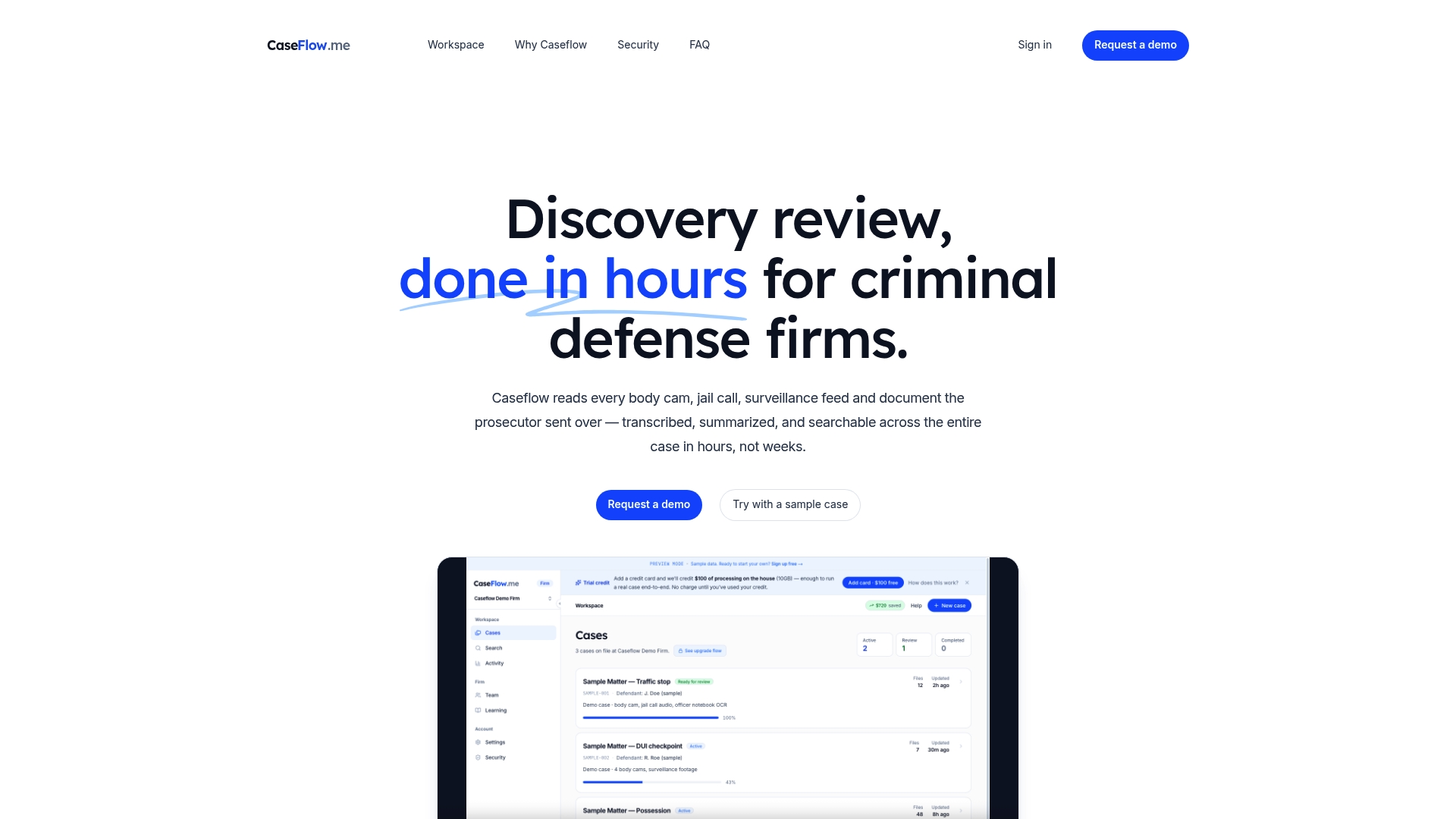
Caseflow's Brady-trail audit log tracks every action taken on case files, generating timestamped, immutable records that meet the standard courts expect at discovery compliance hearings. The platform combines transcription, summarization, and searchable entity extraction in one place, so attorneys can locate and document evidence in hours rather than weeks. Real-time dashboards give compliance officers an immediate view of case status, outstanding obligations, and chain-of-custody at every stage. For criminal defense teams ready to move from reactive to proactive compliance, Caseflow's AI platform delivers the tools that make that shift practical and defensible.
FAQ
What is discovery compliance tracking?
Discovery compliance tracking is the systematic monitoring and recording of every step in the discovery process to verify adherence to legal obligations. It includes audit trails, deadline tracking, and chain-of-custody documentation from intake through production.
Why are spreadsheets inadequate for discovery compliance?
Spreadsheets lack real-time version control and are prone to data entry errors, making them unreliable for ESI management. Manual reconciliation often creates more liability than it prevents, particularly when an audit or hearing requires a complete, unaltered record.
How does continuous monitoring reduce audit preparation time?
Continuous compliance monitoring automates evidence collection and generates pre-built audit packages, shortening preparation from 8–10 weeks to 2–3 weeks. That reduction also cuts associated costs by 25–40%.
What role do audit trails play in discovery compliance hearings?
Judges at discovery compliance hearings review documented evidence of good faith compliance. A complete, timestamped audit trail is the primary tool attorneys use to demonstrate that all obligations were met and to avoid sanctions.
How does AI improve discovery compliance monitoring?
AI scores compliance by cross-referencing completed discovery actions against required procedural categories. That score identifies gaps in real time, allowing attorneys to correct deficiencies before they affect case outcomes or trigger judicial sanctions.