
Evaluating discovery software for firms means selecting the eDiscovery platform that best integrates with your existing technology stack, supports your specific legal workflows, and comes from a vendor with proven long-term stability. Platforms like Relativity, Everlaw, and Logikcull each dominate different segments of the market, but the right choice depends on your firm's caseload, compliance requirements, and operational fit. This guide walks you through the criteria, process, and common mistakes that separate a confident software decision from an expensive one.
What key criteria should firms use to evaluate discovery software?
Integration depth with existing systems is 4x the predictor of long-term platform satisfaction compared to pricing or specific AI features. That finding reframes the entire evaluation. Most firms spend the bulk of their review time comparing AI review accuracy or per-gigabyte pricing, when the real differentiator is how well a platform connects with your billing system, case management software, and document automation tools.
Firms typically use 7–12 technologies across their discovery workflows. Strong integrations between those tools can save $45,000–$80,000 annually. That number reflects reduced manual handoffs, fewer data errors, and faster review cycles.
Beyond integration, here are the core criteria to assess:
- Processing speed and AI review accuracy: Look for platforms with validated Technology Assisted Review (TAR) accuracy rates and documented processing benchmarks. Everlaw and DISCO both publish performance data you can request during demos.
- Vendor viability: The Success Predictor Rating framework evaluates vendors on organizational health and financial stability, not just features. A vendor that cannot survive a multi-year litigation engagement is a liability.
- Total cost of ownership: Hidden costs like data migration, training, and workflow re-engineering routinely cause budget overruns. Model costs over three years, not just the first contract term.
- Security and compliance certifications: Platforms handling sensitive case files must meet SOC 2 Type II, FedRAMP, or equivalent standards. Audit trail capabilities, like those required for Brady material tracking, are non-negotiable for criminal defense work. You can review what a defensible legal audit trail requires before you evaluate any platform.
Pro Tip: Ask every vendor for a written integration map showing exactly how their platform connects to your current case management and billing systems. Vague answers at this stage predict painful implementations later.
How to conduct an effective discovery software evaluation
A structured process prevents the most common failure mode in software selection: evaluating too many options and ending up with no clear winner.
Step 1: Build a focused shortlist.
Shortlist 3–5 platforms to avoid decision paralysis. An ideal shortlist includes one established market leader like Relativity, one mid-market challenger like Logikcull, and one next-generation provider. That mix covers different risk and innovation profiles without overwhelming your evaluation team.
Step 2: Inventory your technology stack.
List every tool your firm uses in discovery, from intake through production. Rank the integrations you need by priority. This becomes your minimum viable requirements list.

Step 3: Score vendors with a structured framework.
The Total Success Predictor Rating (TSPR) framework scores vendors across features, support quality, financial health, and implementation track record. Use a scoring matrix so every evaluator applies the same criteria.
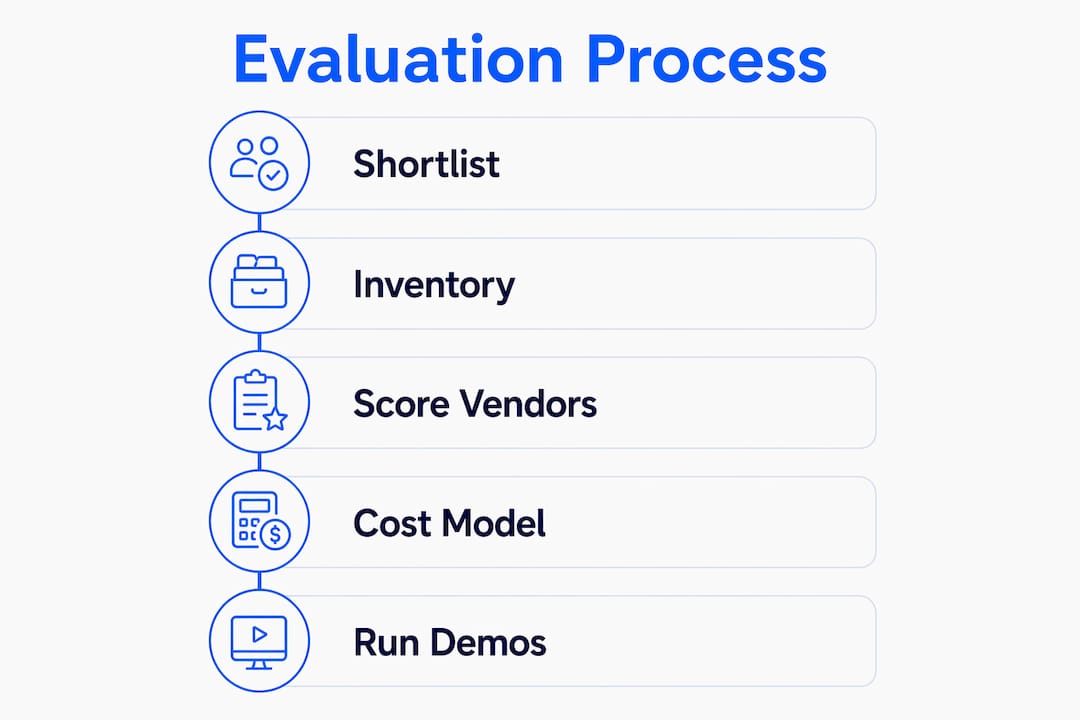
Step 4: Model a 3-year total cost of ownership.
Include licensing, data storage, migration, training, and ongoing support. Platforms with low entry pricing often carry high per-gigabyte costs that compound quickly on complex cases.
Step 5: Run demos on your actual data.
Generic demos show software at its best. Request a pilot using a sample of your real case files. That test reveals how the platform handles your document types, languages, and volume.
| Evaluation Step | Key Action | Output |
|---|---|---|
| Shortlist | Limit to 3–5 vendors | Focused candidate list |
| Stack inventory | Map current integrations | Requirements priority list |
| Vendor scoring | Apply TSPR framework | Objective comparison scores |
| Cost modeling | Build 3-year TCO | Budget-ready decision data |
| Pilot demo | Use real case data | Workflow fit confirmation |
Pro Tip: Implementation support quality is the second highest predictor of satisfaction after integration depth. Weight it heavily in your scoring matrix, not as an afterthought.
How do discovery platforms compare across firm sizes?
The best platform varies by firm size and need. Compliance-intensive firms require strong predictive coding and defensible audit trails. Smaller firms prioritize ease of use and fast deployment over advanced analytics. That distinction shapes every platform comparison.
Platforms like Everlaw, Relativity, DISCO, and Logikcull each offer distinct strengths suited to different firm profiles and litigation complexity levels. Here is how they break down in practice:
- Relativity: Best for large firms and complex litigation. Highly customizable, with deep analytics and a large partner ecosystem. Requires significant IT resources and training investment.
- Everlaw: Strong fit for mid-size firms. Cloud-native, collaborative interface, and solid AI-assisted review. Faster to deploy than Relativity with lower administrative overhead.
- DISCO: Favored by firms with high-volume document review. AI features are central to the product, not bolted on. Pricing scales with data volume, which suits firms with variable caseloads.
- Logikcull: Designed for simplicity. Best for small to mid-size firms that need fast, self-service discovery without a dedicated eDiscovery team. Limited customization compared to enterprise platforms.
- Epiq Discovery: Strong compliance and managed services support. Suits firms that want a vendor to handle significant portions of the review process rather than managing it in-house.
Cloud-based and desktop solutions carry distinct trade-offs in speed, scalability, and deployment complexity. Cloud platforms offer faster setup and remote access, which matters for distributed legal teams. Desktop solutions give IT departments more control over data residency, which some compliance-heavy practices require.
For criminal defense firms specifically, the calculus shifts further. You need platforms that handle automated discovery workflows with strong audit capabilities, multi-language support, and fast document turnaround on time-sensitive cases.
What mistakes should firms avoid during software evaluation?
The most expensive mistakes in eDiscovery software selection are predictable. Avoiding them does not require a larger budget. It requires a different evaluation mindset.
- Evaluating too many platforms: More than five candidates creates comparison fatigue. Teams lose the ability to distinguish meaningful differences and default to price as the tiebreaker.
- Over-indexing on features and price: Firms that focus on feature checklists while ignoring vendor organizational health end up switching platforms within three years. Platform switches are expensive and disruptive.
- Ignoring hidden costs: Training, data migration, and workflow re-engineering are rarely included in vendor quotes. A platform priced at $2,000 per month can cost $60,000 in year one once migration and onboarding are factored in.
- Skipping stakeholder alignment: Attorneys, paralegals, and IT staff use discovery platforms differently. Evaluating without their input produces a technically sound choice that nobody actually adopts.
- Neglecting vendor financial stability: Vendor evaluation must include financial sustainability and leadership authenticity. A vendor acquired or shut down mid-litigation creates serious operational and compliance risk.
"The firms that make the best software decisions treat vendor viability as a first-class evaluation criterion, not a footnote. A platform is only as reliable as the company behind it."
Pro Tip: Engage your IT director and at least two practicing attorneys in the evaluation from day one. Their workflow requirements will surface integration gaps that a procurement-only review will miss entirely.
For a closer look at how technology selection shapes discovery outcomes, the stakes become clear quickly.
Key takeaways
Selecting the right discovery platform requires prioritizing integration depth, vendor viability, and total cost of ownership over feature lists and entry-level pricing.
| Point | Details |
|---|---|
| Integration depth drives satisfaction | Integration with existing systems predicts long-term satisfaction 4x more than pricing or AI features. |
| Shortlist 3–5 platforms only | Include a market leader, a mid-market challenger, and a next-generation vendor to cover diverse needs. |
| Model 3-year total cost | Hidden migration, training, and support costs routinely cause budget overruns if not planned upfront. |
| Score vendor viability formally | Use the Success Predictor Rating framework to assess financial health and organizational stability. |
| Run pilots on real case data | Generic demos hide workflow gaps that only appear when you test with your actual documents and volume. |
What i've learned about evaluating discovery software the hard way
After reviewing dozens of eDiscovery platform decisions across firms of different sizes, the pattern is consistent. Firms that are unhappy with their discovery software almost always made the same mistake: they chose the platform with the most impressive demo and the lowest initial price. They did not ask hard questions about vendor stability, and they did not model what the platform would actually cost in year two or three.
The firms that get this right treat integration depth as the primary filter. They ask vendors to walk through exactly how their platform connects to the firm's existing case management system, billing software, and document storage. If the vendor cannot answer that question with specifics, the evaluation ends there.
I also think the vendor viability question is underrated in most evaluation frameworks. The eDiscovery market has seen significant consolidation. A platform you select today could be acquired, rebranded, or discontinued within your contract term. The Success Predictor Rating framework exists precisely because feature comparisons do not capture that risk. Use it.
One more thing: do not skip the pilot on real data. I have seen firms sign contracts after a polished demo, only to discover during onboarding that the platform struggled with their specific document types or volume. A two-week pilot with actual case files costs nothing compared to a failed implementation.
The firms that make the best decisions here are the ones that slow down the evaluation process just enough to ask the right questions. Speed through the shortlist phase. Be methodical in the scoring phase. And never let price be the final deciding factor when vendor stability and integration fit are still unresolved.
— Faisal
See how Caseflow handles discovery for criminal defense firms
Criminal defense attorneys face discovery challenges that general-purpose eDiscovery platforms were not built to solve. Caseflow is purpose-built for this work.
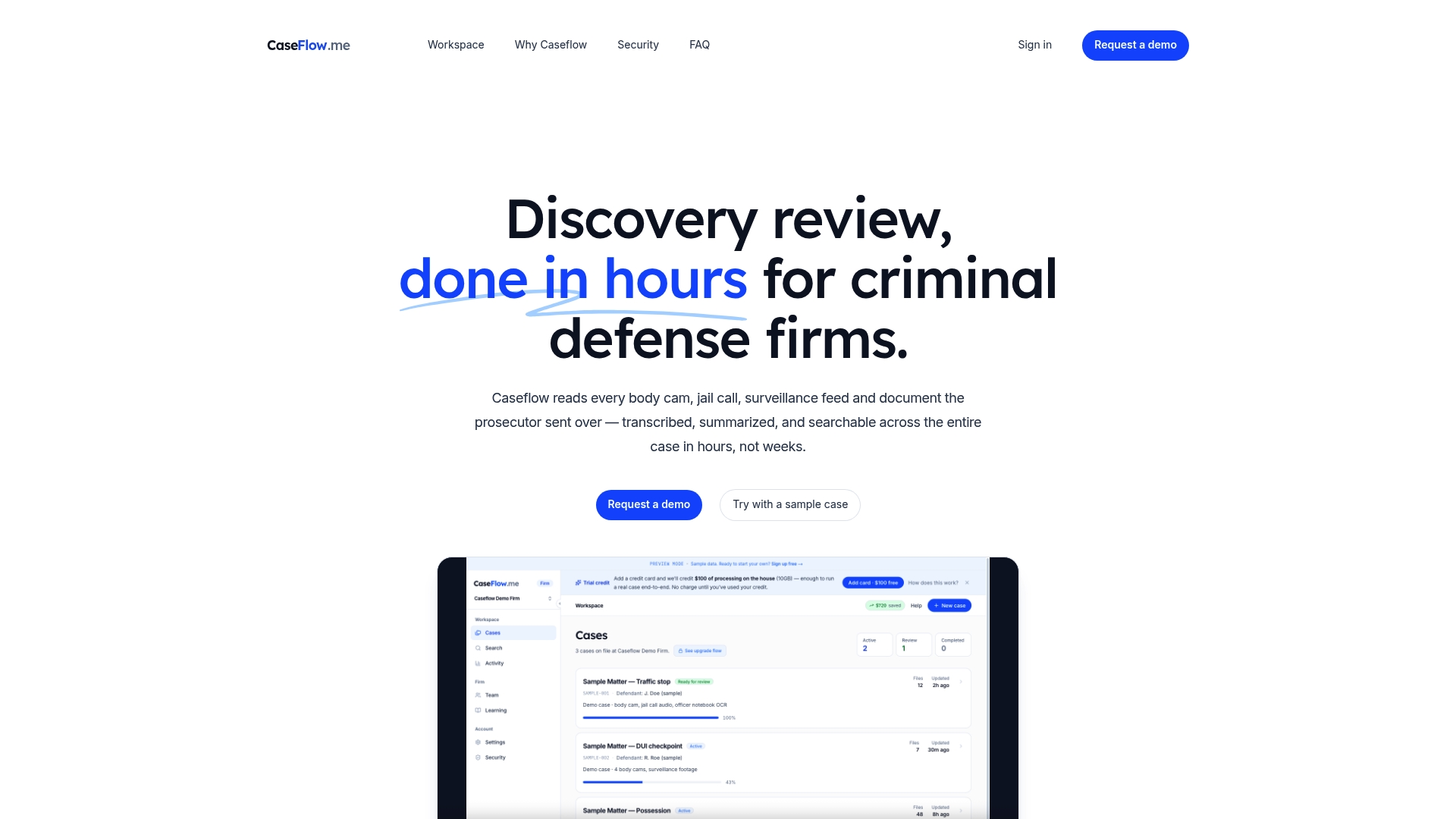
Caseflow combines transcription, summarization, and searchable entity extraction in one platform, cutting case file review from weeks to hours. The Brady-trail audit log tracks every action on every file, giving you the compliance documentation you need without manual logging. Multi-language support preserves original audio while making evidence fully searchable. If you are assessing AI-powered discovery tools designed specifically for criminal defense, Caseflow is built for exactly the workflows you are evaluating. Explore the platform and request a trial to see how it fits your firm's caseload.
FAQ
What does it mean to evaluate discovery software for firms?
Evaluating discovery software for firms means assessing eDiscovery platforms based on integration depth, vendor viability, compliance capabilities, and total cost of ownership to find the best operational fit for your legal workflows.
How many platforms should a firm shortlist during evaluation?
Limit your shortlist to 3–5 platforms. Evaluating more than five options leads to decision paralysis and makes it harder to distinguish meaningful differences between candidates.
Why does integration depth matter more than AI features?
Integration depth with billing, case management, and document systems is 4x the predictor of long-term satisfaction compared to AI features or pricing, because poor integrations create daily workflow friction regardless of how advanced the platform's analytics are.
What is the success predictor rating framework?
The Success Predictor Rating (SPR) framework evaluates eDiscovery vendors on organizational health, financial stability, and leadership quality, not just product features, to predict whether a vendor will remain a reliable partner over a multi-year engagement.
What hidden costs should firms budget for in discovery software?
Budget for data migration, staff training, workflow re-engineering, and ongoing support costs. These items are rarely included in vendor quotes but routinely cause budget overruns when modeled over a three-year contract term.