
Digital discovery tools are software platforms that help legal professionals locate, analyze, and manage electronic evidence across criminal and civil cases. The field spans five distinct categories: forensic analysis software, data profiling platforms, semantic search tools, SaaS discovery solutions, and full-suite workflow systems. Tools like The Sleuth Kit, Autopsy, and Bulk Extractor anchor the forensic end of the spectrum, while AI-powered search agents are reshaping how attorneys interact with large document repositories. Understanding the types of digital discovery tools available is the first step toward building a faster, more defensible case review process.
1. What are forensic digital discovery tools?
Forensic digital discovery tools perform granular analysis of storage media, disk images, and raw data files. The Sleuth Kit and Autopsy offer both command-line and graphical interfaces for disk image analysis and detailed metadata extraction. These tools let investigators examine file system structures, recover deleted files, and document every action taken on evidence.
Bulk Extractor takes a different approach. It scans disk images or raw files to extract targeted information such as email addresses and URLs without parsing the entire file system. That speed makes it the right choice for rapid data triage when time is a constraint.

Forensic Linux distributions like CAINE bundle these tools into a controlled environment. CAINE disables write mounts on target drives automatically, preserving timestamps and maintaining chain-of-custody requirements that courts demand. This technical safeguard is not optional in legal contexts. It is the difference between admissible evidence and a suppression motion.
Pro Tip: Always work from a verified forensic image, never the original drive. CAINE's write-blocking defaults enforce this discipline automatically, removing human error from the equation.
- The Sleuth Kit: Command-line file system analysis with deep metadata access
- Autopsy: Graphical front end for The Sleuth Kit, suited for case-based workflows
- Bulk Extractor: Pattern-based extraction without full file system parsing
- CAINE: Forensic Linux distribution with built-in write protection and chain-of-custody controls
2. How data profiling and semantic search tools work
Semantic search technology finds data by meaning rather than exact keywords. In a large document repository, this distinction matters enormously. A keyword search for "payment" misses documents that reference "wire transfer," "remittance," or "settlement." Semantic search captures all of them.
Auto-profiling extends this capability by generating statistical summaries and identifying data types automatically. A profiling engine can scan a repository and flag which fields contain personal identifiers, financial records, or privileged communications without manual tagging. That automation cuts the time attorneys spend on initial document assessment.
Contextual discussion features built into modern discovery platforms let legal teams annotate and debate documents inside the tool itself. A paralegal flags a suspicious transaction record, an attorney responds with a legal theory, and the exchange stays attached to the document permanently. That workflow replaces email chains and reduces the risk of losing critical analysis.
One limitation deserves attention. Automated tools often struggle with document hierarchy nuances, such as the relationship between a parent email, its attachments, and subsequent replies. Without legal-grade customization, a platform may treat each file as independent, missing the evidentiary thread that connects them.
Pro Tip: When evaluating data profiling tools, test them against a sample of your actual case files, including email threads with attachments. A tool that handles flat documents well may fail on complex email hierarchies.
3. Exploring SaaS and API-based discovery tools
SaaS discovery tools identify which cloud applications exist within an organization's environment, including unauthorized ones. Nine distinct types of SaaS discovery methods exist: Cloud Access Security Brokers (CASBs), API connectors, browser extensions, identity provider and SSO logs, financial and procurement data scans, email scanners, web gateways, network monitoring, and AI-driven discovery agents.
For legal professionals, SaaS discovery matters in two scenarios. First, corporate litigation often requires identifying every application where relevant data might reside. Second, internal investigations need to surface shadow IT, meaning applications employees use without IT approval, which can hold critical communications.
CASBs provide high coverage of both sanctioned and unsanctioned applications with medium to high security-focused data depth. They are the right choice when data loss prevention and compliance are the primary concerns. API connectors go deeper into specific platforms but require more setup time.
| Discovery Method | Coverage | Data Depth | Speed to Value | Best Legal Use Case |
|---|---|---|---|---|
| CASB | High | Medium to High | Medium | Data loss prevention, compliance audits |
| API Connectors | Medium | High | Low | Deep platform-specific investigations |
| Browser Extensions | Low to Medium | Low | High | Rapid shadow IT visibility |
| IdP/SSO Logs | Medium | Medium | Medium | Access pattern analysis |
| Email Scanners | Medium | Medium | High | Communication discovery |
| Web Gateways | High | Low | Medium | Network-level app detection |
Selecting the right SaaS discovery method depends on the balance between coverage and depth. API connectors provide detailed access while browser extensions offer rapid visibility with less granularity. Legal teams running time-sensitive investigations often start with browser extensions or email scanners, then move to API connectors for the platforms that matter most.
4. Comparing digital discovery tool types for legal workflows
Different legal contexts demand different tool types. A criminal defense attorney reviewing police body camera footage and audio recordings needs different capabilities than a corporate litigator processing millions of emails. The table below maps tool types to legal scenarios.
| Tool Type | Strengths | Limitations | Best Legal Scenario |
|---|---|---|---|
| Forensic Software (Autopsy, CAINE) | Chain-of-custody integrity, deep metadata | Steep learning curve, slow on large volumes | Criminal defense, law enforcement investigations |
| Data Profiling Platforms | Fast assessment, auto-classification | Weak on document hierarchies | Corporate litigation, regulatory review |
| Semantic Search Tools | Meaning-based retrieval, high relevance | Requires training data, customization | Large document repositories, complex cases |
| SaaS Discovery (CASB, API) | Cloud coverage, shadow IT detection | Setup complexity, cost | Internal investigations, data governance |
| Full-Suite Platforms | Integrated workflow, audit trails | Higher cost, vendor lock-in | Criminal defense teams, full case management |
Criminal defense attorneys benefit most from full-suite platforms that combine transcription, entity extraction, and audit logging in one place. The digital discovery workflow for a criminal case typically involves audio and video evidence alongside documents, which requires tools that handle multiple media types natively.
Corporate litigators running large-scale document reviews prioritize semantic search and data profiling. Speed and accuracy at volume matter more than forensic-grade chain-of-custody controls in that context.
- Criminal defense: Full-suite platforms with audio transcription and Brady compliance tracking
- Corporate litigation: Semantic search and data profiling for high-volume document review
- Internal investigations: SaaS discovery tools to surface shadow IT and unauthorized communications
- Regulatory response: Data profiling with auto-classification for rapid compliance assessment
5. How AI agents are changing discovery in 2026
AI-powered search agents now reason across datasets continuously rather than returning static lists of documents. This shift transforms discovery from a one-time search event into an ongoing analytical process. An attorney can ask a natural language question and receive a synthesized answer drawn from thousands of documents, not just a ranked list of files to read manually.
The practical impact on legal workflows is significant. An AI agent monitoring a case file can flag new connections between documents as additional evidence arrives. It can surface a witness name that appears in both a financial record and a text message thread, a connection a keyword search would miss entirely.
This evolution also raises new questions about defensible audit trails. When an AI agent surfaces a document, the legal team needs a record of how that document was found and what reasoning led to its inclusion. Courts are beginning to ask these questions, and platforms that log AI reasoning steps will have a clear advantage.
Key takeaways
The most effective digital discovery strategy combines forensic-grade tools for evidence integrity with AI-powered platforms for speed and analytical depth across large document sets.
| Point | Details |
|---|---|
| Match tool type to case type | Forensic tools suit criminal defense; semantic search suits high-volume corporate review. |
| Forensic integrity is non-negotiable | Use write-blocking environments like CAINE to preserve chain-of-custody from the start. |
| Semantic search beats keyword search | Meaning-based retrieval captures synonyms and related concepts that keyword searches miss. |
| SaaS discovery surfaces hidden data | CASBs and API connectors reveal unauthorized apps that hold legally relevant communications. |
| AI agents require audit logging | Platforms must log AI reasoning steps to produce defensible discovery records in court. |
Why tool selection is the decision most attorneys get wrong
The instinct in legal tech is to reach for the most feature-rich platform available. I have seen firms license enterprise forensic suites for cases that needed nothing more than a solid transcription and entity extraction workflow. The result is wasted budget and a team that uses 10% of the tool's capability.
The honest framework is simpler. Start with the evidence type. Audio and video-heavy criminal cases need transcription and searchable entity extraction first. Document-heavy corporate matters need semantic search and profiling. Only after you know the evidence type should you evaluate platforms.
The other mistake I see consistently is treating forensic integrity as a forensic examiner's problem. Every attorney who touches digital evidence needs to understand why write-blocking matters and what a chain-of-custody log should contain. Demonstrating discovery transparency in court is increasingly a competitive differentiator, not just a compliance checkbox.
AI agents are genuinely exciting in 2026, but they are not a replacement for understanding your evidence. They are a force multiplier for attorneys who already know what they are looking for. The attorneys who will get the most from these tools are the ones who understand the underlying tool types well enough to ask the right questions.
— Faisal
How Caseflow supports criminal defense discovery
Criminal defense teams processing large volumes of audio, video, and document evidence need a platform built for that specific workflow, not a general-purpose forensic suite.
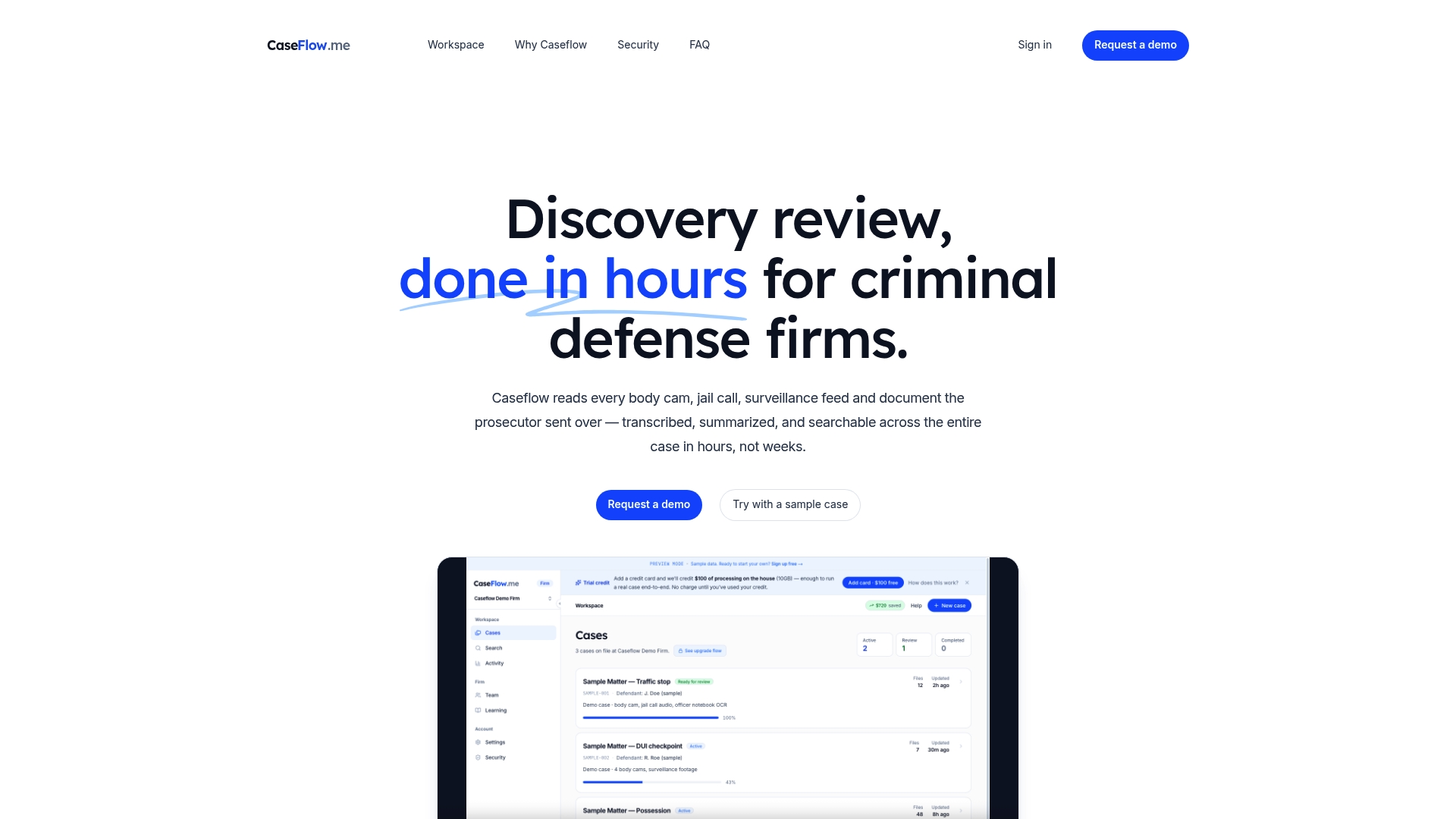
Caseflow combines transcription, summarization, and searchable entity extraction in one integrated platform. Its Brady-trail audit log tracks every action taken on case files, creating the defensible record that courts increasingly require. The platform handles multiple languages and preserves original audio alongside transcripts, so attorneys work with accurate evidence without losing context. For criminal defense teams that need to move from case files to trial-ready insights in hours rather than weeks, Caseflow is built for exactly that workflow. Teams evaluating their options can also review the benefits of affordable discovery software tailored for defense attorneys.
FAQ
What are the main types of digital discovery tools?
The main types are forensic analysis software, data profiling platforms, semantic search tools, SaaS discovery solutions, and full-suite workflow management systems. Each type serves a distinct legal use case, from chain-of-custody evidence preservation to high-volume document review.
How do forensic tools differ from e-discovery platforms?
Forensic tools like Autopsy and CAINE focus on disk-level evidence extraction and chain-of-custody integrity, while e-discovery platforms prioritize document review, search, and case workflow management. Most legal teams need both at different stages of a case.
What is semantic search in legal discovery?
Semantic search finds documents by meaning rather than exact keyword matches, capturing synonyms and related concepts that traditional search misses. This capability is critical in large legal document repositories where relevant evidence often uses varied terminology.
How do SaaS discovery tools help in legal investigations?
SaaS discovery tools identify every cloud application in use within an organization, including unauthorized ones that may hold relevant communications. CASBs and API connectors are the most thorough methods for legal investigations requiring comprehensive data coverage.
What should legal professionals prioritize when choosing discovery software?
Legal professionals should match the tool type to their primary evidence format, prioritize platforms with defensible audit logging, and verify that the tool handles document hierarchies accurately. Evaluating discovery software against real case file samples before committing to a platform is the most reliable selection method.